










Aakaar sets Xelix plan for 500-plus clinics from FY28 onwards
Key highlights
- Aakaar reports Xelix at 70-plus clinics across 24 cities, although it does not date this figure.
- Xelix’s roadmap targets 30 clinics in FY26, 100-plus in FY27 and 500-plus during the three years from FY28 onwards.
- The doctor-owned, doctor-operated model is designed to require zero capital expenditure per clinic, according to Aakaar.
- Aakaar cites a 12,000-plus covered doctor network and a 146-SKU B2B supply chain as expansion advantages.
powered by IRIS
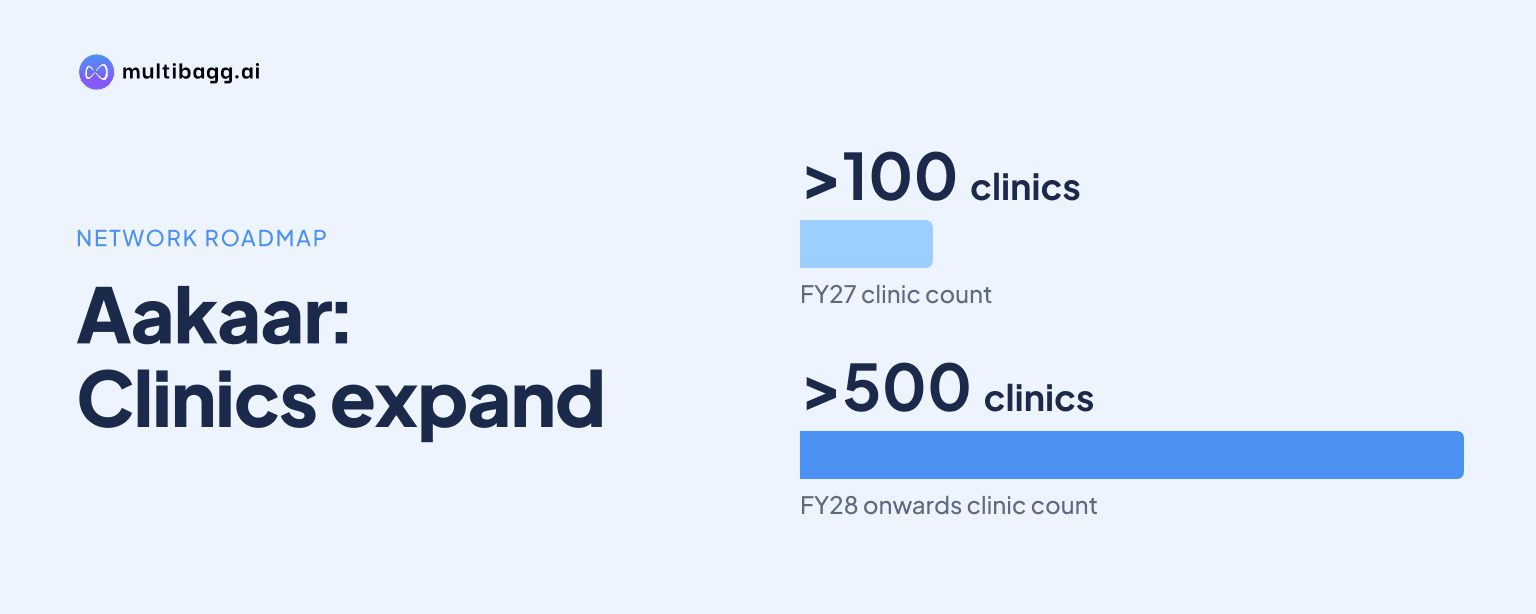
Aakaar plans to scale Xelix to 500-plus clinics during the FY28 onwards three-year period, following milestones of 30 clinics in FY26 and 100-plus in FY27. The plan is based on Xelix’s doctor-owned, doctor-operated model, a 12,000-plus covered doctor network and Aakaar’s 146-stock-keeping-unit business-to-business supply chain rather than clinic-level capital expenditure.
Know Aakaar Medical Technologies inside out
Results, valuation, peers and who's buying, in one view.
What is Aakaar’s Xelix platform?
Xelix is Aakaar’s doctor-owned, doctor-operated medical aesthetics platform for hair, skin and body services. Aakaar describes Xelix as India’s first organised, doctor-led aesthetics platform, built on clinical rigour, a brand and product portfolio, and services offered by aesthetic doctors through its 12,000-plus covered doctor network.
The platform is designed to address issues that Aakaar identifies for doctors and patients. For doctors, the presentation cites a credibility crisis caused by non-qualified doctors and technicians, high and inconsistent patient-acquisition costs, and competition from direct-to-consumer brands and salons. For patients, it lists information overload, lack of standardisation, unpredictable outcomes and safety, and price uncertainty.
Aakaar’s stated response combines a unified national brand with its doctor network and business-to-business, or B2B, supply chain. The listed moats are the doctor-owned, doctor-operated, or DODO, model; the 12,000-plus covered network; Aakaar’s B2B supply chain; and national branding. These are operating components described in the presentation, rather than disclosed evidence of Xelix revenue or profitability.
Xelix reports a current state of 70-plus clinics in 24 cities, supported by a nationwide network of dermatologists and plastic surgeons. That figure is higher than the FY26 roadmap milestone of 30 clinics, which is described as the model-validation stage with 30 clinics onboarded. Aakaar does not date the 70-plus current-clinic figure or explain its relationship with the FY26 milestone.
How does Aakaar plan to expand Xelix clinics?
Aakaar’s roadmap sets out 30 Xelix clinics in FY26, 100-plus clinics in FY27 and 500-plus clinics in the FY28 onwards three-year period. The company assigns a different operating objective to each stage: model validation in FY26, active onboarding in FY27, and a functional revenue model from FY28 onwards.
In FY26, Aakaar says it will launch the Xelix model to its network and onboard 30 clinics. For FY27, it expects network effects to generate organic partner referrals and says its platform discovery engine will be fully operational. These are management plans rather than reported results for either period.
For FY28 onwards, Aakaar plans to cross-sell across an established clinic base and use a technology platform and outcome data as competitive moats. The clinic threshold therefore rises from 100-plus in FY27 to 500-plus in the following three-year phase, while the stated focus changes from onboarding partners to operating a revenue model across the network.
Got a follow-up? Ask IRIS
How does the doctor-partner model limit clinic investment?
Aakaar says Xelix’s DODO structure requires zero capital expenditure per clinic. Under the asset-light model, each partner clinic joins without an infrastructure burden, while Aakaar’s B2B backbone is intended to make products available from day one.
The company says its 12,000-plus doctor relationships and 146-SKU B2B supply chain provide distribution advantages at launch compared with a new entrant. Aakaar describes this as “zero greenfield risk,” but the presentation does not provide a cost comparison, capital budget, clinic-level economics or a measure of actual utilisation of the 146 stock-keeping units, or SKUs.
Aakaar links the supply-chain proposition to its doctor-engagement activity. The presentation says it has direct coverage and telecalling access to 12,000-plus doctors across India to offer products and devices. It also says it has participated in 20-plus international, national and local conferences, including AMWC, IMCAS, DERMACON and CDSI.
Training is another element of the wider ecosystem. Aakaar says its MICA, or Masterclass in Contouring Aesthetics, programme has conducted 75-plus sessions, trained 574-plus participants and led 44-plus participants to venture. A trichology workshop started in FY 2025-26, although the presentation does not state how many MICA-trained doctors have joined Xelix.
What revenue and network mechanisms does Aakaar identify for Xelix?
Aakaar identifies four potential value streams from each Xelix partner clinic: in-clinic procedures, proprietary technology access, a home-care product ecosystem and long-term patient-retention programmes. It says these streams can compound lifetime value for doctors and patients, but does not disclose pricing, revenue, margins or revenue-sharing terms.
The company’s network-effect thesis is that each additional clinic strengthens the Xelix brand, which attracts more patients; more patients generate richer outcome data; and better data deepens doctor trust and accelerates adoption. The mechanism depends on clinical credibility and two-sided participation by doctors and patients, rather than on a disclosed clinic-construction programme.
Aakaar describes India’s medical aesthetics market as large, fast-growing and underpenetrated, with organised players holding less than 5% share. The presentation does not provide a market-size figure, date or named external benchmark for that share estimate. Aakaar’s stated opportunity is to capture share through a standardised doctor-led network, not through a quantified market-revenue forecast.
The move from 70-plus current clinics in 24 cities to a 500-plus clinic threshold also points to wider geographic coverage, although Aakaar does not specify the number of cities planned for the later network. Likewise, it says the discovery engine will be fully operational in FY27 and that technology and outcome data will become moats from FY28 onwards, without providing launch dates or operating metrics for those systems.
Conclusion
Aakaar’s Xelix expansion plan combines a reported base of 70-plus clinics in 24 cities with a roadmap for 500-plus clinics during the FY28 onwards three-year period. The proposed model relies on doctor partners operating their own clinics, zero capital expenditure per clinic, a 12,000-plus covered doctor network and a 146-SKU B2B supply chain rather than a disclosed programme of company-owned clinic construction.
The next disclosed milestones are 30 clinics in FY26 under model validation and 100-plus clinics in FY27, when Aakaar says partner referrals and its platform discovery engine should support active onboarding. The presentation leaves unresolved how the current 70-plus clinic count relates to the FY26 30-clinic milestone, and provides no revenue, margin, partner-economics or clinic-retention data for the planned functional revenue model.