Welcome to Multibagg AI
Log in to access personalized features
Welcome to Multibagg AI
Log in to access personalized features

Portfolio

Alerts

Ask Iris

Discovery

Timeline
Multibagg AI is an AI powered stock research and analysis platform. We provide data, information, content, and analytics for publicly traded Indian companies listed on NSE and BSE. AI can make mistakes, check important information.
Research powered by GOALZEN CAPITAL SERVICES PRIVATE LIMITED · SEBI Research Analyst INH000013448
Prices might be delayed by a few minutes.
Join our Exclusive Community


Join our Exclusive Community
Made with 💙 in India. © Finsky Technologies Pvt Ltd. 2026



Jio Platforms Limited's FY26 revenue and profit were 34.1% and 40.3% above FY24, while finance costs more than doubled to Rs 8,653.4 crore.
Jio reports 12,477 technology employees, 45% of its workforce, and 7,220 patent applications supporting its claimed nationwide standalone 5G technology stack.
India’s mobile broadband market is projected to reach Rs 5,10,000 crore by FY2031 as monthly ARPU rises to Rs 326.4 from Rs 199.5.
India’s SMEs have under-3% enterprise digital-services adoption versus 75% to 90% for large businesses in a Rs 5,12,000 crore FY2026 addressable market.
Jio Platforms will earmark ₹27,500 crore of IPO net proceeds for RJIL debt prepayment, against identified candidate borrowings of ₹29,917.1 crore.
Jio Platforms had no parent fund-based borrowing on June 30, 2026, while RJIL held Rs 59,140.2 crore, or 95.18% of group funded debt.
Reliance Industries Limited promoter group disclosures list Rs 47,891.3 crore of tax claims, including Rs 6,795.5 crore of telecom GST demands not recognised as contingent liabilities.
Jio fixed broadband reached 28.6 million customers by June 2026 and captured 61.73% of net customer additions during the quarter.
Jio Platforms’ spectrum-under-development balance fell by Rs 1,20,990.6 crore in two years as recognised spectrum’s net carrying value increased Rs 1,18,268.3 crore.
Jio identifies Rs 19.73 lakh crore in overseas FWA, 5G and smart-featurephone spending, led by Rs 12.84 lakh crore of FWA deployment capital expenditure.
Jio Platforms reduced net debt to Rs 9,539.1 crore at 30 June 2026 from Rs 48,440 crore in March 2024, cutting net gearing to 0.03 times.
Jio held 78.62% of India’s advanced FWA customers in Q1 FY2027, while fixed wireless supplied 9.8 million of 14.2 million FY2026 additions.
Reliance Industries Limited was cleared of fraud in the 2007 derivatives case, while position-limit disclosure liability remains after a Rs 447.3 crore disgorgement order.
Reliance Retail Limited is Jio’s sole prepaid distributor, serving a category that generated 76.37% to 79.35% of consolidated revenue from operations.
Jio Platforms says administrative satellite-spectrum allocation may lower providers’ entry economics, while its material subsidiary supplied 87.74% of Fiscal 2026 consolidated revenue.
RJIL relies on JDFPL for approximately 98% of optic-fibre requirements, while SDIL owns 174,451 of the 360,537 towers it uses.
Reliance Jio Infocomm generated 93.71% of Jio Platforms’ FY26 consolidated profit-or-loss allocation, equivalent to Rs 28,173.2 crore of the Rs 30,064.3 crore total.
Jio says digital connectivity generates substantially all revenue, while 362.6 million application monthly active users show the scale of its bundled apps, cloud and AI strategy.
Jio reported 0.46x net leverage at June 30, 2026, excluding Rs 1,04,573.7 crore of deferred Department of Telecommunications payment liabilities.
Jio Platforms remained dependent on RJIL in Fiscal 2026, when RJIL contributed 87.74% of revenue and 94.88% of EBITDA, without platform-specific KPIs.
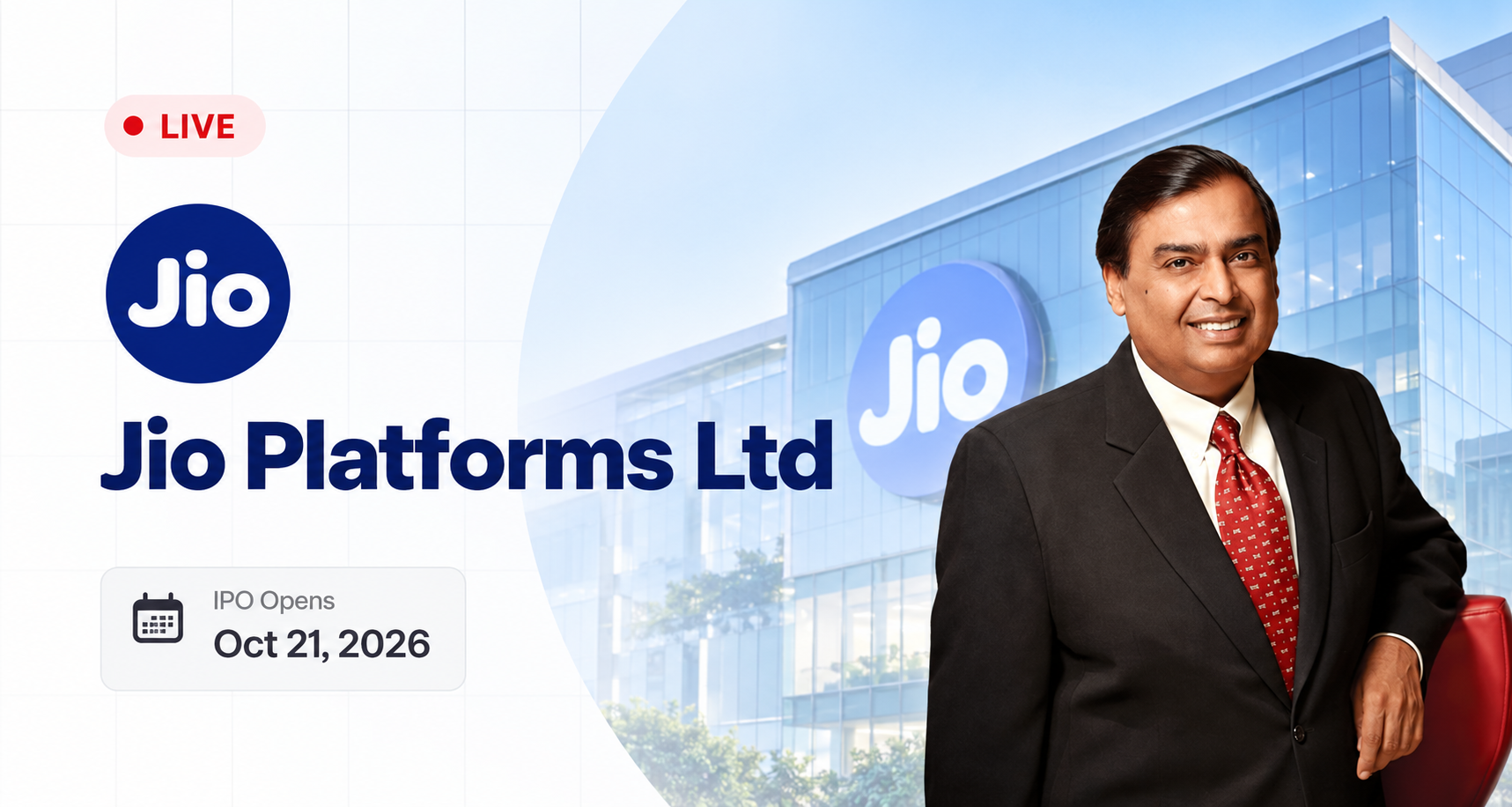
Jio Platforms’ IPO opens October 21-23 with a ₹1,065-₹1,119 band, a 27 crore fresh issue, and listing expected October 28 on NSE and BSE.
Social media debates on the Jio Platforms IPO focus on how oversubscription triggers lotteries, how the RIL shareholder quota works, and why final odds appear only after bidding closes.
Social media focus has shifted to Jio Platforms’ October IPO after Elon Musk’s Starlink posts, as investors debate valuation, competition, and India’s pending security clearances.
Jio Platforms IPO allotment odds for retail, sHNI and bHNI depend on final category-wise subscription, with lottery allotment whenever a tranche is oversubscribed.