










Aelea Commodities expands cashew capacity to 140 MT per day
Key highlights
- Aelea Commodities increased raw cashew processing capacity from 40 MT per day to 140 MT per day.
- Unit 2 in Surat involved a disclosed investment of ₹37.08 crore and increased output potential by 250%.
- Aelea Commodities reported FY25 revenue of ₹182 crore, up 26% year on year.
- The company secured working-capital facilities of ₹27.50 crore from ICICI Bank and ₹13.86 crore from HDFC Bank in June 2026.
powered by IRIS
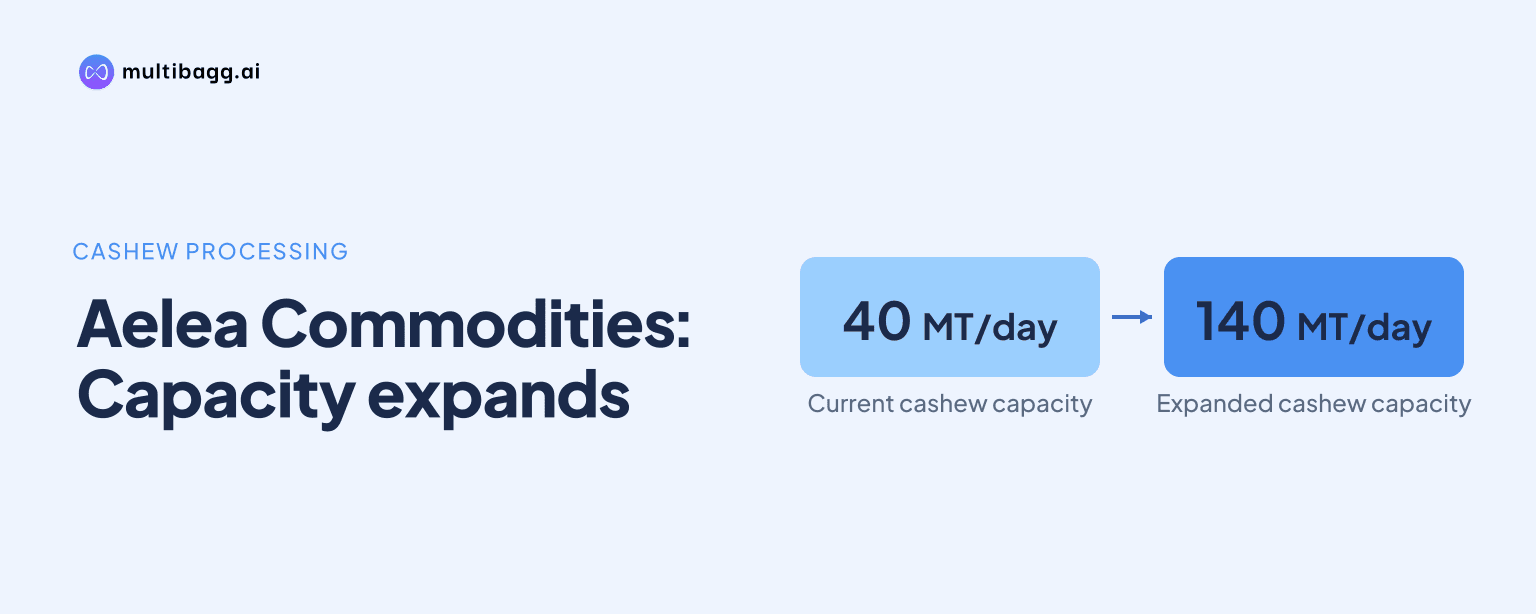
Aelea Commodities Limited has expanded raw cashew processing capacity from 40 MT per day to 140 MT per day, supported by a ₹37.08 crore investment in Unit 2 at Surat. The increase raises the company’s output potential by 250% and is central to its plan to focus entirely on cashew processing and related by-products.
Know Aelea Commodities inside out
Results, valuation, peers and who's buying, in one view.
How did Aelea Commodities expand its cashew processing capacity?
Aelea Commodities expanded its capacity through the commissioning of Unit 2 in Surat, taking installed raw cashew nut processing capacity to 140 MT per day from 40 MT per day. The company stated that the new unit is fully automated, covers 238,454 square feet and is designed to support higher efficiency and quality output.
The company had earlier reported that more than 75% of the expansion work was complete and that trial runs had been conducted. Subsequent disclosures said Unit 2 was commissioned and operated at full capacity for 3.5 months during the first half of FY26. This sequence reflects the transition from construction and trials to commercial operations.
The earlier processing unit was operating at 95% utilisation, equivalent to 38 MT per day, as of December 31, 2023. High utilisation at the original facility was cited as a reason for adding machinery and another processing unit. The expansion also includes plans for an additional 50 MT of cashew nut shell liquid, or CNSL, oil capacity.
Aelea Commodities processes raw cashew nuts imported from African countries and sells processed cashews under the Supreme and Tryble brands. It serves business-to-business and business-to-consumer markets in India and overseas. The company has also said it eliminated its trading business to concentrate on cashew processing.
What are the main facts behind the Unit 2 expansion?
The main operational change is the rise in raw cashew processing capacity to 140 MT per day, while commercial processing capacity for shelled cashew kernels was stated at 35 MT. The company has described the capacity addition as Phase 1 of a wider plan that includes CNSL processing and future value-added products.
The company said Phase 1 was complete, with full utilisation expected in Q1 FY26. It later reported that Unit 2 had operated at full capacity for 3.5 months in H1 FY26. These disclosures indicate that management’s immediate operational priority is stabilising utilisation rather than announcing another near-term increase in raw cashew capacity.
For the next phase, Aelea Commodities is developing a CNSL oil operation. Management said site works for CNSL extraction were about 30 days from completion in one operational update, and that the value-accretive benefits were expected to appear by the second half. The company aims to convert CNSL into cardanol and residol, which are products with applications linked to sustainable fuel demand.
How is Aelea Commodities funding expansion and working capital?
Aelea Commodities has used public fundraising for the capacity expansion and has added bank facilities to support working-capital requirements. The company signed a sanction letter with ICICI Bank on June 26, 2026, for a ₹27.50 crore secured working-capital facility backed by fixed deposits, current assets and a personal guarantee.
The ICICI Bank facility adds to a ₹13.86 crore working-capital term loan from HDFC Bank under the Emergency Credit Line Guarantee Scheme 5.0. The board approved that facility on June 23, 2026. Both facilities were identified by the company as funding for working capital while it expands cashew processing and pursues diversification into other commodities.
The rise in borrowing capacity is relevant because a larger processing operation requires procurement of raw cashew nuts, inventory management and distribution funding. Aelea Commodities has said it is prioritising working-capital discipline as it scales operations and advances sustainability-related projects.
Management has also outlined a 4 MW solar plant intended to reduce power costs and improve sustainability. Capex targets disclosed by the company include the CNSL facility and solar plant by the end of FY26 or early FY27. The stated timing provides a defined set of operational milestones for investors monitoring the next phase of investment.
Got a follow-up? Ask IRIS
What does the expansion mean for revenue and margins?
Aelea Commodities reported revenue of ₹182 crore in FY25, up 26% from the previous year, and unaudited revenue from operations exceeding ₹108 crore in the first quarter of FY27. The higher processing capacity creates the operational base for handling more raw cashew volumes, but the company has not provided a confirmed full-year FY27 revenue forecast.
The company previously indicated projected revenue of around ₹200 crore to ₹240 crore in the second half of FY26. It also stated that it is targeting annual EBITDA margins of 12% to 13%. These are management targets, rather than reported margin outcomes, and depend on capacity utilisation, sourcing conditions and operating costs.
Management attributed recent performance to capacity optimisation, stronger sourcing networks and broader product applications. It also said Q2 FY27 production capacity was 81% booked and Q3 capacity was filling rapidly before the festive season. The company reported managing supply-chain challenges arising from currency volatility and geopolitical tensions through proactive planning.
The shift away from trading changes the company’s business emphasis toward processing economics. This places greater importance on procurement, plant utilisation and the conversion of cashew by-products into products such as CNSL oil, cardanol, biocharcoal and de-oil cake.
What should investors monitor after the capacity increase?
Investors should monitor whether Aelea Commodities maintains high utilisation at the 140 MT-per-day Unit 2 facility, because the financial benefit of the expansion depends on sustained throughput and orderly working-capital management. The original unit’s 95% utilisation showed strong use of the 40 MT-per-day facility, but the larger base requires significantly higher raw material sourcing and production volumes.
CNSL commissioning is another material operating milestone. The company has positioned Phase 2 as a move into by-product processing, while Phase 3 is intended to add products including cardanol, biocharcoal and de-oil cake. These initiatives could broaden the product mix, although financial contributions have not yet been reported.
The planned Unit 3 also remains relevant. Aelea Commodities has acquired 412,164 square feet of industrial land at Vasaravi in Surat for the proposed facility. The company said the site will focus on cardanol, biocharcoal and de-oil cake production, linking the next stage of expansion to by-product valorisation rather than another stated raw cashew capacity addition.
Conclusion
Aelea Commodities has materially increased its raw cashew processing capacity from 40 MT per day to 140 MT per day through Unit 2 in Surat. The expansion follows high utilisation at its previous facility and is accompanied by a strategic focus on processing, higher-capacity operations and cashew by-products rather than trading.
The next items to watch are the commissioning and commercial contribution of the CNSL facility, progress on the 4 MW solar plant and management’s ability to sustain utilisation while managing working capital. The proposed Unit 3 at Vasaravi and the stated 12% to 13% annual EBITDA margin target remain longer-term reference points for the company’s execution.