










Blue Chip Tex Industries returns to profit as revenue rises 21%
Key highlights
- Blue Chip Tex Industries reported Rs 79.47 lakh profit after tax in the September 2026 quarter, reversing a Rs 75.17 lakh loss in June 2026 and a Rs 23.71 lakh loss a year earlier.
- Revenue from operations rose 21% year on year to Rs 67.5737 crore in the September 2026 quarter and increased 14% sequentially from Rs 59.0649 crore.
- Blue Chip Tex Industries posted only Rs 4.31 lakh profit after tax for the six months ended September 30, 2026, after a Rs 75.17 lakh first-quarter loss.
- The company generated Rs 26.08 lakh of operating cash in the first half of 2026, compared with Rs 1.0835 crore of operating cash outflow a year earlier.
powered by IRIS
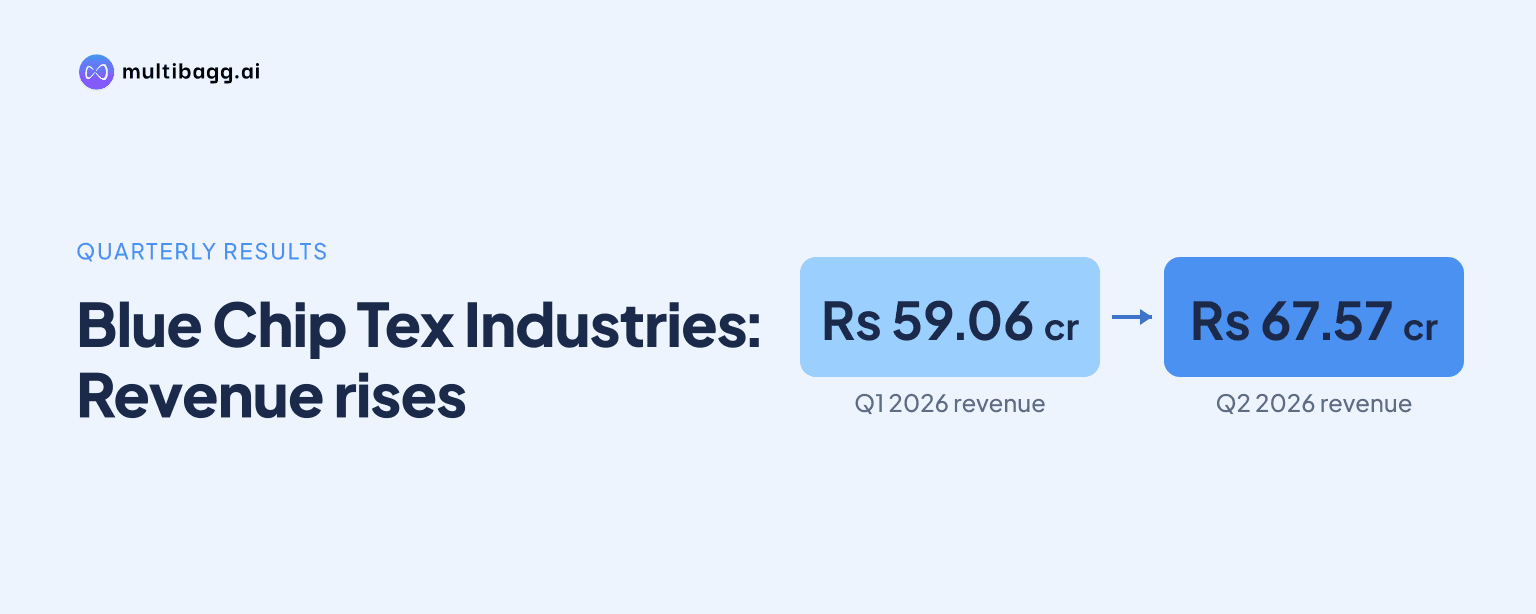
BLUE CHIP TEX INDUSTRIES LIMITED reported profit after tax of Rs 79.47 lakh for the quarter ended September 30, 2026, reversing losses in the preceding and year-earlier quarters. Revenue from operations rose 21% year on year to Rs 67.5737 crore, while profit before tax was Rs 1.142 crore against a Rs 37.87 lakh loss a year earlier.
Know Bluechip Tex Industries inside out
Results, valuation, peers and who's buying, in one view.
Did Blue Chip Tex Industries return to profit in September 2026?
Yes. Blue Chip Tex Industries reported Rs 79.47 lakh of profit after tax for the quarter ended September 30, 2026, compared with a Rs 75.17 lakh loss in the quarter ended June 30, 2026 and a Rs 23.71 lakh loss in the quarter ended September 30, 2025. Profit before tax was Rs 1.142 crore, compared with pre-tax losses of Rs 99.62 lakh and Rs 37.87 lakh in those respective comparison quarters.
Total income reached Rs 67.8869 crore in the September 2026 quarter, including Rs 67.5737 crore of operating revenue and Rs 31.32 lakh of other income. Total expenses were Rs 66.7449 crore, leaving the reported pre-tax profit of Rs 1.142 crore. In the June 2026 quarter, total expenses of Rs 60.1042 crore exceeded total income of Rs 59.108 crore.
The September-quarter tax expense was Rs 34.73 lakh, comprising current tax of Rs 21.21 lakh and deferred tax of Rs 13.52 lakh. Basic and diluted earnings per share, or EPS, were Rs 4.03 for the quarter, compared with losses per share of Rs 3.81 in June 2026 and Rs 1.20 in September 2025.
How much did Blue Chip Tex Industries' revenue grow?
Blue Chip Tex Industries recorded operating revenue of Rs 67.5737 crore for the quarter ended September 30, 2026, up from Rs 55.7419 crore in the September 2025 quarter and Rs 59.0649 crore in the June 2026 quarter. The increases were 21% year on year and 14% sequentially, calculated from the reported operating-revenue figures.
For the half year ended September 30, 2026, operating revenue rose to Rs 126.7754 crore from Rs 113.0297 crore in the corresponding 2025 half year. Total income for the 2026 half year was Rs 126.995 crore, compared with Rs 113.043 crore a year earlier, with other income of Rs 21.96 lakh versus Rs 1.33 lakh.
Blue Chip Tex Industries identifies manufacturing of polyester texturised yarn as its main business segment and states that it has no separate reportable segments under Indian Accounting Standard 108, Operating Segments. The filing therefore provides no split of the Rs 67.5737 crore quarterly operating revenue by product, customer or geography.
Raw-material consumption was Rs 56.1809 crore in the September 2026 quarter, up from Rs 46.3182 crore a year earlier and Rs 49.0998 crore in June 2026. Other expenses rose to Rs 9.7798 crore from Rs 8.579 crore a year earlier, while the company reported a Rs 1.1701 crore change in finished-goods inventories, compared with a Rs 94.11 lakh inventory-related expense in the preceding quarter.
Why was Blue Chip Tex Industries' half-year profit limited?
Blue Chip Tex Industries reported profit after tax of Rs 4.31 lakh for the half year ended September 30, 2026 because its Rs 79.47 lakh September-quarter profit followed a Rs 75.17 lakh loss in the June quarter. The half-year outcome compared with a Rs 84.58 lakh loss in the half year ended September 30, 2025.
Profit before tax for the six months was Rs 14.59 lakh, reversing a Rs 1.1296 crore pre-tax loss in the prior-year half. Total expenses increased to Rs 126.8491 crore from Rs 114.1728 crore, while total income increased to Rs 126.995 crore from Rs 113.043 crore, producing the reported narrow pre-tax surplus.
The half-year tax expense was Rs 10.28 lakh, made up of Rs 21.21 lakh of current tax partly offset by a Rs 10.93 lakh deferred-tax credit. Other comprehensive loss was Rs 5.53 lakh, including a Rs 7.39 lakh remeasurement loss on defined-benefit obligations partly offset by Rs 1.86 lakh of related income tax.
Total comprehensive income for the half year was therefore a Rs 1.22 lakh loss, compared with a Rs 87.25 lakh loss a year earlier. Basic and diluted EPS was Rs 0.22 for the 2026 half year, against a loss per share of Rs 4.29 for the corresponding period of 2025.
Got a follow-up? Ask IRIS
What do Blue Chip Tex Industries' balance sheet and cash flow show?
Blue Chip Tex Industries reported total assets of Rs 34.6952 crore at September 30, 2026, compared with Rs 33.7214 crore at March 31, 2026. Total liabilities rose to Rs 7.9874 crore from Rs 7.0015 crore, while total equity was Rs 26.7077 crore compared with Rs 26.7199 crore at the financial year-end.
Current assets increased to Rs 18.9399 crore from Rs 16.8007 crore over the six months. Inventories rose to Rs 10.3175 crore from Rs 9.605 crore, trade receivables increased to Rs 5.6268 crore from Rs 5.2508 crore, and cash and cash equivalents rose to Rs 1.1782 crore from Rs 91.44 lakh.
Current liabilities rose to Rs 6.7783 crore at September 30 from Rs 5.656 crore at March 31. The September balance included Rs 2.1223 crore of trade payables to micro and small enterprises, Rs 2.9237 crore due to other creditors and Rs 1.0604 crore of other current liabilities.
Net cash generated from operating activities was Rs 26.08 lakh for the half year ended September 30, 2026, compared with net operating cash used of Rs 1.0835 crore in the corresponding 2025 period. The cash-flow statement records a Rs 71.25 lakh increase in inventories and a Rs 51.83 lakh increase in trade and other receivables, partly offset by a Rs 40.79 lakh increase in trade and other payables.
What is Blue Chip Tex Industries' proposed buyback plan?
Blue Chip Tex Industries' board approved a proposed buyback of up to 250,000 fully paid equity shares at Rs 130 per share, for an aggregate amount of up to Rs 3.25 crore, on October 30, 2026. The proposed maximum represents 12.69% of the company's existing paid-up equity share capital and remains subject to shareholder approval.
An extraordinary general meeting is scheduled for December 2, 2026 at noon through video conference or other audio-visual means to seek the required special resolution. Blue Chip Tex Industries said its promoters and promoter group do not intend to participate in the proposed buyback.
The record date, process, timetable and actual number of shares purchased have not yet been determined, according to the disclosure. The filing also says the post-buyback shareholding pattern cannot be provided until the buyback is completed because the number of shares acquired and the shareholder categories tendering shares are not yet known.
The financial results were reviewed by the audit committee and approved by the board on October 30, 2026. D K P & Associates issued a limited-review report dated October 30, 2026, stating that nothing had come to its attention suggesting the results failed to make disclosures required under the listing regulations or contained a material misstatement.
Conclusion
Blue Chip Tex Industries moved from losses in the June 2026 and September 2025 quarters to a Rs 79.47 lakh September-quarter profit as operating revenue rose to Rs 67.5737 crore. The six-month result remained limited at Rs 4.31 lakh of profit after tax because the September recovery largely offset the June-quarter loss.
The next disclosed event is the December 2, 2026 extraordinary general meeting on the proposed Rs 3.25 crore buyback. Shareholder approval, the record date, the actual number of shares bought back and the resulting post-buyback ownership pattern remain matters to watch under the disclosed plan.