










Carborundum Universal Q2 profit falls to Rs 12.45 crore
Key highlights
- CUMI’s Q2FY27 consolidated sales rose 13.1% to Rs 1,455 crore from Rs 1,287 crore.
- CUMI reported Q2FY27 profit after tax and non-controlling interest of Rs 12.45 crore, versus Rs 75 crore a year earlier.
- An Rs 80.26 crore exceptional expense related to CAAG’s closure affected CUMI’s Q2FY27 reported profit.
- CUMI’s consolidated Ceramics sales rose 36.1% to Rs 410 crore in Q2FY27.
powered by IRIS
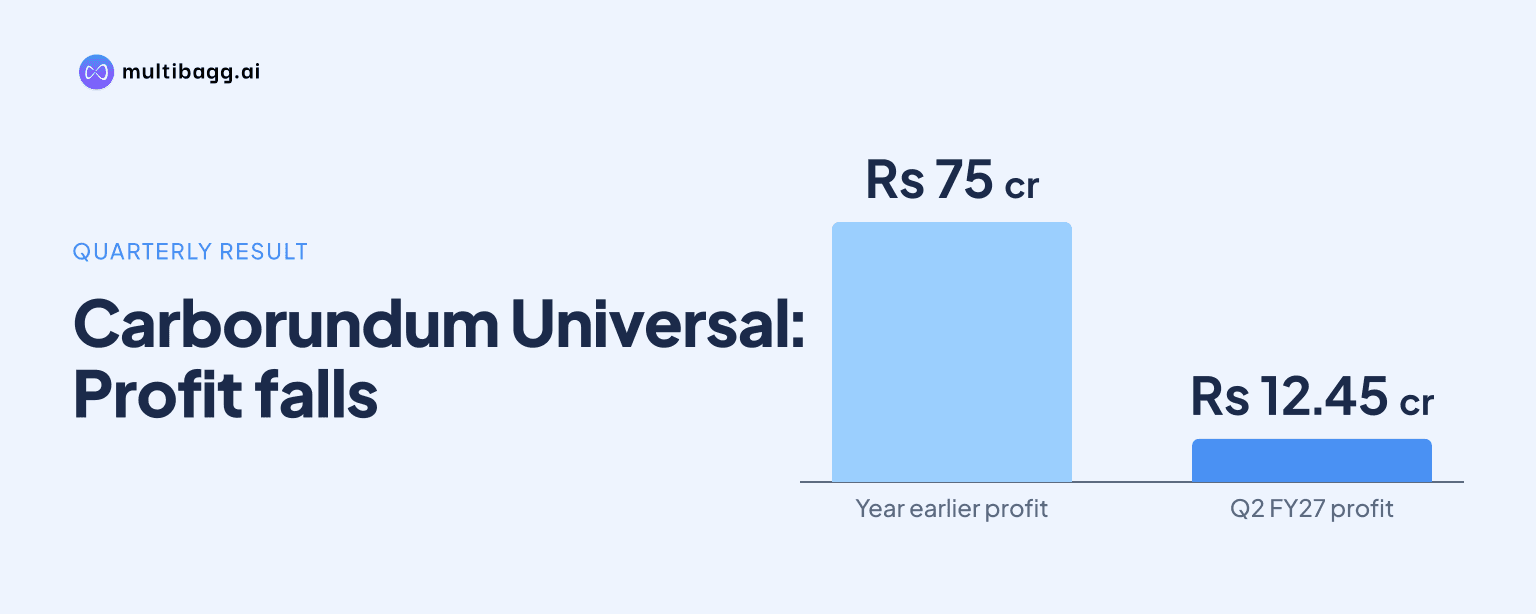
CUMI reported consolidated profit after tax and non-controlling interest of Rs 12.45 crore in Q2FY27, down from Rs 75 crore a year earlier, after booking an Rs 80.26 crore exceptional expense related to the closure of CUMI Awuko Abrasives GmbH (CAAG), even as consolidated sales rose 13.1% to Rs 1,455 crore.
Know Carborundum Universal inside out
Results, valuation, peers and who's buying, in one view.
Why did CUMI’s Q2FY27 profit decline despite higher sales?
CUMI’s reported Q2FY27 profit declined because the Rs 80.26 crore exceptional charge outweighed the improvement in operating profit before exceptional items and tax. Consolidated profit before exceptional items and tax increased to Rs 138 crore from Rs 113 crore in Q2FY26, a Rs 25 crore rise, while profit after tax and non-controlling interest fell from Rs 75 crore to Rs 12.45 crore.
The charge was connected with the closure of CAAG, CUMI’s wholly owned step-down subsidiary in Germany. CUMI said CAAG’s financial information was prepared on a realisable-value, non-going-concern basis during the closure process. The Q2FY27 expense represented write-downs of assets and restructuring costs, following Rs 119 crore recorded under exceptional items for CAAG in the year ended March 31, 2026.
CUMI said Q2FY27 profit after tax and non-controlling interest would have been Rs 92.7 crore without the exceptional item. That amount was Rs 17.7 crore above the Rs 75 crore reported in Q2FY26, illustrating that the reported year-on-year decline was driven by the closure-related accounting expense rather than the stated profit before exceptional items and tax measure.
How did CUMI’s businesses contribute to Q2FY27 sales growth?
CUMI’s consolidated sales growth was led by Ceramics, whose Q2FY27 sales rose 36.1% to Rs 410 crore from Rs 301 crore in Q2FY26. Consolidated Electrominerals sales increased 11.1% to Rs 443 crore, while consolidated Abrasives sales rose 4.0% to Rs 607 crore, making Abrasives the largest sales segment but the slowest-growing one in the quarter.
Ceramics also showed the largest increase in consolidated profit before finance cost and tax, rising to Rs 101 crore in Q2FY27 from Rs 62 crore in Q2FY26 and Rs 74 crore in Q1FY27. CUMI linked standalone ceramics growth to orders in engineered ceramics, metallized cylinders and refractories, while consolidated ceramics sales also increased 17.6% sequentially from Q1FY27.
Electrominerals presented a different pattern: sales increased 11.1% from Q2FY26 but declined 6.3% from Q1FY27 to Rs 443 crore. Its consolidated profit before finance cost and tax was Rs 26 crore, compared with Rs 33 crore in Q2FY26 and Rs 22 crore in Q1FY27. Abrasives profit before finance cost and tax increased to Rs 40 crore from Rs 33 crore a year earlier and was at a similar level to Q1FY27.
Got a follow-up? Ask IRIS
What happened in CUMI’s CAAG closure process?
CUMI said CAAG entered agreements in October 2026 to sell all its property, plant and equipment and inventory for aggregate consideration of Rs 5.34 crore. CAAG also reached a reconciliation of interest and social plan with all employees under applicable German labour-law requirements, and CUMI recognised the resulting Rs 80.3 crore expense in Q2FY27 exceptional items.
The Q2FY27 announcement described CAAG as proceeding to final liquidation and deregistration under German laws after these steps. The charge includes asset write-downs and restructuring costs, meaning the Rs 5.34 crore consideration for the asset and inventory sale does not represent the overall financial impact of the wind-down. CUMI’s reported Rs 80.26 crore quarterly exceptional-item figure gives the more precise amount used in its consolidated profit discussion.
The closure charge also affected the first-half comparison. For H1FY27, consolidated profit after tax and non-controlling interest was Rs 89 crore, versus Rs 136 crore in the same period of FY26. CUMI said H1FY27 profit would have been Rs 169 crore without the Q2FY27 exceptional expense, which was Rs 33 crore above the prior-year reported first-half profit.
How did CUMI’s first-half earnings, investment and debt change?
CUMI’s H1FY27 consolidated sales were Rs 2,865 crore, up 14.9% from the comparable prior-year period, with Ceramics, Electrominerals and Abrasives growing 26.3%, 14.0% and 11.5%, respectively. The segment comparison again shows Ceramics growing fastest, while Abrasives supplied Rs 1,217 crore of first-half consolidated sales, compared with Rs 1,091 crore in H1FY26.
Consolidated capital expenditure was Rs 127 crore in H1FY27, down from Rs 162 crore in H1FY26. As of September 30, 2026, consolidated debt stood at Rs 362 crore and cash was Rs 251 crore, excluding cash held at Volzhsky Abrasive Works, resulting in net debt of Rs 111 crore. CUMI reported a debt-equity ratio of 0.09 at that date.
Standalone performance did not include the consolidated CAAG exceptional-item effect in the figures presented by CUMI. Standalone Q2FY27 sales rose 28.0% to Rs 911 crore from Rs 712 crore, and standalone profit after tax rose to Rs 72 crore from Rs 64 crore. For H1FY27, standalone profit after tax was Rs 160 crore versus Rs 209 crore, although CUMI noted that H1FY26 included a one-time Rs 68 crore dividend from a subsidiary.
Conclusion
CUMI’s Q2FY27 announcement shows a contrast between sales and operating progress and the reported bottom-line result. Consolidated sales reached Rs 1,455 crore and profit before exceptional items and tax reached Rs 138 crore, while the Rs 80.26 crore CAAG closure expense reduced profit after tax and non-controlling interest to Rs 12.45 crore. Ceramics contributed the quickest sales growth at 36.1%, whereas Abrasives remained the largest quarterly sales segment at Rs 607 crore.
The next disclosed development is CAAG’s final liquidation and deregistration under German law, following its October 2026 agreements to sell assets and inventory for Rs 5.34 crore and its employee social-plan arrangements. CUMI also continues to monitor the uncertain environment surrounding Volzhsky Abrasive Works, for which prior-year impairment expense of Rs 104.13 crore had been recorded, according to the review report.