










DICABS plans 132 kV volume cable output by December 2027
Key highlights
- DICABS plans to complete its sixth CCV line, including type testing, by 31 December 2027.
- The sixth CCV line is expected to add about 150 km a month of 66 kV single-core cable at full run.
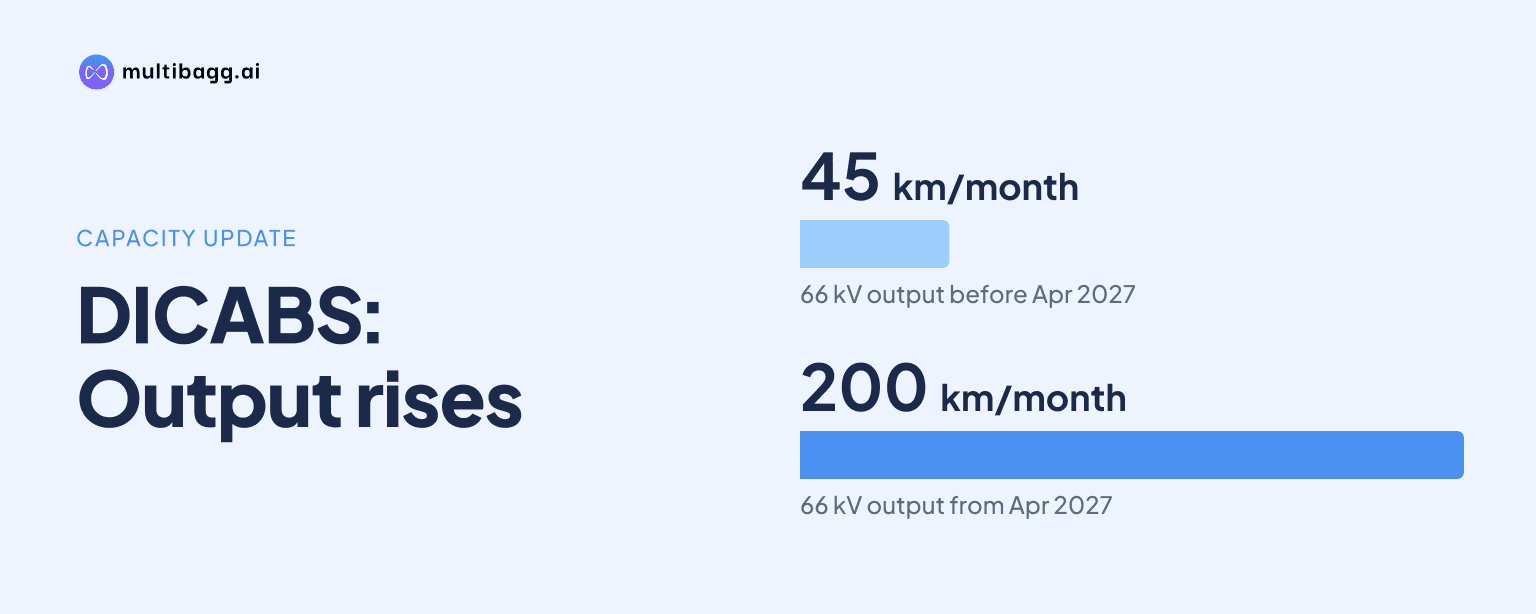
- DICABS plans to raise existing 66 kV output from 45 km to 200 km a month from April 2027.
- The Integrated Polymer Complex is planned for 84,500 metric tonnes per annum across seven lines.
powered by IRIS
Diamond Power Infrastructure Limited, branded as DICABS, plans to complete its sixth catenary continuous vulcanisation (CCV) line and type testing by 31 December 2027, adding about 150 km a month of 66 kilovolt (kV) single-core cable capacity at full run and moving 132 kV cable toward volume production.
Know Diamond Power Infrastructure inside out
Results, valuation, peers and who's buying, in one view.
What is DICABS adding by December 2027?
DICABS is adding a sixth CCV line for 66 kV and 132 kV single-core extra-high-voltage (EHV) cable, with machinery delivery scheduled for August 2027 and erection, commissioning and type testing due by 31 December 2027. The line will be installed in an extension of the existing EHV shed rather than at a new greenfield location.
The stated base product is a 66 kV, one-core, 630 square millimetre cable, while the same line is qualified for 132 kV cable. DICABS says the project will take 132 kV cable from a type-tested product to a volume product for the Siemens, port and refinery customer classes it already supplies. The fifth CCV line was under erection for March 2027, before the planned December 2027 commissioning of the sixth line.
DICABS describes its Vadodara campus as a 130-acre integrated site with 14 manufacturing units, 2.8 million square feet of built-up area and a 765 kV high-voltage test laboratory. Its stated cable range is 1.1 kV to 400 kV, and it reports more than 135 type-tested products, including 66 kV, 132 kV and 220 kV cables.
How much 66 kV capacity will DICABS add?
DICABS expects the sixth CCV line to add about 150 km a month of 66 kV single-core cable at full run, alongside an increase in output on existing 66 kV lines from 45 km to 200 km a month from April 2027. The disclosed plan therefore combines debottlenecking of current operations with a dedicated new line.
The 150 km monthly addition will use shared Class 6 clean-room infrastructure, drum handling and the 765 kV laboratory, according to DICABS. The presentation also says the addition comes on top of five existing CCV lines, while its campus overview identifies six CCV lines within a broader platform of 10 medium-voltage and EHV lines, reflecting different scopes and stages of the expansion programme.
DICABS separately reports annual cable capacity of 34,300 km for low-voltage cable, 18,000 km for high-voltage cable and 2,000 km for EHV cable. The sixth line is more narrowly directed at 66 kV and 132 kV single-core products, where type testing and customer qualification are part of the supply process.
Why is DICABS expanding 66 kV and 132 kV cable output?
DICABS says its 66 kV order book, including GETCO Jamnagar, Adani and data-centre work, is filling existing lines and is the immediate reason for the capacity addition. Management describes EHV as its fastest-growing cable family and as having the highest realisation per kilometre, but the presentation does not provide order-book value, pricing or projected revenue for the sixth line.
The presentation identifies grid build-out, renewable-energy evacuation, urban undergrounding, data centres, industrial projects and ageing overseas grids as demand drivers for medium-voltage and EHV cable. These are sector themes cited by DICABS, not company sales forecasts, and the company provides no market-share target for the 66 kV or 132 kV expansion.
DICABS also links the plan to customer approval requirements. It says utilities approve the compound brand as part of the cable, while it already has type-tested 66 kV and 132 kV products. The expansion is therefore designed to combine cable-line capacity with access to qualifying insulation compound.
Got a follow-up? Ask IRIS
How will polymer production support DICABS's CCV expansion?
DICABS plans an Integrated Polymer Complex with 84,500 metric tonnes per annum of capacity across seven lines, including a Phase II super-clean line for 66 kV to 400 kV compound. Phase I, with 66,500 metric tonnes per annum across six lines, is scheduled for commissioning from June to December 2027; the 18,000-tonne Phase II line is planned for early 2028 after pilot trials.
DICABS says compound, rather than extrusion capacity, is the binding constraint on EHV growth because super-clean 66 kV to 400 kV compound was supplied intermittently during 2026. The company says only three overseas suppliers make this compound and none is in India. Phase II is intended to make peroxide cross-linked polyethylene insulation for 66 kV, 132 kV, 220 kV and 400 kV cables; semiconducting screen compounds are excluded because they use a different process.
The company says the CCV and polymer projects are sized for each other, allowing EHV cable extrusion using DICABS's own super-clean compound. About 40% of Phase II output is planned for captive use and about 60% for sale to other Indian high-voltage and EHV cable manufacturers.
What funding and projects come after the sixth CCV line?
DICABS lists Rs 366.7 crore of QIP-approved capital expenditure plus internal accruals for the wider capacity programme. It assigns about Rs 73 crore to balancing equipment for existing medium-voltage and EHV lines, Rs 129 crore to the low-voltage cable plant and about Rs 170 crore to the two-phase polymer complex; it does not disclose a separate cost for the sixth CCV line.
The balancing equipment includes corrugation lines, stranders and a drum twister, and is scheduled in FY27 as the first project to deliver. DICABS says this equipment will debottleneck existing medium-voltage and EHV lines before the fifth CCV line targeted for March 2027 and the sixth line targeted for December 2027.
For the polymer complex, DICABS gives a Phase I cost of Rs 78 crore and a Phase II cost of Rs 92 crore when built together, compared with Rs 110 crore for Phase II on a stand-alone basis. Funding shown includes Rs 100 crore of QIP proceeds, about Rs 70 crore of Phase II term debt and working capital from accruals. The company says these estimates remain under validation by its chief financial officer, director of marketing and polymer expert, with board final approval to follow.
DICABS identifies two further 66 kV CCV lines, one 132 kV CCV line and a vertical continuous vulcanisation line for 220 kV and above as Phase II projects. It also lists an FY28 1,000 km monthly single-core cable plant for 3.3 kV aluminium-armoured solar-park cable at about Rs 40 crore, and states a standing commitment from 2028 to add five new medium-voltage lines each year.
Conclusion
The sixth CCV line is DICABS's specified December 2027 step toward volume production of 132 kV cable. Its about 150 km monthly 66 kV capacity addition follows the planned increase in existing 66 kV output from 45 km to 200 km a month from April 2027, using the Vadodara site's existing testing, clean-room and material-handling infrastructure.
The next disclosed milestones are the fifth CCV line targeted for March 2027, Phase I polymer commissioning from June to December 2027, machinery delivery for the sixth CCV line in August 2027 and completion of its type testing by 31 December 2027. Early-2028 commissioning of the Phase II polymer line, and validation and board approval of its financial estimates, remain relevant to the next planned move into 220 kV and higher-voltage products.