










Evonile Pharma posts ₹775.4 million Q2 loss after sales fall
Key highlights
- Evonile Pharma reported a ₹775.4 million net loss in Q2 FY27, compared with a ₹242.2 million profit a year earlier.
- Revenue from operations fell to ₹560.5 million from ₹903.3 million in Q2 FY26.
- Exceptional charges totalled ₹682.6 million, including ₹610 million tied to major-customer termination and inventory arrangements.
- The board approved a rights issue of up to ₹9,000 million as the company targets significant debt reduction.
powered by IRIS
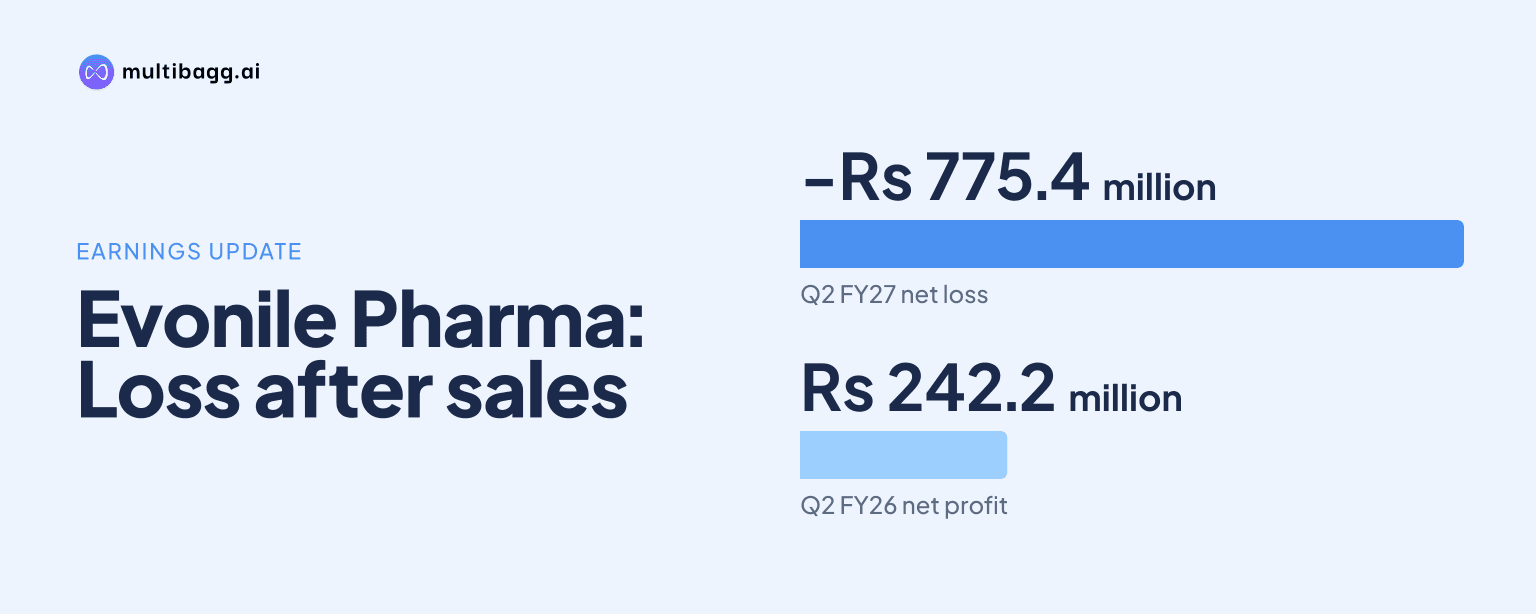
Evonile Pharma Limited reported a ₹775.4 million net loss for the September quarter of FY27 after revenue from operations fell to ₹560.5 million and exceptional charges totalled ₹682.6 million. The result reflects the cost of moving away from a single-customer model while the company builds an independent commercial and distribution network.
Know Novartis India inside out
Results, valuation, peers and who's buying, in one view.
Why did Evonile Pharma report a Q2 net loss?
Evonile Pharma reported a Q2 FY27 net loss because lower sales coincided with substantial one-time charges related to a major customer transition. The company had reported a ₹242.2 million profit in the corresponding quarter a year earlier, making the latest result a significant reversal in reported profitability.
Exceptional items amounted to ₹682.6 million during the quarter. Of this, ₹610 million arose from termination and related inventory-purchase arrangements with a major customer, according to the regulatory filing. These costs were recorded as the business shifts from its earlier commercial structure to an independent operating model.
The company is establishing its own carrying and forwarding agent network, stockist network, distribution capabilities and field force. Management said market availability has been fully re-established through its own CFAs and stockists. It has also stated that the infrastructure build-out is expected to be completed by Q4 FY27.
What were Evonile Pharma's key Q2 FY27 financial figures?
Evonile Pharma's revenue from operations declined to ₹560.5 million in Q2 FY27 from ₹903.3 million in the year-earlier quarter, while expenses rose to ₹965.9 million from ₹670.8 million. The higher expense base and exceptional charges together produced the quarterly loss.
Revenue was lower by about 38% year on year based on the figures disclosed. The filing linked the financial pressure to lower sales, customer-transition costs and portfolio changes. It also indicated that the first half of FY27 moved into a net-loss position as the transition affected operating performance.
The quarter therefore includes both a weaker revenue base and costs that management has characterised as transition-related. The reported numbers do not separate the operating impact of each commercial initiative, so the filing does not provide a standalone measure of profitability excluding exceptional items.
How is the commercial transition changing Evonile Pharma's operations?
Evonile Pharma is moving from a single-customer model to an independent commercial model, a change that requires new distribution, sales and market-access infrastructure. The company has said it is building its own CFA and stockist network alongside field-force capabilities to support portfolio growth.
This transition explains why customer arrangements became a material item in the quarter. The termination and inventory-purchase arrangements with the major customer accounted for most of the ₹682.6 million exceptional charge. While these charges weighed on Q2 earnings, the company has framed the independent commercial structure as a foundation for longer-term portfolio management.
The company has set out three operational priorities: completing infrastructure by Q4 FY27, significantly reducing debt through a capital infusion, and returning to growth across its portfolio. These are stated corporate objectives rather than financial guidance, and the filing does not specify revenue or profit targets for FY27.
Got a follow-up? Ask IRIS
What portfolio and funding actions were disclosed during the quarter?
Evonile Pharma completed two strategic transactions during the quarter: the acquisition of Minipress XL and an ophthalmology in-licensing agreement. The disclosures also refer to a cardiology intellectual-property acquisition, reflecting the company's effort to reshape and expand its portfolio during the commercial transition.
The board has approved a rights issue of up to ₹9,000 million. The company has said the planned capital infusion is intended to significantly reduce debt. No issue price, record date, entitlement ratio or fundraising timetable was included in the information provided.
For investors, the rights issue is relevant because it sits alongside a period of elevated transition costs and lower sales. Its eventual terms will determine the amount of capital raised, the extent of participation available to existing shareholders and the effect on the company's capital structure.
What does the Q2 result mean for investors and operations?
The Q2 result shows that the costs of becoming an independent commercial business are currently exceeding the revenue generated during the transition. Revenue declined despite the company reporting that market availability had been restored through its own distribution network, highlighting that supply availability and sales recovery are separate measures.
The quarterly loss was also driven chiefly by identified exceptional charges rather than by revenue decline alone. However, expenses of ₹965.9 million were well above quarterly revenue of ₹560.5 million, which underscores the immediate cost burden of the new operating structure.
Evonile Pharma has scheduled an earnings call for November 4, 2026, at 2:30 PM IST to discuss unaudited Q2 and H1 FY27 results. Investors and analysts will be able to seek detail on customer-transition costs, the portfolio additions, distribution build-out and the proposed rights issue.
Conclusion
Evonile Pharma's ₹775.4 million Q2 FY27 loss was driven by a sharp fall in revenue and ₹682.6 million of exceptional charges, largely tied to the termination and related inventory arrangements with a major customer. The figures document the near-term financial effect of replacing a single-customer model with the company's own commercial, distribution and field-force infrastructure.
The next disclosed milestones are the November 4 earnings call, completion of the infrastructure build-out by Q4 FY27 and further details of the rights issue approved for up to ₹9,000 million. Management's progress on restoring portfolio growth and reducing debt through capital infusion remains central to the transition plan.