










Faze Three Q2 FY27 Revenue Reaches ₹267.8 Crore, Up 29.1%
Key highlights
- Faze Three reported Q2 FY27 total income of ₹267.82 crore, up 29.1% year-on-year.
- Q2 FY27 EBITDA rose to ₹35.59 crore from ₹5.52 crore in Q2 FY26.
- Faze Three's EBITDA margin improved to 13.29% from 2.66% a year earlier.
- Q2 FY27 PAT was ₹15.46 crore, compared with a ₹5.22 crore loss in Q2 FY26.
powered by IRIS
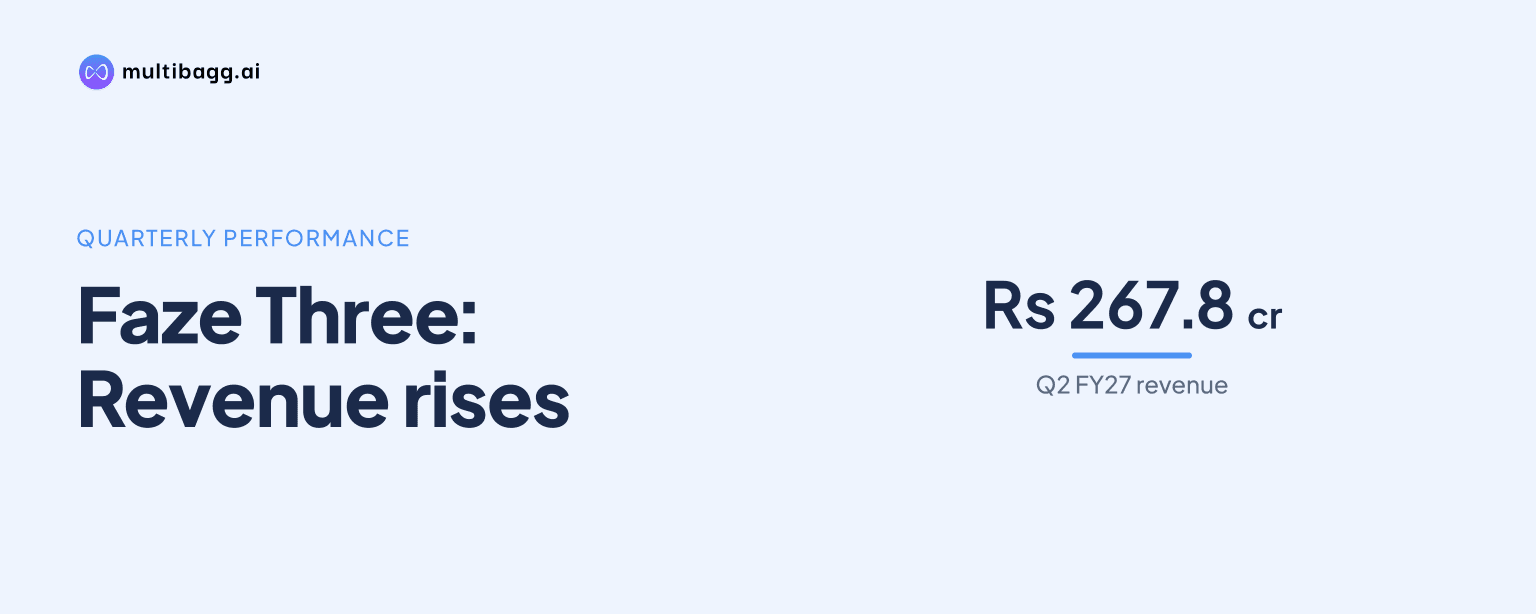
Faze Three Ltd reported total income of ₹267.82 crore in Q2 FY27, its highest-ever September-quarter revenue, representing year-on-year growth of 29.1%. The investor presentation also showed EBITDA rising to ₹35.59 crore and profit after tax turning positive at ₹15.46 crore, alongside a sharp improvement in margins.
Know Faze Three inside out
Results, valuation, peers and who's buying, in one view.
What did Faze Three report for Q2 FY27?
Faze Three reported Q2 FY27 total income of ₹267.82 crore, compared with ₹207.4 crore in Q2 FY26, according to its investor presentation published on November 3, 2026. The company described the quarterly figure as its highest-ever revenue for a September quarter.
The 29.1% year-on-year increase followed a period in which the company had already reported ₹229.39 crore of consolidated revenue from operations in Q1 FY27. The Q2 presentation uses total income as its reported revenue measure, and the figures in this report are presented on that basis. The company has not published an earnings-call transcript for the quarter, so the disclosed presentation figures, rather than management commentary or guidance, form the basis for the update.
The quarterly financial performance showed a notable improvement in profitability. EBITDA was ₹35.59 crore in Q2 FY27, up from ₹5.52 crore in the comparable quarter a year earlier. Profit after tax was ₹15.46 crore, compared with a loss of ₹5.22 crore in Q2 FY26.
How did Faze Three's margins improve year on year?
Faze Three's EBITDA margin improved to 13.29% in Q2 FY27 from 2.66% in Q2 FY26, while PAT margin moved to 5.77% from negative 2.52%. The margin movement was accompanied by revenue growth and the return to quarterly profitability.
The comparison is significant because Q2 FY26 included a reported mark-to-market impact on currency forwards. The earlier investor presentation stated that the Q2 FY26 EBITDA margin was 2.66%, while the margin excluding the notional currency-forward mark-to-market loss was 10.82%. Faze Three's Q2 FY27 presentation reported the 13.29% EBITDA margin without setting out a comparable adjusted-margin measure in the supplied material.
The shift in PAT was also substantial. A ₹5.22 crore loss in Q2 FY26 became a ₹15.46 crore profit in Q2 FY27, taking the PAT margin into positive territory. These figures indicate that the expansion in operating earnings was reflected at the net-profit level as well, although the presentation does not provide an earnings-call explanation of each cost or non-operating item.
Got a follow-up? Ask IRIS
Why is the September-quarter performance important?
The September-quarter result is important because Faze Three recorded its highest-ever revenue for this period while materially improving profitability. Revenue growth alone does not establish earnings quality, but the simultaneous increase in EBITDA and the return to positive PAT make the quarter relevant for investors assessing the company's operating trajectory.
The comparison with Q2 FY26 also needs to be read in context. In the prior-year quarter, Faze Three reported an exceptional currency-forward mark-to-market effect that affected its reported EBITDA margin. The company had separately indicated that EBITDA excluding that impact was ₹22.44 crore, with an adjusted margin of 10.82%. The FY27 presentation reports EBITDA of ₹35.59 crore and a 13.29% margin, which remains above that previously disclosed adjusted comparison.
Faze Three had earlier stated that it expected FY26 revenue growth to exceed its previous 25% guidance and projected FY27 revenue growth of at least 22% to 25%, subject to the tariff scenario. The Q2 FY27 presentation cited in the supplied material does not provide a new formal guidance statement. As a result, the reported quarterly figures should be separated from any assumption about full-year performance.
What does the update mean for investors and operations?
For investors, the key development is the combination of 29.1% growth in total income and the improvement in reported EBITDA margin to 13.29%. This narrows the gap between revenue expansion and profit conversion that can arise when costs, foreign-exchange effects, or operating inefficiencies weigh on a quarter's earnings.
The figures also matter for the company's capital-allocation context. In its earlier Q2 FY26 presentation, Faze Three said its planned capital expenditure was expected to conclude by FY27. It had indicated that, following completion of this capex, 40% to 45% of cash flow from operations could be available for alternative uses. The supplied Q2 FY27 material does not disclose a fresh capex amount, revised completion schedule, or allocation decision.
The November 3, 2026 board meeting approved unaudited results for the quarter and half-year ended September 30, 2026, and the filing included a limited review report from MSKA & Associates. Investors should distinguish the investor-presentation metrics from other figures cited in the supplied material, including separate standalone and consolidated financial-result disclosures that use revenue from operations and other stated measures.
Conclusion
Faze Three's Q2 FY27 investor presentation shows a record September-quarter total income of ₹267.82 crore, 29.1% above the prior-year quarter, with EBITDA of ₹35.59 crore and PAT of ₹15.46 crore. The reported 13.29% EBITDA margin and 5.77% PAT margin mark a clear improvement from Q2 FY26, when the company reported lower margins and a net loss.
The next points to watch are progress toward the previously stated FY27 revenue-growth range of at least 22% to 25%, subject to the tariff scenario, and the status of capex expected to conclude by FY27. Faze Three has previously said completion of that programme could leave 40% to 45% of cash flow from operations available for alternative uses, but no updated allocation details were disclosed in the supplied Q2 FY27 presentation.