








Fusion Finance posts ₹86.48 crore Q2 profit, raises MSME cap
Key highlights
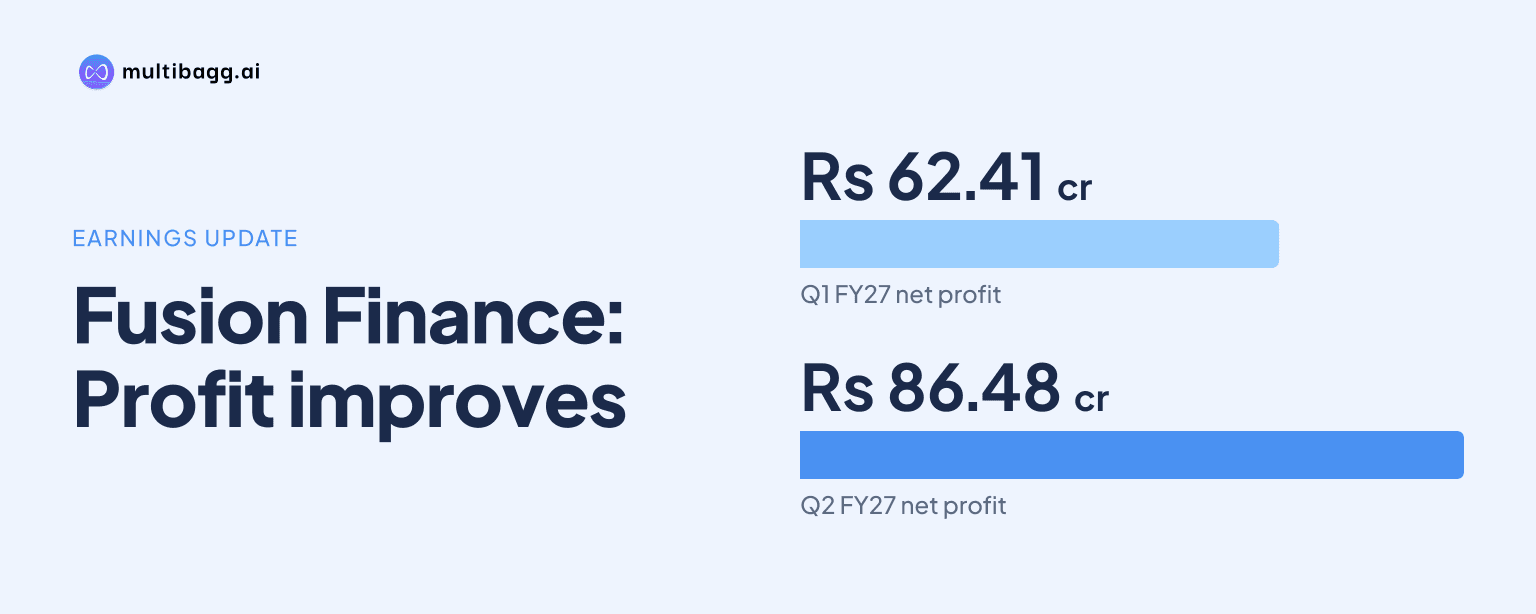
- Fusion Finance reported Q2 FY27 net income of ₹86.48 crore, versus a ₹22 crore loss in Q2 FY26.
- Fusion Finance stated that impairment costs declined year-on-year in Q2 FY27.
- Fusion Finance doubled its maximum MSME lending ticket size from ₹25 lakh to ₹50 lakh.
- Fusion Finance reported Q1 FY27 net profit of ₹62.41 crore and revenue of ₹458.31 crore.
powered by IRIS
Fusion Finance Ltd returned to profitability in Q2 FY27 with net income of ₹86.48 crore, supported by lower year-on-year impairment costs, while its board doubled the maximum MSME lending ticket size to ₹50 lakh. The quarter marks a recovery from the ₹22 crore loss reported in Q2 FY26 and pairs improved earnings with a change in lending capacity.
Know Fusion Finance inside out
Results, valuation, peers and who's buying, in one view.
How did Fusion Finance return to profit in Q2 FY27?
Fusion Finance reported net income of ₹86.48 crore for Q2 FY27, reversing the loss recorded in the corresponding quarter a year earlier. The available interim-report summary identifies lower impairment costs on a year-on-year basis as the key factor accompanying the return to profit. Impairment costs are charges recognised for expected credit losses, making their movement particularly relevant for a microfinance-focused lender.
The company had reported a net loss of ₹22 crore in Q2 FY26, which covered the September 2025 quarter. The Q2 FY27 result therefore represents an improvement of ₹108.48 crore from that reported base. The supplied information does not specify the absolute impairment expense for either period, the operating-profit figure, or the revenue reported for Q2 FY27.
The latest result follows a profitable Q1 FY27, when Fusion Finance reported net profit of ₹62.41 crore. Q1 FY27 revenue was ₹458.31 crore, compared with ₹442 crore in Q1 FY26. While these first-quarter figures provide recent context, they should not be treated as Q2 FY27 figures because the supplied material does not state second-quarter revenue.
Why did impairment costs matter to Fusion Finance's quarterly earnings?
Lower impairment costs mattered because these provisions directly affect a lender's reported profitability. Fusion Finance's Q2 FY27 interim-report summary links the year-on-year reduction in impairment costs with its return to a net profit of ₹86.48 crore. For a non-banking financial company that lends primarily to women borrowers in rural and semi-urban areas, credit-cost trends are an important measure of portfolio performance.
The result must be read against a period in which Fusion Finance had reported losses. The supplied quarterly data show losses in several earlier periods, including a ₹92 crore loss in Q1 FY26 and a ₹22 crore loss in Q2 FY26. The move to profit in Q1 FY27 and Q2 FY27 indicates that the company has reported positive net results in two consecutive quarters.
However, the material does not provide asset-quality ratios, collection data, write-off figures, gross non-performing asset data, or a breakdown of the impairment-cost reduction. It also does not provide management guidance on future credit costs. Investors therefore have a confirmed profit figure and the stated direction of impairment expenses, but not the detailed operating data needed to quantify the change in portfolio quality.
What is Fusion Finance's new ₹50 lakh MSME loan limit?
Fusion Finance's board doubled the maximum ticket size for MSME lending to ₹50 lakh. This means the stated upper limit for an eligible MSME loan has increased from ₹25 lakh to ₹50 lakh. The decision expands the size of individual loans that Fusion Finance can extend within this lending category.
MSME lending is distinct from the company's core microfinance focus. The source describes Fusion Finance as a microfinance-focused non-banking financial company serving women borrowers, primarily in rural and semi-urban India. Raising the MSME ticket ceiling gives the lender room to serve larger funding requirements within the MSME segment, subject to its underwriting and eligibility processes.
The information supplied does not state when the revised limit becomes operational, the expected disbursement amount under the higher cap, or the number of customers likely to use it. It also does not indicate whether the company has changed pricing, collateral requirements, geographic coverage, or risk limits alongside the board decision.
Got a follow-up? Ask IRIS
What does the Q2 result mean for Fusion Finance investors and customers?
For investors, the Q2 FY27 result provides evidence of a reported recovery in net profitability, with ₹86.48 crore of net income following the Q2 FY26 loss. The lower year-on-year impairment costs are central to interpreting that change, as credit provisions can materially influence the earnings of a lender. No share-price movement, valuation data, dividend decision, or market reaction is included in the supplied material.
For customers, the ₹50 lakh MSME limit potentially broadens the amount that qualifying borrowers can seek from Fusion Finance. The decision does not automatically mean all applicants will receive larger loans, since lending remains dependent on the company's credit assessment. The available information does not identify affected states, borrower groups, or the likely pace of larger-ticket disbursements.
The company had scheduled its Q2 and H1 FY27 earnings conference call for 2 November 2026 at 6:00 PM IST. Shareholders were invited to hear management discuss the performance and results. The supplied material does not include a conference-call transcript or management commentary, so no additional statements on business conditions, portfolio quality, or outlook can be attributed to the company.
How does this result compare with Fusion Finance's recent performance?
Fusion Finance's Q2 FY27 profit extends the improvement visible in Q1 FY27, when it reported ₹62.41 crore of net profit. In contrast, Q1 FY26 had produced a net loss of ₹92 crore. The sequence of reported net results shows a shift from losses in the comparable prior-year quarters to profits in the first two reported quarters of FY27.
The longer backdrop includes uneven quarterly earnings. The supplied quarterly data show that Fusion Finance reported negative earnings before tax in several earlier quarters before turning positive in later periods. That history makes the stated decline in impairment costs relevant, although the current material does not establish whether the lower charge reflects a sustained trend or a one-quarter movement.
Fusion Finance's reported Q1 FY27 revenue of ₹458.31 crore was 3.69% above ₹442 crore in Q1 FY26. No Q2 FY27 revenue figure is provided in the source material, and therefore the quarterly profit recovery should not be presented as a conclusion about second-quarter revenue growth. The confirmed facts are the ₹86.48 crore Q2 net income, lower year-on-year impairment costs, and the expanded MSME ticket limit.
Conclusion
Fusion Finance reported a clear year-on-year turnaround in Q2 FY27, moving from a ₹22 crore loss to net income of ₹86.48 crore as impairment costs fell. The board's decision to raise the maximum MSME loan ticket to ₹50 lakh also expands the company's stated lending capacity in that segment, alongside its microfinance operations.
The next items to watch are management's discussion of the Q2 and H1 FY27 performance, the detailed financial filing, and any disclosure on asset quality, impairment costs and larger-ticket MSME disbursements. The supplied source confirms the 2 November 2026 earnings call but does not provide the resulting management commentary or a forward-looking target.