










GE Vernova T&D India Named L1 Bidder for 6,000 MW HVDC Project
Key highlights
- GE Vernova T&D India was named L1 bidder on September 7, 2026 for a 6,000 MW, ±800 kV HVDC project.
- The assignment covers two 3,000 MW LCC HVDC terminal stations from Barmer-II to South Kalamb.
- GE Vernova T&D India shares rose 7.44% on September 8 following the L1-bidder disclosure.
- The company has not disclosed the final contract value, and a letter of award is still pending.
powered by IRIS
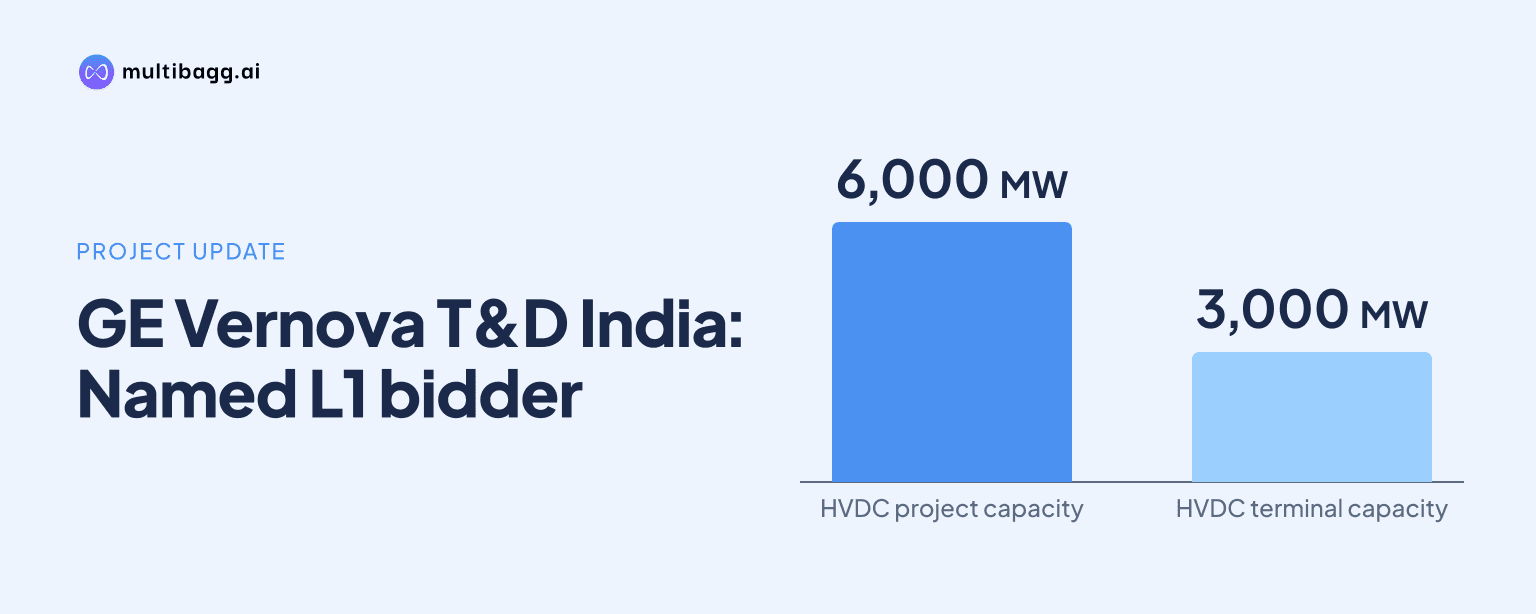
GE Vernova T&D India Limited has been named the L1 bidder for Power Grid Corporation of India Limited’s 6,000 MW, ±800 kV HVDC terminal-station project linking Barmer-II and South Kalamb. The September 7, 2026 intimation positions GE Vernova T&D India for a potentially significant renewable-power transmission assignment, although a final order has not yet been confirmed.
Know GE Vernova T&D India inside out
Results, valuation, peers and who's buying, in one view.
What has GE Vernova T&D India been selected to do?
GE Vernova T&D India has emerged as the lowest, or L1, bidder for the design and establishment of a 6,000 MW, ±800 kV high-voltage direct-current terminal station for Power Grid. The project is part of the interstate transmission system intended to evacuate renewable electricity from Barmer-II in Rajasthan to South Kalamb in Maharashtra.
The scope covers the design, supply and execution of line-commutated converter, or LCC, terminal stations. The 6,000 MW capacity is configured as two 3,000 MW terminals. GE Vernova T&D India said the work would be undertaken through a domestic entity and executed over multiple years.
Power Grid informed the company of its L1 status through a letter dated September 7, 2026. The developer had been awarded the overall transmission project in September 2026, following a tariff-based competitive bidding process for the Barmer II-South Kalamb HVDC interstate transmission system scheme.
Does L1 status mean the HVDC contract has been awarded?
No, L1 status means GE Vernova T&D India submitted the lowest commercial bid among technically qualified bidders, rather than confirming a final executed contract. The company’s stock-exchange filing identifies it as the L1 bidder and does not state that a letter of award or final contract has been issued.
Power Grid must complete tender-related formalities before issuing a letter of award or entering into a contract. Until that stage is completed, the potential project should not be treated as a confirmed addition to GE Vernova T&D India’s order book.
The company did not disclose the contract value in its regulatory filing. Reports on the overall transmission scheme cited a winning tariff quote of ₹3,240 crore, but this figure relates to the tariff-based competitive bidding arrangement for the broader scheme and is not a disclosed contract value for GE Vernova T&D India’s terminal-station scope.
Why is the Barmer-II to South Kalamb link important?
The Barmer-II to South Kalamb link is designed to move renewable power from Rajasthan to another demand and grid region. Large HVDC systems are used for high-capacity, long-distance power transfers, and the planned ±800 kV configuration underlines the scale of the proposed transmission infrastructure.
The National Committee on Transmission had approved the 6 GW, 800 kV project in May 2025. The scheme was subsequently offered under tariff-based competitive bidding, a process in which developers bid to build and operate transmission assets at a quoted tariff.
For the power system, the project is linked to the evacuation of renewable generation rather than conventional generation. Its two-terminal design and 6,000 MW capacity are intended to support transfer of electricity from the Barmer-II area to South Kalamb once the broader transmission system is developed.
Got a follow-up? Ask IRIS
How did investors respond to GE Vernova T&D India’s announcement?
GE Vernova T&D India shares rose 7.44% on September 8 after the L1-bidder announcement, with other reports describing a rise of around 7% to 8% during the session. The market response reflected investor attention on the potential addition to the company’s project pipeline.
The potential scale is notable because commentary on the development estimated that a confirmed Barmer-II-South Kalamb order could take the company’s order inflow to about ₹23,100 crore, nearly four times its FY26 revenue. This remains an estimate linked to a future final award rather than a figure disclosed by GE Vernova T&D India in its filing.
The lack of a disclosed contract value is an important qualification for investors. The company has confirmed the project’s technical scope, customer and multiyear execution period, but not the financial value, delivery milestones or final award date.
What does the project indicate about India’s transmission market?
The bid indicates continued activity in India’s grid-expansion programme for renewable-power evacuation. As renewable generation is developed in resource-rich locations, transmission systems are required to carry that electricity to distant consumption centres and strengthen inter-regional power transfers.
HVDC projects can require specialised converter technology, controls and execution capability. The current tender involves LCC terminals, a distinct technical scope within the HVDC value chain. GE Vernova T&D India’s L1 position therefore relates to the supply and execution of the converter-terminal infrastructure, not merely the construction of a transmission line.
The company has also disclosed a separate domestic letter of award from Power Grid for refurbishing the 2x500 MW Chandrapur back-to-back HVDC link. That assignment covers upgrades to HVDC thyristor valves and controls and protection systems, and is also scheduled for execution over multiple years.
Conclusion
GE Vernova T&D India’s L1 status for the 6,000 MW Barmer-II-South Kalamb HVDC terminal project places it at the front of a major renewable-power transmission tender. The development helped lift investor interest because of the project’s capacity, specialised HVDC scope and possible contribution to future order inflow, but it is not yet a final contract award.
The next material disclosure will be Power Grid’s completion of tender formalities and any letter of award or signed contract. Investors will also need to watch for confirmation of the contract value, execution schedule and the point at which the order is formally included in GE Vernova T&D India’s order book.