










Harish Textile Engineers Flags Liquidity Stress in Q2 Filing
Key highlights
- Harish Textile Engineers Ltd approved unaudited standalone Q2 and H1 FY27 results on 3 November 2026.
- The filing flagged liquidity stress, debenture defaults, regulatory scrutiny and a qualified review report.
- Q1 FY27 revenue from operations was ₹39.44 crore, up 23.9% year on year.
- Q1 FY27 net profit was ₹0.90 crore, down 25.0% year on year.
powered by IRIS
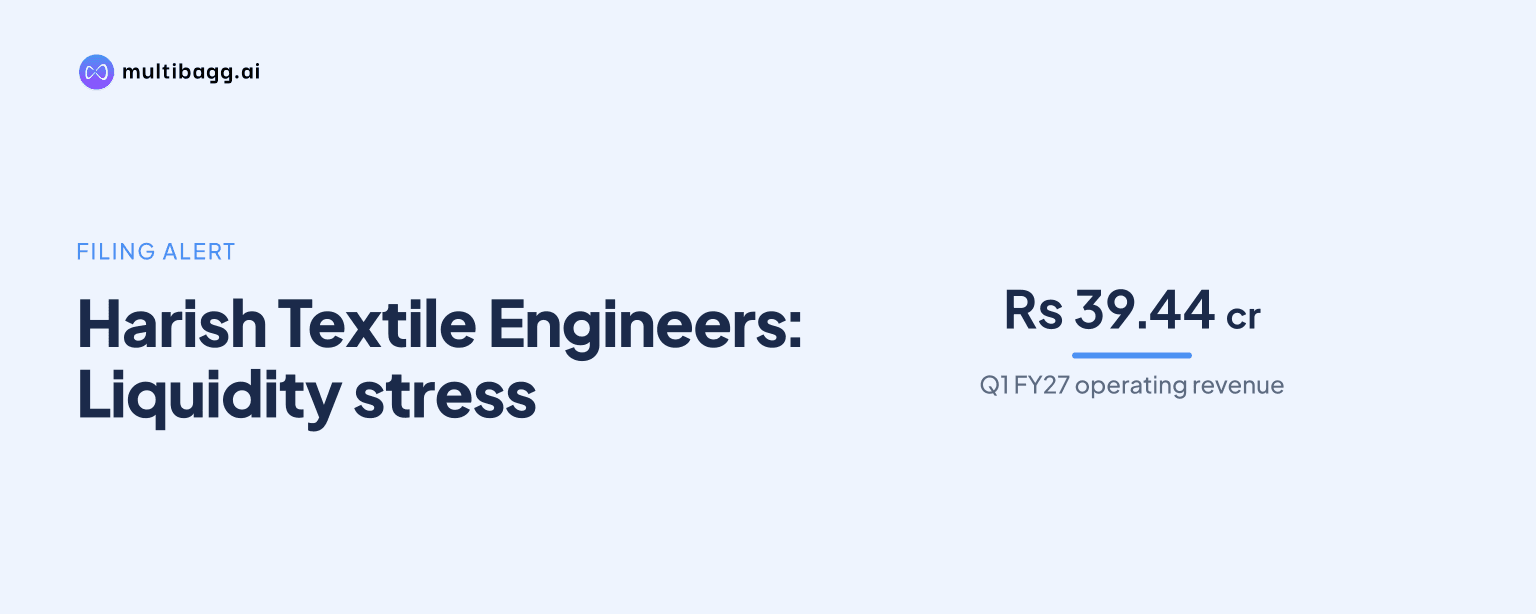
Harish Textile Engineers Ltd approved its unaudited standalone Q2 and H1 FY27 financial results on 3 November 2026, but the accompanying filing highlighted liquidity stress, debenture defaults and regulatory scrutiny. The disclosures matter because they raise concerns about the company’s capacity to meet financial obligations despite revenue growth reported in the preceding quarter.
Know Harish Textile Engineers inside out
Results, valuation, peers and who's buying, in one view.
What did Harish Textile Engineers Ltd disclose in its Q2 FY27 filing?
Harish Textile Engineers Ltd disclosed that its board had approved the unaudited standalone financial results for the quarter and half year ended September 2026. The filing was marked as a high-importance event and included information on significant liquidity stress and defaults relating to debentures.
The company’s review report was qualified, with the stated concerns including liquidity conditions, debenture defaults and regulatory scrutiny. A qualified review report signals that the reviewer has raised a specific matter in connection with the financial statements. The available information does not provide the amount of the debenture defaults, the precise liquidity position, or detailed Q2 and H1 FY27 financial figures.
The disclosure therefore places the focus on the company’s balance-sheet and cash-flow obligations rather than only on quarterly revenue or profit. For investors, the absence of detailed figures in the available event summary makes the qualified review observations particularly relevant when assessing the filing.
How did the results announcement unfold?
The board approval followed the closure of Harish Textile Engineers Ltd’s insider-trading window from 1 October 2026 until 48 hours after the release of unaudited results for the September 2026 quarter. The closure was stated to be in line with SEBI insider-trading requirements ahead of the board’s consideration of the results.
The company had earlier announced a board meeting to consider its June-quarter results, which were approved on 14 August 2026. For Q1 FY27, Harish Textile Engineers Ltd reported revenue from operations of ₹39.44 crore, up 23.9% year on year, while net profit was ₹0.90 crore, down 25.0% year on year.
A separate earnings summary described the June-quarter profit as ₹0.896 crore and indicated a quarterly decline in net profit. While the company’s Q1 revenue expanded, the lower profit and the subsequent disclosure of liquidity stress show that revenue growth alone does not address all financial risks.
No direct management statement on a resolution plan, repayment timetable, or the status of the regulatory matter was included in the information provided. As a result, the reported facts are limited to the board approval, the qualified review observations, and the stated areas of concern.
What do the earlier financial results show?
Harish Textile Engineers Ltd’s recent operating performance showed a recovery in revenue but uneven profitability. Revenue from operations rose to ₹39.44 crore in Q1 FY27 from about ₹31.8 crore in the comparable quarter a year earlier, based on the reported 23.9% growth.
However, Q1 FY27 net profit of ₹0.90 crore was below the prior-year level. The quarterly data shows operating profit of about ₹3 crore in June 2026, compared with ₹3 crore in March 2026, while the operating profit margin fell to 7.4% from 9.0% in the preceding quarter. Net profit margin was reported at 2.3% in June 2026, compared with 5.1% in March 2026.
For FY26, the company reported revenue from operations of ₹138.8359 crore and net profit of ₹5.538 crore. In the March 2026 quarter, it reported net profit of ₹1.85 crore and revenue from operations of ₹36.468 crore. These figures provide context for the Q1 result, but they do not establish the amount or timing of the debenture defaults disclosed in the Q2 filing.
Got a follow-up? Ask IRIS
Why do liquidity stress and debenture defaults matter to investors?
Liquidity stress matters because it concerns a company’s ability to meet near-term payment commitments. Debenture defaults are particularly material because they involve borrowings and can affect relationships with lenders, debenture holders, suppliers and other creditors.
The qualified review report brings these issues into the company’s financial reporting process. It does not, based on the available disclosure, quantify the liabilities involved or state a confirmed remedy. Investors will therefore need to distinguish between the company’s reported operating revenue and its ability to manage debt-servicing and other obligations.
The development also adds a compliance dimension through the reference to regulatory scrutiny. The supplied information does not identify a regulator, specify an inquiry, or state an outcome. It would be inappropriate to infer the nature, scale or consequence of the scrutiny beyond what the filing explicitly notes.
How could the disclosure affect shareholders and business operations?
For shareholders, the filing shifts attention from the June-quarter revenue increase to the quality of cash generation, debt obligations and disclosures in future financial statements. The company’s shares may be assessed against both its operating performance and the unresolved issues identified in the qualified review report.
For business operations, liquidity constraints can be relevant to working-capital management and payments to counterparties. However, Harish Textile Engineers Ltd has not provided, in the available material, any confirmed information on operational disruption, customer impact, employee impact or changes to production.
The company’s next disclosures will be important for clarifying whether the debenture defaults have been cured, restructured or remain outstanding. They may also provide details on the regulatory scrutiny and any measures being taken to address the liquidity position.
Conclusion
Harish Textile Engineers Ltd’s 3 November approval of Q2 and H1 FY27 results is significant because the filing identifies liquidity stress, debenture defaults and regulatory scrutiny alongside a qualified review report. Its Q1 FY27 revenue of ₹39.44 crore showed growth, but the reported decline in profit and the later financial-risk disclosures require separate consideration.
The next items to watch are the detailed Q2 and H1 FY27 financial statements, any quantification of defaults, and disclosures on repayment or resolution measures. Investors will also await further clarity on the regulatory scrutiny referenced in the filing and the company’s future review reports.