










HEG Advanced Materials Limited Plans ₹5,500 Crore Expansion
Key highlights
- HEG Advanced Materials plans about ₹5,500 crore of post-demerger capital expenditure across anodes, storage and green power.
- TACC's 20,000-tonne synthetic graphite anode plant near Indore involves about ₹2,250 crore and targets Q1 FY28 production.
- Replus Engitech received ₹217.56 crore of Indus Towers orders for lithium-ion battery banks, due for execution by March 31, 2027.
- Replus intends to make 1.5 GWh of BESS capacity available over two years under its non-binding Indus Towers MoU.
powered by IRIS
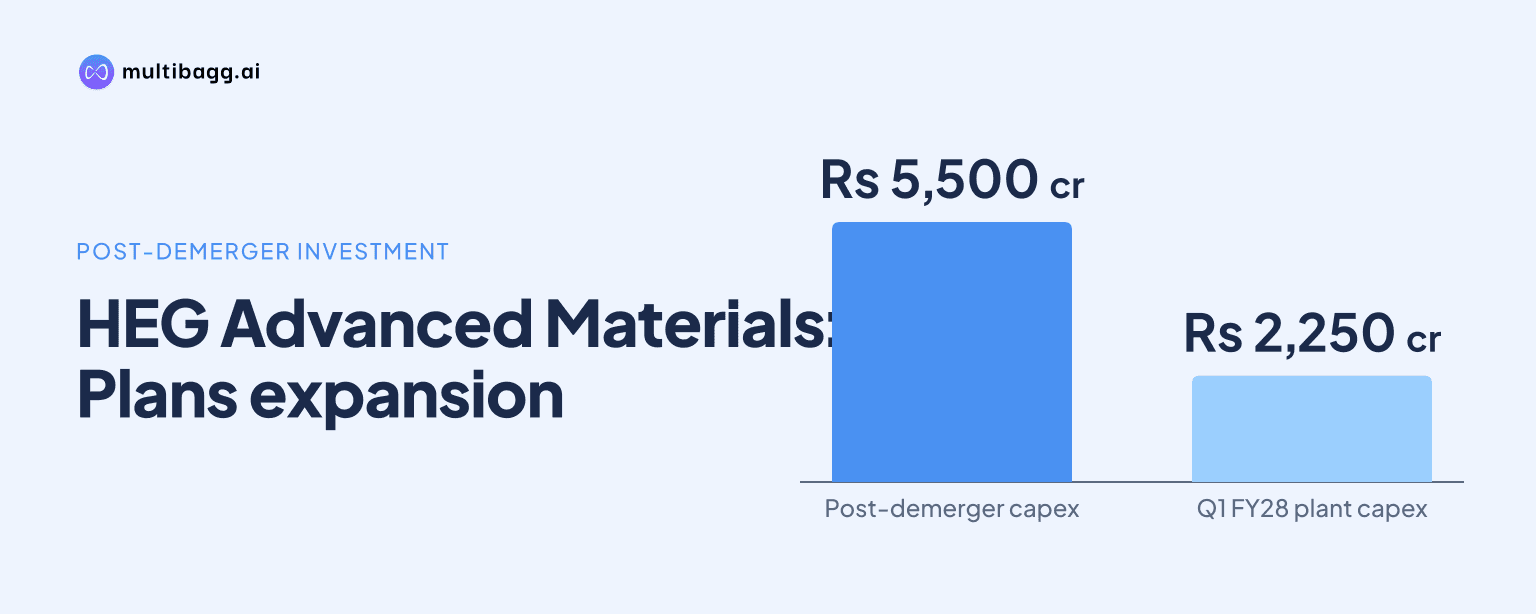
HEG Advanced Materials Limited has outlined a ₹5,500 crore post-demerger expansion programme, led by a ₹2,250 crore, 20,000-tonne synthetic graphite anode plant near Indore targeted to begin commercial production in Q1 FY28. The investment plan also covers battery energy storage and renewable-power projects as the company shifts beyond graphite electrodes.
Know HEG Advanced Materials inside out
Results, valuation, peers and who's buying, in one view.
What is HEG Advanced Materials investing in after the demerger?
HEG Advanced Materials is building a portfolio of advanced battery materials, battery energy solutions and green-power assets after the separation of its graphite-electrode business. The company, formerly known as HEG Limited, completed the final steps of a composite scheme of arrangement sanctioned by the National Company Law Tribunal, Indore Bench, on August 13, 2026. Its name was changed in September 2026 following a fresh certificate of incorporation.
Under the scheme, the graphite-electrode business was demerged into HEG Graphite Limited, while Bhilwara Energy Limited was amalgamated into the existing listed company. HEG Advanced Materials retains the advanced materials, battery energy solutions and green-power businesses. HEG Graphite is expected to be listed on BSE and NSE after the separation process.
The largest proposed allocation within HEG Advanced Materials' ₹5,500 crore capital-expenditure programme is for synthetic graphite anode materials. The company is also pursuing battery storage, solar generation and possible graphene derivatives. Before the separation, the business had net financial debt of about nil and treasury of about ₹790 crore, while the first anode project was described as fully funded.
How is the Indore synthetic graphite anode project progressing?
HEG Advanced Materials is constructing a 20,000-tonne-a-year synthetic graphite anode facility through its wholly owned subsidiary, TACC Limited, near Indore in Madhya Pradesh. The project occupies 100 acres and involves capital expenditure of about ₹2,250 crore. Commercial production is targeted for Q1 FY28, which corresponds with the stated March 2027 commissioning timeline.
Project updates have indicated that engineering was about 90% complete. Another update said engineering was complete and procurement was 85% complete. The site has been designed for future expansion, with initial plans allowing capacity to rise to about 30,000 tonnes. The company has stated that the broader location could ultimately support 60,000 tonnes of capacity by FY32.
TACC has also operated a 200-tonne demonstration plant at Mandideep, Madhya Pradesh, for about 12 months. Material samples from the pilot operation have been sent to more than 20 global cell manufacturers, and the company has said samples have received qualification from global cell makers. These customer qualification steps are important because battery-anode materials must meet cell manufacturers' technical and commercial requirements before large-scale supply contracts are secured.
Why are synthetic graphite anodes central to the strategy?
Synthetic graphite anodes are central to HEG Advanced Materials' strategy because they are used in lithium-ion batteries and India remains significantly dependent on imports for this part of the battery supply chain. The company is positioning TACC to supply both energy-storage-system and electric-vehicle applications, including high-capacity synthetic graphite and silicon-anode grades.
Management expects Indian cell-manufacturing capacity to reach around 250 GWh by 2035. It has also estimated that domestic graphite-anode demand could exceed 100,000 tonnes by 2030, driven first by energy-storage systems and subsequently by electric vehicles. HEG Advanced Materials views synthetic graphite as particularly suitable for fast-charging applications.
Government policy is also focused on localising battery supply chains. The article data refers to an upcoming ₹12,000 crore policy push for local battery-component manufacturing, with at least a quarter of the incentive outlay expected to be directed towards anode materials. The policy framework could support domestic component manufacturing, though it does not itself establish sales volumes or customer commitments for TACC.
Beyond the core anode project, TACC is considering a graphene-derivative line with 150 tonnes of capacity. The company is also working on silicon-based anodes. These initiatives remain separate from the 20,000-tonne commercial synthetic-graphite project and represent potential additions to its materials portfolio.
Got a follow-up? Ask IRIS
What do the Indus Towers order and MoU mean for Replus Engitech?
Replus Engitech, a subsidiary of HEG Advanced Materials, has received domestic orders worth ₹217.56 crore, including GST, from Indus Towers Limited for lithium-ion battery banks. The order is scheduled for execution by March 31, 2027, and is distinct from TACC's battery-anode manufacturing project.
The companies also announced a memorandum of understanding on September 30, 2026, to explore battery energy storage system solutions for telecom infrastructure in India. Replus intends to make 1.5 GWh of dedicated BESS production capacity available over a two-year period under the proposed collaboration. The arrangement follows the firm Indus Towers purchase order received on September 18.
The MoU records an intention to collaborate rather than a binding purchase commitment. As a result, the confirmed ₹217.56 crore battery-bank order is the immediate disclosed commercial transaction, while the extent to which the proposed 1.5 GWh capacity translates into firm orders remains unresolved. Replus is intended to serve telecom power, grid storage and e-mobility markets within the broader energy-solutions business.
How do renewable power and storage projects support the plan?
HEG Advanced Materials plans to expand renewable-power generation capacity from 292 MW in FY26 to 680 MW by FY28. The proposed build-out includes a 200-MWh battery-energy-storage project in Gujarat, targeted for Q3 FY27, and a 300-MWp solar project in Chhattisgarh, targeted for Q2 FY28.
These projects place the company in several parts of the energy-transition value chain: battery materials through TACC, storage solutions through Replus, and renewable generation through its power business. However, each project has its own execution timeline and commercial milestones. The company has identified anode-plant commissioning, customer approvals and contracts, progress towards 60,000 tonnes of capacity, renewable expansion, and storage and solar project delivery as key milestones.
For investors, the transition changes the business profile from one that was historically driven primarily by graphite electrodes. The separated graphite-electrode business has 100,000 tonnes of annual capacity and is pursuing a 15,000-tonne brownfield expansion targeted to lift capacity to 115,000 tonnes by 2028. That business is being placed in HEG Graphite, while HEG Advanced Materials' performance will increasingly depend on execution in newer businesses.
Conclusion
HEG Advanced Materials is using its post-demerger structure to direct capital towards synthetic graphite anodes, battery storage solutions and renewable power. The 20,000-tonne Indore anode facility is the central project, supported by a pilot plant, customer-sample activity and an expected domestic battery-manufacturing opportunity. Replus' ₹217.56 crore Indus Towers battery-bank order provides a separate, confirmed revenue opportunity within the energy-solutions business.
The next disclosed milestones are the Gujarat 200-MWh storage project targeted for Q3 FY27, the Indore anode plant's Q1 FY28 commercial-production target, and the 300-MWp Chhattisgarh solar project targeted for Q2 FY28. Investors will also watch whether the Indus Towers MoU converts into binding orders and whether TACC secures commercial contracts following customer qualification.