










Lloyds Metals & Energy Sets Q2 FY27 Investor Call for Nov 4
Key highlights
- Lloyds Metals will hold its Q2 and H1 FY27 investor call on 4 November 2026 at 3:30 PM IST.
- Lloyds Metals reported Q1 FY27 revenue of ₹7,354.40 crore, up 208.55% year on year.
- Q1 FY27 net profit was ₹1,733.89 crore, up 170.25% year on year.
- The supplied H1 FY27 summary reported 112% revenue growth and 151% EBITDA growth year on year.
powered by IRIS
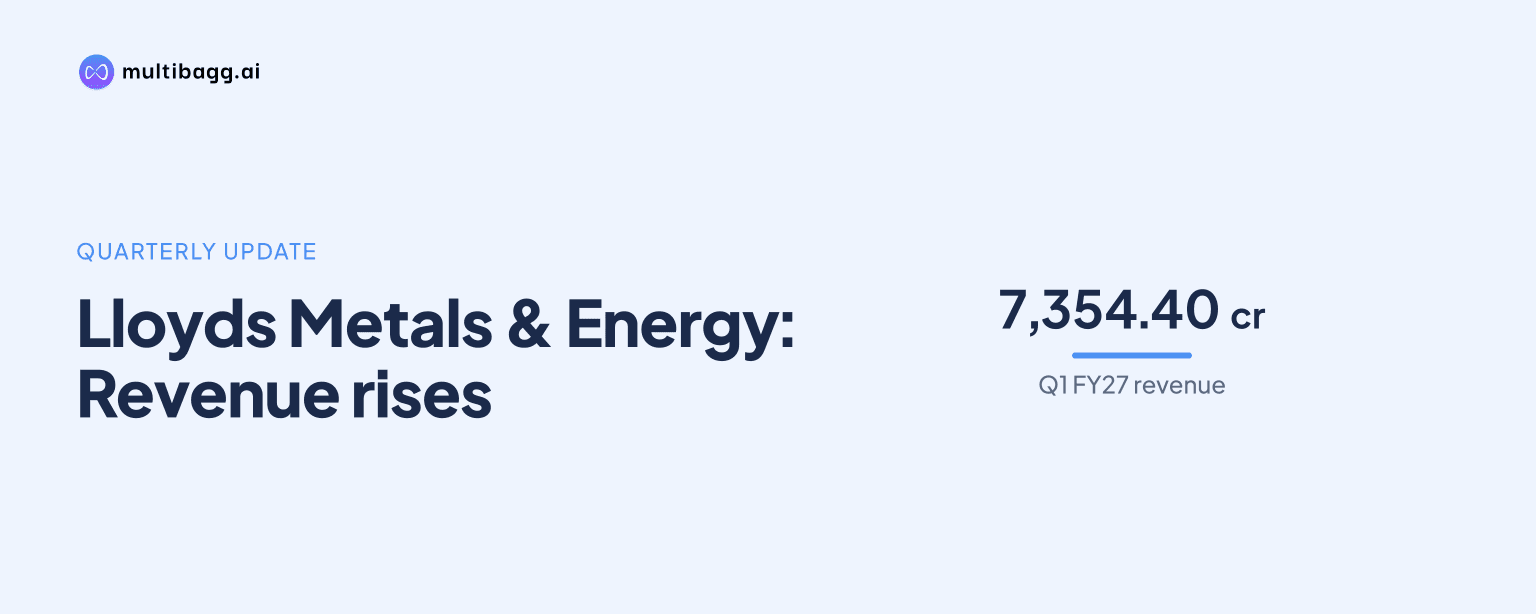
Lloyds Metals & Energy Ltd. has scheduled its Q2 and H1 FY27 investor and analyst conference call for 4 November 2026 at 3:30 PM IST, following Q1 FY27 revenue of ₹7,354.40 crore. The call gives shareholders an opportunity to hear management discuss the unaudited September-quarter and first-half performance, operating developments and outlook.
Know Lloyds Metals & Energy inside out
Results, valuation, peers and who's buying, in one view.
When is Lloyds Metals' Q2 and H1 FY27 conference call?
Lloyds Metals will hold the conference call on 4 November 2026 at 3:30 PM IST. The company disclosed the plan through an intimation under Regulation 30 of the Listing Obligations and Disclosure Requirements regulations on 29 October 2026.
The call is intended for investors and analysts and will cover Q2 FY27 and H1 FY27 performance. Participants are expected to be able to ask management questions after the presentation. The September quarter covers the period from 1 July 2026 to 30 September 2026.
The disclosure is important because it provides a defined forum for the market to assess operating progress and management commentary alongside the results. The material provided does not specify Q2 FY27 revenue, profit or margin figures, so the scheduled discussion is distinct from the previously reported Q1 results.
What financial information will investors examine?
Investors will examine the unaudited Q2 and H1 FY27 results, with particular attention to revenue growth, profitability and the drivers of margins. A report associated with Lloyds Metals' 4 November investor-slide release stated that H1 FY27 consolidated revenue increased 112% year on year and EBITDA rose 151%.
That report attributed margin expansion to higher volumes, product mix and logistics gains. However, it did not provide the underlying absolute H1 revenue or EBITDA figures in the supplied information. Investors will therefore need to rely on the formal results and management commentary for a complete assessment of the half-year performance.
The company has also flagged significant capacity-building activity as part of its FY27 plans. The conference call may clarify the timing of these projects, their operational relevance and how management views the associated execution requirements.
How did Lloyds Metals perform in Q1 FY27?
Lloyds Metals reported strong Q1 FY27 growth, with revenue of ₹7,354.40 crore, up 22.17% quarter on quarter and 208.55% year on year. The June 2026 quarter established a high base for the company ahead of the scheduled discussion of the September quarter and first half.
Operating profit for Q1 FY27 was ₹2,781.46 crore, representing a 9.28% sequential increase and 250.23% year-on-year growth. Profit before tax stood at ₹2,405.38 crore, up 9.98% from the preceding quarter and 209.56% from a year earlier.
Net profit was ₹1,733.89 crore, increasing 13.32% quarter on quarter and 170.25% year on year. These results indicate that profit growth remained substantial during the quarter, although the Q2 call will be relevant for determining whether that momentum continued during July to September.
Got a follow-up? Ask IRIS
What are the capacity and cost issues around the outlook?
Lloyds Metals' FY27 outlook is linked to production growth and major capacity projects, according to the supplied investor-material summary. Capacity additions can support higher volumes, but they also require disciplined execution, spending control and reliable access to essential inputs.
The same summary identified copper feedstock, input-cost movements and debt-settlement risks as factors relevant to the outlook. These issues matter because changes in raw-material availability or cost can affect operating economics, while debt-related matters can influence financial flexibility.
No quantified estimate of the effect of these risks was provided in the available material. Management's remarks during the call will be important for understanding the current position on feedstock, project progress and any actions being taken to manage input or financing-related pressures.
What does the call mean for investors and industry operations?
The call gives investors a direct opportunity to compare the company’s Q2 and H1 trajectory with the robust Q1 FY27 base. For shareholders, the central issues will be whether volume, mix and logistics improvements continued to support profitability and whether expansion plans remain aligned with operational targets.
For the broader metals and mining ecosystem, Lloyds Metals' updates are relevant because feedstock security, logistics efficiency and input costs are recurring determinants of production and margins. The disclosed risks also underline that growth plans in the sector depend on both capacity execution and stable operating conditions.
The company has not provided a Q2 FY27 results date separately in the supplied material, but it has announced the 4 November analyst and investor interaction. Investors should distinguish confirmed disclosures from expectations, particularly where absolute H1 figures, capital-spending details and project milestones have not been provided.
Conclusion
Lloyds Metals has set a 4 November 2026 conference call to discuss Q2 and H1 FY27 results after reporting Q1 FY27 revenue of ₹7,354.40 crore and net profit of ₹1,733.89 crore. The available H1 summary points to 112% revenue growth and 151% EBITDA growth, with volume, mix and logistics cited as margin supports.
The next item to watch is management’s commentary during the scheduled call on capacity projects, copper feedstock, input costs and debt-settlement matters. Formal Q2 and H1 disclosures will provide the figures needed to assess how these factors affected performance during the September quarter.