










Meesho says 6% margin gains will partly fund lower prices
Key highlights
- Meesho reported a 6% contribution margin in Q2 FY27, with logistics as the main driver.
- An analyst cited a 15% delivery-speed improvement, and Meesho said the trend should continue across Q2 and Q3.
- Meesho expects server costs as a percentage of NMV to return to an earlier baseline by Q4 FY27.
- Meesho plans product and category expansion over the next 12 to 18 months through continued reinvestment.
powered by IRIS
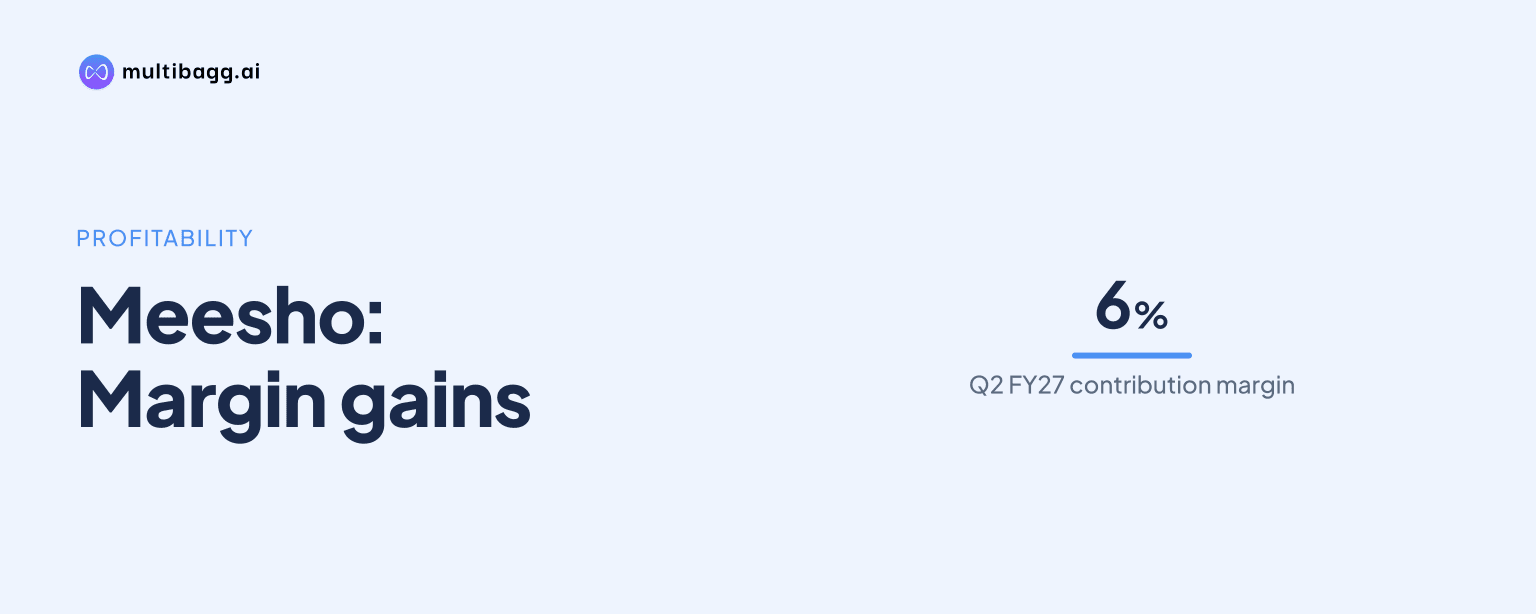
Meesho Limited said its 6% contribution margin in Q2 FY27 was driven mainly by logistics efficiencies and that it expects to reinvest part of such savings in lower prices as elevated server costs normalise. Management said the policy is intended to make additional products, sellers and categories viable over the next 12 to 18 months.
Know Meesho inside out
Results, valuation, peers and who's buying, in one view.
Why did Meesho's contribution margin reach 6% in Q2 FY27?
Meesho said the principal driver of the 6% contribution margin in Q2 FY27 was logistics, rather than a change in advertising monetisation. Chief Financial Officer Dhiresh Bansal identified a lower return-to-origin, or RTO, rate, rising order density, network redesign and continuing efficiencies at Valmo as the main mechanisms reducing the company's cost structure.
The Q2 FY27 change was not attributed to volume-linked pricing slabs from third-party logistics providers, or 3PLs. Bansal said there was no specific slab-linked movement in the quarter and that such benefits usually arise more in the festive Q3 period. That distinction means the reported improvement came from operational changes, including middle-mile utilisation, rather than a carrier-rate concession.
Will Meesho reinvest its logistics savings in lower prices?
Yes. Meesho said it typically has a lead-lag between gaining cost efficiencies and passing them to sellers and consumers through lower pricing. In Q2 FY27, additional server costs, especially for graphics processing units, or GPUs, meant it did not pass the logistics gains on; management said pricing could be reduced to support further growth when that cost situation normalises.
Management did not specify a contribution-margin floor for the second half of FY27 or offer numerical full-year guidance. Instead, Bansal said Meesho expects FY27 contribution margin to be substantially better than FY26 and framed its outer guidance as restoring some logistics-related spread lost in FY26 toward the level seen in FY25, while retaining flexibility over how much efficiency to return through pricing.
The rationale extends beyond a short-term sales response. Chief Executive Officer Vidit Aatrey said a price reduction does not necessarily produce an immediate 10% or 15% growth jump. Management's view is that lower prices can make products and categories that were unviable in the prior month or year workable, attract sellers in those categories, and produce results over two, three or four quarters.
What logistics changes are supporting Meesho's lower costs?
Meesho said faster delivery in Q2 FY27 is a continuing trend and expects the improvement to persist when Q2 and Q3 are considered together. An analyst referred to a 15% improvement in delivery speed, while management cited greater density and capacity, including a route moving from two line-haul shifts to three, as mechanisms that can shorten delivery times.
The redesign has focused primarily on the middle mile, while the last-mile model remains broadly similar, according to management. Higher volumes allow Meesho to use line hauls more efficiently, deploy bigger trucks in some locations, and improve how gateway and sorter nodes are used. These measures lowered cost while improving delivery times, rather than requiring a trade-off between speed and cost.
Meesho also cited GeoIndia LLM, its address-accuracy tool, as a mechanism with both cost and speed effects. Better addresses can reduce the number of delivery attempts while helping parcels reach customers faster. Management said RTO as a percentage of orders improved versus the previous quarter, even though the net merchandise value, or NMV, to gross merchandise value, or GMV, ratio did not appear to change significantly.
Got a follow-up? Ask IRIS
How will Valmo and technology spending affect Meesho's margin plan?
Meesho said Valmo continued to reduce its cost of doing business in Q2 FY27 and had a good festive season for both capacity availability and operating efficiency. Management said the broader logistics ecosystem problems seen in the previous year were largely behind it. Automation across Valmo nodes is expected to increase every quarter, though the company did not provide a percentage automation target.
Server costs are expected to normalise as a percentage of NMV by Q4 FY27, rather than necessarily decline in absolute terms. Bansal described server expense as semi-variable: some costs are fixed and benefit when conversion improves, while more browsing or use of compute-intensive recommendation algorithms can raise usage. That normalisation is a stated condition behind the potential pricing reinvestment.
Aatrey said Meesho does not currently expect automation investment to affect free cash flow because partners in the Valmo network are undertaking much of the capital expenditure. Management said it would communicate if the company itself needed to make a larger share of those investments. The approach is intended to expand the network as platform volumes grow without assuming that most capital spending sits on Meesho's balance sheet.
How does Meesho see demand and category expansion?
Meesho said it had not yet seen a demand concern in its Q2 FY27 user data, citing healthy traffic conversion in utility-oriented categories including personal care, beauty, home, kitchen and baby care. Management contrasted this with supply-side disruption: volatile crude prices over the preceding month had affected sellers' supply chains because petroleum products are inputs across categories.
The planned pricing reinvestment is connected to a stated 12-to-18-month product and category expansion plan. Aatrey said Meesho needs to keep reinvesting in its flywheel to bring more consumers to the platform and make more sellers, products and categories viable. That is management's strategic explanation for not treating the quarterly contribution margin as a run-rate to maximise.
Management also said seller demand for advertising remained robust, but it did not disclose advertising as a percentage of NMV or quantify its quarter-on-quarter movement. Bansal was explicit that logistics was the large part of Q2 FY27 improvement. Meesho expects advertising monetisation as a percentage of NMV to become a benefit in FY28, separating that possible future driver from the logistics-led Q2 result.
Conclusion
The Q2 FY27 call indicates that Meesho's margin expansion was tied to operating mechanisms including higher network density, middle-mile redesign, lower RTO and Valmo efficiencies. Management's approach is to retain flexibility between keeping those gains in the profit and loss account and using lower prices to widen the range of viable sellers, products and categories over several quarters.
The next disclosed checkpoint is Q4 FY27, when management expects server costs as a percentage of NMV to return to the baseline of two quarters earlier. Meesho's progress will also depend on whether delivery-speed improvements continue through Q2 and Q3 and whether FY27 contribution margin becomes substantially better than FY26 while logistics-related spread moves toward the FY25 level.