










Sai Silks (Kalamandir) Ltd Q2 Turnover Falls 2.25% to ₹434 Crore
Key highlights
- Sai Silks reported Q2 FY27 turnover of ₹434 crore, down 2.25% from ₹444 crore in Q2 FY26.
- Sai Silks' H1 FY27 turnover was ₹809 crore, compared with ₹823 crore in H1 FY26.
- Sai Silks opened 4 stores in Q2 FY27, adding 26,324 sq. ft. across Karnataka and Andhra Pradesh.
- Sai Silks extended the ₹20.27 crore warehouse IPO-proceeds utilisation deadline to September 30, 2027.
powered by IRIS
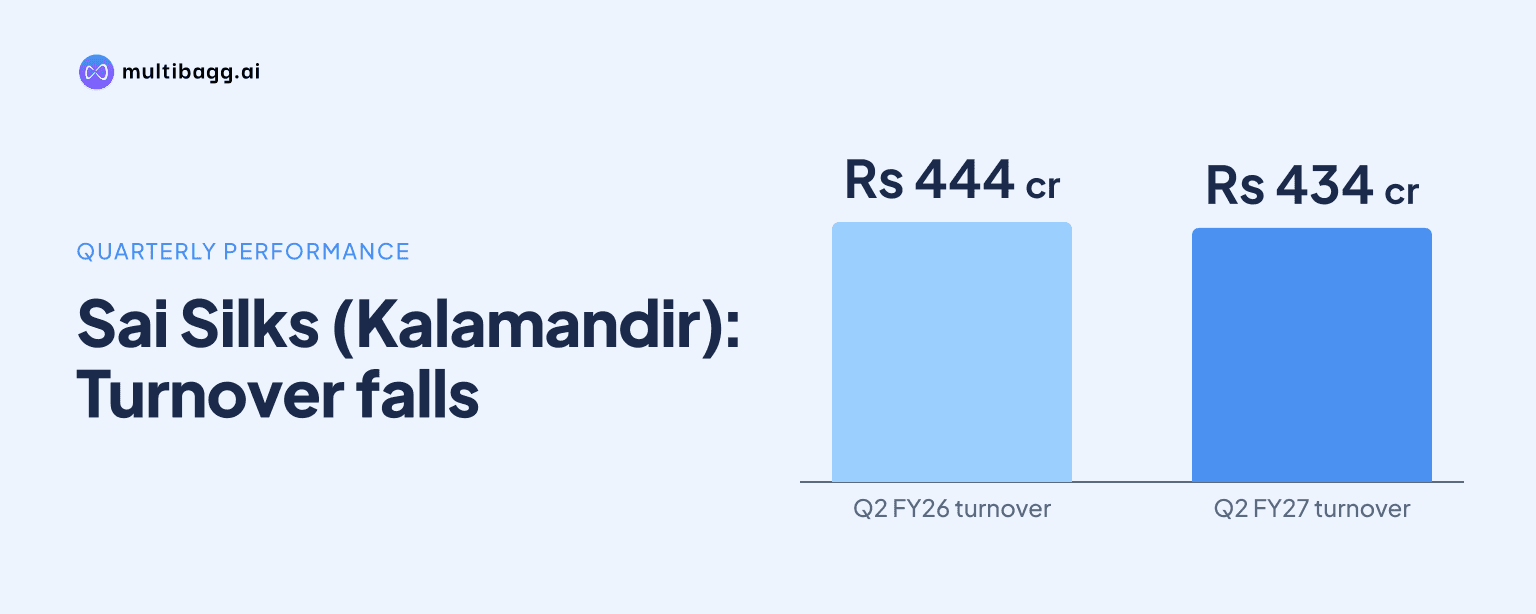
Sai Silks (Kalamandir) Ltd reported Q2 FY27 turnover of ₹434 crore, 2.25% below the ₹444 crore recorded a year earlier, while opening four stores that lifted its retail area to 8.20 lakh sq. ft. as of September 30, 2026.
Know Sai Silks (Kalamandir) inside out
Results, valuation, peers and who's buying, in one view.
What did Sai Silks report for Q2 FY27?
Sai Silks reported turnover of ₹434 crore for the quarter ended September 30, 2026, compared with ₹444 crore in Q2 FY26. The decline was modest in absolute terms but followed a softer start to the financial year, with turnover for the first half at ₹809 crore against ₹823 crore a year earlier.
The company also disclosed unaudited financial results for the quarter and half-year after approval by its Board of Directors. Reported Q2 revenue was ₹434.05 crore and net profit was ₹31.08 crore, with both figures lower year-on-year. The company’s statutory auditors issued their limited review report, which was considered by the board along with the half-year statement of assets and liabilities and cash-flow statement.
The Q2 update follows a weaker Q1 FY27. For the April-June 2026 quarter, Sai Silks had reported revenue of ₹375 crore, down 1.1% from ₹379 crore, while net profit declined 13.3% to ₹26 crore from ₹30 crore. Q1 earnings per share were ₹1.67.
How did Sai Silks expand its store network during the quarter?
Sai Silks opened four new-format stores in Q2 FY27, with two each in Karnataka and Andhra Pradesh. The additions contributed 26,324 sq. ft. of retail space and increased the company’s total retail footprint to about 8.20 lakh sq. ft. at the end of September.
The company said its first-half additions amounted to roughly 56,000 sq. ft. The Q2 expansion therefore accounted for a substantial share of the additional space added during the April-September period. The update identifies store additions and retail area, but does not provide individual store-level sales, investment or profitability figures.
This physical expansion came despite lower turnover in both the quarter and the first half. Retailers can add capacity ahead of periods expected to have stronger customer demand, but the reported data does not establish the trading performance of the new stores. It does, however, show that Sai Silks continued to build its presence in the two southern states during the period.
Got a follow-up? Ask IRIS
What is the status of Sai Silks' warehouse funding plan?
Sai Silks extended the deadline for using ₹20.27 crore of unutilised IPO proceeds earmarked for warehouse development to September 30, 2027. The board considered the matter while approving the September-quarter and half-year financial results.
The amount had originally been set aside for setting up warehouses. The company extended the timeline for use of the funds for the same stated purpose, rather than reporting a completed warehouse deployment during the period. The disclosure provides a specific revised deadline but does not state the number, location or planned capacity of the warehouses.
Warehouse infrastructure is relevant for an apparel and textile retailer with a growing store footprint because inventory must move across stores and regions. Still, the company has not quantified the financial benefit, operating-cost effect or implementation schedule associated with the planned warehouse spending.
Why do the turnover trend and expansion matter to investors?
The reported numbers show that Sai Silks entered the second half of FY27 with first-half turnover below the prior-year level, even as it continued to add selling space. Q2 turnover was ₹10 crore lower than the year-earlier quarter, while H1 turnover was ₹14 crore lower than the comparable prior-year period.
Profit performance also warrants attention. In Q1, profit declined faster than revenue, with net profit falling 13.3% against a 1.1% revenue decline. For Q2, the company reported net profit of ₹31.08 crore and stated that it was lower year-on-year. This makes revenue growth, margins and store productivity important metrics for assessing how the expanding network translates into financial performance.
Management had stated after Q1 that it was guiding for FY27 consolidated revenue growth of 12% to 15%, supported by 5% to 10% more wedding dates across Q2 to Q4 than in the prior year. This is management guidance, not a reported result. The first-half turnover data provides the starting point against which investors can assess progress during the remaining quarters.
Conclusion
Sai Silks recorded a 2.25% year-on-year decline in Q2 FY27 turnover to ₹434 crore and a roughly 1.70% decline in first-half turnover to ₹809 crore. At the same time, it added four stores and 26,324 sq. ft. in Q2, taking total retail space to 8.20 lakh sq. ft. The results place the company’s network expansion alongside a period of lower reported revenue and profit.
The next developments to watch are the company’s revenue trajectory through Q3 and Q4 against its stated 12% to 15% FY27 consolidated revenue-growth guidance, along with reported margins and the productivity of the added retail area. Investors can also track progress on the ₹20.27 crore warehouse allocation, whose utilisation deadline now runs through September 30, 2027.