










Sanghvi Movers Limited Q2 revenue rises 32% to ₹277 crore
Key highlights
- SML’s Q2 FY27 consolidated revenue from operations rose 32% year on year to ₹277 crore.
- SML’s Q2 FY27 EBITDA increased 20% to ₹106 crore, while EBITDA margin declined to 36% from 41%.
- SML’s secured order book rose 26% to ₹1,582 crore as of October 23, 2026, from ₹1,253 crore on July 24, 2026.
- SML’s H1 FY27 consolidated PAT increased 22% year on year to ₹106 crore.
powered by IRIS
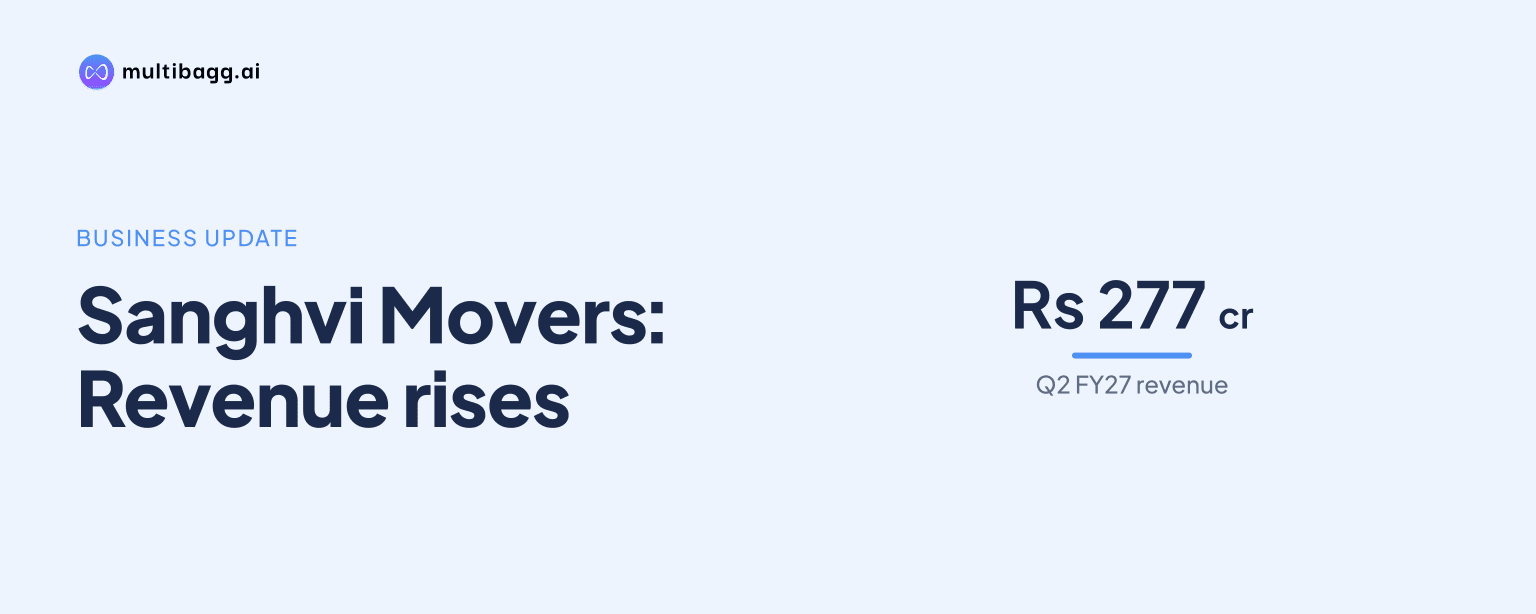
Sanghvi Movers Limited reported consolidated revenue from operations of ₹277 crore in Q2 FY27, up 32% from ₹210 crore a year earlier, while its secured order book rose 26% to ₹1,582 crore as of October 23, 2026. EBITDA and profit after tax increased, although both margins were below Q2 FY26 levels.
Know Sanghvi Movers inside out
Results, valuation, peers and who's buying, in one view.
How did SML perform in Q2 FY27?
SML recorded consolidated revenue from operations of ₹277 crore in Q2 FY27, compared with ₹210 crore in Q2 FY26, an increase of 32% for the quarter ended September 30, 2026. Earnings before interest, tax, depreciation and amortisation, or EBITDA, rose 20% to ₹106 crore from ₹88 crore, while profit after tax, or PAT, increased 11% to ₹40 crore from ₹36 crore.
Revenue grew faster than the two profit measures during Q2 FY27. EBITDA margin declined by 5 percentage points to 36% from 41% in Q2 FY26, while PAT margin fell by 3 percentage points to 14% from 17%, based on the consolidated results released on November 2, 2026.
The Q2 FY27 results show a ₹67 crore increase in revenue, against increases of ₹18 crore in EBITDA and ₹4 crore in PAT. SML did not provide revenue or profitability by customer, project, geography or service line in its release, so the disclosed comparison is confined to group-level consolidated figures.
What were SML’s H1 FY27 results?
SML reported consolidated revenue from operations of ₹657 crore in H1 FY27, up 36% from ₹483 crore in H1 FY26 for the six months ended September 30, 2026. H1 EBITDA increased 25% to ₹245 crore from ₹195 crore, and PAT rose 22% to ₹106 crore from ₹87 crore.
First-half margins also declined from the prior-year period despite higher absolute earnings. EBITDA margin was 36% in H1 FY27, compared with 39% in H1 FY26, while PAT margin was 15%, compared with 17% a year earlier.
The H1 FY27 revenue growth rate of 36% was 4 percentage points higher than the 32% reported for Q2 FY27, while H1 PAT growth of 22% exceeded the quarter’s 11% increase. The release did not disclose Q1 FY27 standalone financial figures or a quarter-on-quarter comparison, limiting any assessment of the contribution from the April-June period.
Why did SML’s order book reach ₹1,582 crore?
SML’s secured order book rose to ₹1,582 crore on October 23, 2026, from ₹1,253 crore on July 24, 2026, an increase of ₹329 crore, or 26%, over 13 weeks. The company attributed the expansion to contributions from SML and Sangreen Future Renewable Private Limited, which it referred to as SFRPL.
Managing Director Rishi Sanghvi said the order book was driven by healthy demand across all verticals and gave management confidence in achieving annual targets. The announcement did not disclose the annual target value, the share of orders expected to be executed in FY27, or a delivery schedule for the ₹1,582 crore secured order book.
SML said Sangreen Future Renewable Private Limited and Sangreen Logistics Private Limited are integral to the group’s renewable-energy operations. It also identified renewable wind energy, infrastructure, power, steel, cement, petrochemicals and construction among its served sectors, but did not provide an order-book split by sector, subsidiary or geography as of October 23, 2026.
The ₹329 crore order-book addition over 13 weeks was larger than the ₹67 crore year-on-year rise in Q2 FY27 revenue. That comparison does not establish a revenue conversion rate because the release did not state contract durations, cancellation terms, execution milestones or the timing of individual orders.
Got a follow-up? Ask IRIS
What could affect SML’s FY27 execution plans?
SML said geopolitical, shipping-related and supply-chain disruptions in the Middle East may delay planned capital expenditure and crane deployment in the Kingdom of Saudi Arabia, or KSA. The company said phased procurement and prioritisation of contracted orders are intended to mitigate the effect of delayed supply.
Mr. Sanghvi said utilisation levels remained above annual targets, but SML did not disclose either the utilisation percentage or its annual target. He described the KSA impact as timing-related rather than structural, citing phased procurement linked to order inflows, positive Q2 FY27 EBITDA of ₹106 crore and a project pipeline as mitigation factors.
SML is evaluating opportunities in key African markets as potential new growth markets, with no investment amount, entry date or expected revenue contribution disclosed in the November 2, 2026 release. The company said it operates more than 500 cranes, including KSA, with lifting capacities from 20 metric tonnes to 1,600 metric tonnes, and has operations in India, Saudi Arabia and Botswana.
The company also disclosed Salesforce for customer relationship management, HRMS for workforce management and NEXXS AI for internal artificial-intelligence-powered automation. SML did not state the cost, implementation schedule or expected financial impact of these systems, which were listed alongside its Africa evaluation and KSA procurement measures.
Conclusion
SML delivered higher consolidated revenue, EBITDA and PAT in Q2 FY27 and H1 FY27, with Q2 revenue rising 32% to ₹277 crore and H1 revenue increasing 36% to ₹657 crore. However, EBITDA and PAT growth lagged revenue in both periods, resulting in Q2 EBITDA and PAT margins of 36% and 14%, respectively, below the prior-year levels.
Investors will next watch the execution of the ₹1,582 crore secured order book, which management said supports confidence in annual targets, alongside the timing of KSA crane deployment amid shipping and supply-chain disruption. SML’s stated plans also include phased procurement, evaluation of African market opportunities and the ELEVATE 2030 growth plan, although the release gave no financial targets or timetable for these initiatives.