










Thomas Cook (India) Ltd Q2 PBT holds at ₹84.8 crore
Key highlights
- Thomas Cook (India) Ltd reported Q2 FY27 headline PBT of ₹84.8 crore.
- Total income declined 6% year-on-year to ₹1,944.2 crore in Q2 FY27.
- Financial Services revenue from operations grew 21% year-on-year in Q2 FY27.
- Cash and short-term investments stood at ₹2,843.0 crore on September 30, 2026.
powered by IRIS
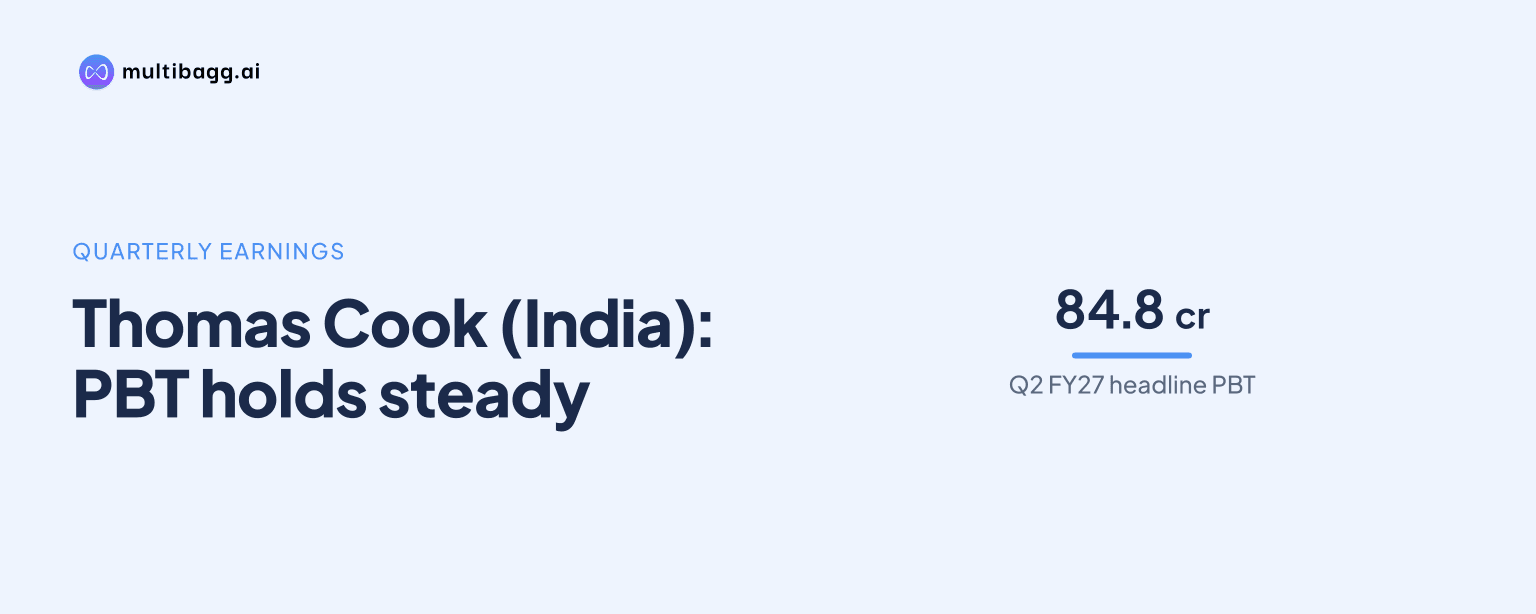
Thomas Cook (India) Ltd reported Q2 FY27 profit before tax of ₹84.8 crore despite global headwinds, while total income declined 6% year-on-year to ₹1,944.2 crore for the quarter ended September 30, 2026. The result reflects stronger financial-services earnings and a recovery in India travel operations despite disruption linked to the West Asia conflict.
Know Thomas Cook (India) inside out
Results, valuation, peers and who's buying, in one view.
What did Thomas Cook (India) Ltd report for Q2 FY27?
Thomas Cook (India) Ltd reported Q2 FY27 PBT of ₹84.8 crore in its November 2 earnings release, compared with ₹84.5 crore in Q2 FY26, according to the company’s stated comparison. The company said disciplined execution and a focus on margins helped it manage a shortfall in travel business activity.
The company’s earnings presentation reported total income of ₹1,944.2 crore, down 6% year-on-year, and PBT of ₹84.8 crore, down 14% year-on-year. The differing year-on-year comparisons in the supplied disclosures indicate that the company’s headline release and presentation use different profit measures or comparatives. Investors should therefore distinguish the reported PBT headline from the presentation’s comparison when assessing quarterly performance.
Separate consolidated financial-result figures placed PBT at ₹84.0 crore and net profit at ₹53.7 crore for the September quarter. For the first half of FY27, consolidated PBT was ₹172.5 crore and consolidated net profit was ₹117.4 crore.
Which businesses supported Thomas Cook (India) Ltd's earnings?
The Financial Services segment was the principal growth contributor, with revenue from operations rising 21% year-on-year in Q2 FY27 and 14% in the first half. On a standalone basis, Financial Services revenue rose 17.4% to ₹86.8 crore, while segment profit before tax and interest increased to ₹37.5 crore from ₹37.2 crore a year earlier.
The India Travel Businesses staged a recovery during the quarter, ending about 6% below the previous year, according to the company. These businesses recorded EBIT margins of 3.8%, with domestic and short-haul travel identified as important contributors. India Destination Management Services grew 16% in what the company described as a seasonally softer quarter.
Travel and Related Services remained under pressure in the standalone segment data. Revenue declined 10.1% year-on-year to ₹458.8 crore and segment profit before tax and interest fell to ₹20.6 crore from ₹24.5 crore. The company linked the travel-business pressure to continuing global headwinds and the impact of the West Asia conflict.
How did standalone performance compare with the prior year?
Standalone revenue from operations was ₹548.1 crore in Q2 FY27, down 6.6% year-on-year from ₹586.8 crore. Other income increased to ₹59.4 crore from ₹42.4 crore, taking standalone total income to ₹607.5 crore.
Standalone profit before exceptional items and tax rose 27.1% to ₹61.1 crore from ₹48.1 crore. However, reported PBT after exceptional items was ₹60.3 crore, compared with ₹73.7 crore in Q2 FY26, because the prior-year quarter included an exceptional gain of ₹25.7 crore from the sale of immovable property. Q2 FY27 included exceptional expenses of ₹0.8 crore.
Standalone net profit was ₹45.1 crore, compared with ₹47.0 crore a year earlier. For the first half, standalone revenue from operations declined 2% to ₹1,375.7 crore, while net profit increased 1.3% to ₹103.8 crore. These figures show that comparisons with the previous year are affected by the prior-year one-time property-sale gain.
Got a follow-up? Ask IRIS
What does the quarter mean for investors and travel demand?
The quarter highlights the role of Financial Services in supporting earnings when travel demand is affected by external disruptions. Its revenue growth contrasted with the lower Travel and Related Services revenue, while the recovery in domestic and short-haul travel helped limit the decline in India Travel Businesses.
Thomas Cook (India) Ltd maintained cash and short-term investments of ₹2,843.0 crore as of September 30, 2026. Separately, standalone cash and cash equivalents stood at ₹542.3 crore, compared with ₹532.8 crore at the end of FY26. The different figures refer to different reported bases and should not be treated as interchangeable.
For customers and travel-industry participants, elevated airfares and other input costs remain relevant constraints. The company nevertheless said forward bookings for Q3 FY27 were trending 30% above the prior year, indicating improved booking momentum for the current quarter.
Why are exceptional items important in Thomas Cook (India) Ltd's comparison?
Exceptional items are important because they changed the appearance of year-on-year profit movement. Q2 FY26 included a ₹25.7 crore gain from the sale of immovable property, while Q2 FY27 recorded ₹0.8 crore of exceptional expenses. As a result, standalone net profit and reported PBT were lower year-on-year even as profit before exceptional items and tax rose.
The company’s reported basic earnings per share before exceptional items increased to ₹0.98 from ₹0.65. Earnings per share after exceptional items was ₹0.97, compared with ₹1.01 in Q2 FY26. This distinction provides context for the difference between underlying operating profit and profit after one-time items.
Conclusion
Thomas Cook (India) Ltd’s Q2 FY27 performance combined lower income with a resilient profit outcome, supported by Financial Services growth, margin discipline and a partial recovery in India travel. The quarter also showed that reported year-on-year profit comparisons require adjustment for the prior-year property-sale gain and differing disclosed profit measures.
The key disclosed indicator for the next quarter is the company’s 30% year-on-year growth in forward bookings for Q3 FY27. Investors will also watch whether domestic and short-haul travel momentum continues, whether travel-business margins remain stable, and how global conditions and airfares affect demand.