










Wockhardt Limited first-half cash flow reaches ₹237 crore
Key highlights
- Wockhardt generated ₹237 crore of operating cash inflow in the six months ended September 30, 2026, versus ₹189 crore a year earlier.
- Wockhardt spent ₹155 crore on intangible assets and additions under development, compared with ₹127 crore in the prior-year half.
- Wockhardt's net investing cash outflow was ₹2 crore, versus ₹417 crore in the six months ended September 30, 2025.
- Wockhardt ended September 30, 2026 with ₹330 crore in cash and cash equivalents, up from ₹217 crore at March 31, 2026.
powered by IRIS
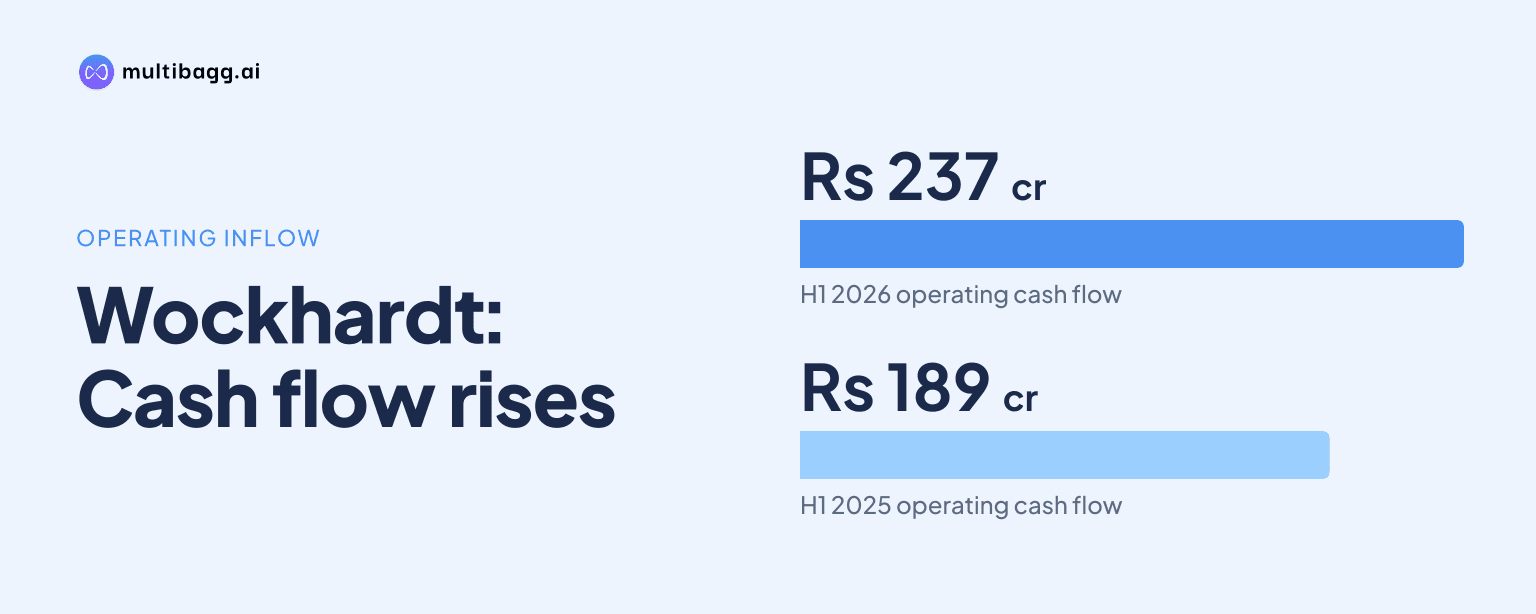
Wockhardt Limited generated ₹237 crore of net operating cash inflow in the six months ended September 30, 2026, compared with ₹189 crore a year earlier, while spending ₹155 crore on intangible assets and additions under development. Wockhardt ended September with ₹330 crore of cash and cash equivalents.
Know Wockhardt inside out
Results, valuation, peers and who's buying, in one view.
How did Wockhardt's operating cash flow change?
Wockhardt's net cash inflow from operating activities rose to ₹237 crore in the six months ended September 30, 2026, from ₹189 crore in the six months ended September 30, 2025. The increase followed cash generated from operations of ₹248 crore, compared with ₹201 crore in the prior-year period, after net income-tax payments of ₹11 crore.
Operating profit before working-capital changes increased to ₹370 crore from ₹281 crore. Profit before exceptional items and tax was ₹189 crore, compared with a loss of ₹18 crore a year earlier; depreciation and amortisation were ₹110 crore against ₹109 crore, while finance costs were ₹108 crore against ₹103 crore.
Working-capital movements were mixed in the 2026 half-year. Inventory absorbed ₹78 crore of cash, less than the ₹109 crore absorbed in the prior-year period, while trade receivables used ₹37 crore after releasing ₹52 crore a year earlier. Loans, advances and other assets used ₹36 crore, versus a ₹45 crore release in 2025, and liabilities and provisions contributed ₹29 crore after a ₹68 crore outflow.
What did Wockhardt invest in intangible assets?
Wockhardt spent ₹155 crore on purchases of intangible assets and additions to intangible assets under development in the six months ended September 30, 2026, compared with ₹127 crore in the corresponding 2025 period. The outlay exceeded the ₹53 crore spent on property, plant and equipment and capital work-in-progress during the same six months.
The balance sheet records other intangible assets of ₹271 crore at September 30, 2026, up from ₹145 crore at March 31, 2026. Intangible assets under development were ₹1,743 crore, compared with ₹1,708 crore at the preceding financial year-end. These balance-sheet movements provide context for the ₹155 crore cash expenditure, although the filing does not identify individual projects or products within the intangible investment.
Wockhardt's investing activities as a whole used ₹2 crore of net cash, compared with ₹417 crore used in the previous first half. The result was affected by ₹307 crore of net proceeds from sales or purchases of investments, compared with a ₹260 crore net purchase in 2025, and ₹85 crore of proceeds from property, plant and equipment sales, against ₹14 crore a year earlier.
Why was Wockhardt's investing cash outflow limited?
Wockhardt's net investing outflow was limited to ₹2 crore because investment-sale and asset-sale proceeds offset investment spending and restricted bank balances. The group received ₹307 crore from net sales of investments, ₹85 crore from fixed-asset sales and ₹22 crore as final settlement proceeds of a holdback amount under a business transfer agreement.
Against those inflows, Wockhardt spent ₹155 crore on intangible assets, ₹53 crore on property, plant and equipment and capital work-in-progress, and ₹184 crore on margin money under lien and bank balances other than cash and cash equivalents. The ₹184 crore movement contrasts with a ₹24 crore inflow from that line in the six months ended September 30, 2025, showing that the near-neutral total investing cash flow reflected several offsetting movements.
The filing also reports ₹6 crore of interest received in the 2026 first half, versus ₹2 crore in the prior-year period. It does not set out a forward spending target for intangible assets, capital work-in-progress or other investing categories, so the disclosed figures show cash deployed through September 30 rather than a management forecast for the remainder of the financial year.
Got a follow-up? Ask IRIS
How did Wockhardt finance its first-half cash position?
Wockhardt used ₹123 crore of net cash in financing activities during the six months ended September 30, 2026, compared with a ₹297 crore inflow in the same period of 2025. Long-term borrowing proceeds were ₹109 crore and repayments were ₹101 crore, while short-term borrowings added ₹85 crore on a net basis.
The financing outflow also included ₹156 crore of repayments of long-term loans from related parties, ₹38 crore of lease-liability repayments and ₹102 crore of finance costs paid. The lease repayment comprised ₹4 crore of interest and ₹34 crore of principal, compared with ₹6 crore and ₹29 crore respectively in the prior-year half.
Cash and cash equivalents increased by ₹112 crore during the period, compared with a ₹69 crore increase in the 2025 half-year. Wockhardt began the 2026 period with ₹217 crore and ended it with ₹330 crore, all held in bank current accounts according to the cash-flow reconciliation. The statement was prepared using the indirect method under Indian Accounting Standard 7, or Ind AS 7, Statement of Cash Flows.
What balance-sheet movements accompany the cash flow?
Wockhardt reported cash and cash equivalents of ₹330 crore at September 30, 2026, compared with ₹217 crore at March 31, 2026. Inventories increased to ₹973 crore from ₹887 crore, aligning with the ₹78 crore operating cash outflow recorded for inventory during the six-month period.
Trade receivables rose to ₹632 crore at September 30 from ₹588 crore at March 31, while current borrowings increased to ₹719 crore from ₹607 crore. Non-current borrowings declined to ₹1,431 crore from ₹1,518 crore. These closing balances sit alongside the period's positive operating inflow, near-neutral investing outflow and negative financing cash flow.
Wockhardt's other intangible assets rose by ₹126 crore between March 31 and September 30, while intangible assets under development rose by ₹35 crore. Cash spending of ₹155 crore on those categories cannot be directly reconciled to the balance-sheet changes from the filing alone, because the statement also records amortisation of ₹110 crore across the group and does not provide a category-level reconciliation.
Conclusion
Wockhardt's first-half cash generation improved as operating cash inflow rose by ₹48 crore to ₹237 crore, supported by an ₹89 crore increase in operating profit before working-capital changes. The group simultaneously spent ₹155 crore on intangible assets and additions under development, while investment sales and fixed-asset-sale proceeds held total investing cash use to ₹2 crore.
The filing does not provide a target or timetable for further intangible investment beyond the ₹155 crore deployed through September 30, 2026. The key unresolved matters for subsequent disclosures are whether spending on intangible assets continues, how the ₹184 crore movement in margin money and other bank balances changes, and whether financing remains a cash outflow after the ₹123 crore first-half use.