Actions
Action Type



Welcome to Multibagg AI
Log in to access personalized features


Portfolio

Alerts

Ask Iris

Discovery

Timeline
Multibagg AI is an AI powered stock research and analysis platform. We provide data, information, content, and analytics for publicly traded Indian companies listed on NSE and BSE. AI can make mistakes, check important information.
Prices might be delayed by a few minutes.
Join our Exclusive Community


Join our Exclusive Community
Made with 💙 in India. © Finsky Technologies Pvt Ltd. 2026


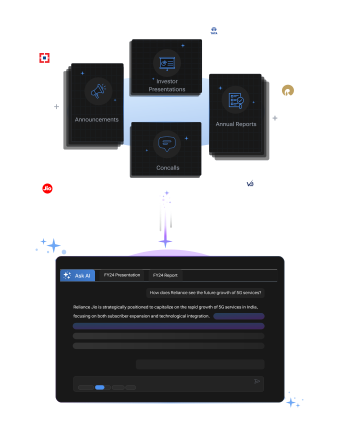
Get instant AI-powered insights about company performance, financials, and strategy. Ask questions about trends, competition, and developments while receiving responses backed by official documents and market data, with clear attribution to source documents.




 Discovery themes featuring this stock
Bearish
3
Neutral
6
Bullish
5
Bearish
29
Neutral
6
Bullish
11
Bearish
26
Neutral
0
Bullish
6
Bearish
3
Neutral
6
Bullish
5
Bearish
3
Neutral
6
Bullish
5
Bearish
26
Neutral
0
Bullish
6
Bearish
26
Neutral
0
Bullish
6
Bearish
26
Neutral
0
Bullish
6
View Standalone
View Standalone
View Standalone
View Standalone
View Standalone
View Standalone
View Standalone
View Standalone



Investor Presentation
Q4 FY26
Investor Presentation
Q2 FY26
Investor Presentation
Q1 FY26
Investor Presentation
Q4 FY25
Investor Presentation
Q3 FY25
Investor Presentation
Q2 FY25


 Discovery themes featuring this stock

Australian Premium Solar (India) Ltd. focuses on manufacturing monocrystalline and Topcon solar modules, catering primarily to the residential, commercial, and agricultural sectors.
The company is handling a significant increase in demand, evidenced by an 84.5% rise in total income year-over-year, indicating robust market growth and effective business strategy.
Their aggressive expansion into solar cell manufacturing, with a planned 4 GW facility, marks a strategic leap aimed at achieving vertical integration and enhancing competitive edge.
APS shows strong financial health with a low net debt-equity ratio, enabling flexible capital management amidst significant expansion plans without over-leveraging.
The company's strategic geographic and product line expansions, including a push into the solar pump segment, are expected to fuel a projected CAGR of 75%, signaling strong growth outlook.
Consumable Fuels
Coal
465 Cr
High Risk
9.6
8.4
0.1
2.8
543.95
225.10
Sales CAGR
Profit CAGR
ROE
ROCE

Australian Premium Solar (India) Ltd (APS) is currently trading at 233.35 per share. Stock prices fluctuate during market hours on NSE and BSE based on demand, company updates, and overall market conditions. Refer to the live price chart above for the most recent price movement.
Australian Premium Solar (India) Ltd. focuses on manufacturing monocrystalline and Topcon solar modules, catering primarily to the residential, commercial, and agricultural sectors. The company is handling a significant increase in demand, evidenced by an 84.5% rise in total income year-over-year, indicating robust market growth and effective business strategy. Their aggressive expansion into solar cell manufacturing, with a planned 4 GW facility, marks a strategic leap aimed at achieving vertical integration and enhancing competitive edge. APS shows strong financial health with a low net debt-equity ratio, enabling flexible capital management amidst significant expansion plans without over-leveraging. The company's strategic geographic and product line expansions, including a push into the solar pump segment, are expected to fuel a projected CAGR of 75%, signaling strong growth outlook.
Over the past 52 weeks, Australian Premium Solar (India) Ltd has traded between a low of ₹225.10 and a high of ₹543.95. The 52-week high and low indicate the stock’s price range over the last year and help investors understand its volatility and recent trading levels.
Australian Premium Solar (India) Ltd has a market capitalization of approximately 464.69. Market capitalization represents the total value of a company’s outstanding shares and helps investors understand its size, stability, and relative risk compared to other listed companies.
Australian Premium Solar (India) Ltd’s investment profile depends on its business fundamentals, valuation, and long-term outlook. The stock currently trades at a PE ratio of 9.63 and operates in the its sector sector. Investors typically assess financial performance, growth prospects, and individual risk tolerance before making investment decisions.
Based on its market capitalization of 464.69 Cr, Australian Premium Solar (India) Ltd is classified as a Small Cap stock. Large-cap stocks are generally more stable, while mid-cap and small-cap stocks tend to offer higher growth potential along with higher price volatility.
Australian Premium Solar (India) Ltd operates in the its sector sector. Sector classification matters because companies in the same sector are often affected by similar economic conditions, regulatory changes, and competitive dynamics, which can influence overall stock performance.
The Price-to-Earnings (PE) ratio of Australian Premium Solar (India) Ltd is 9.63. The PE ratio compares a company’s share price to its earnings and is commonly used to assess valuation. Comparing the PE ratio with sector peers and historical levels provides better context.


| Symbol | Watchlist | Price | Market Cap | P/E | P/B | Div Yield (%) | ROE (%) | ROCE (%) | ROA (%) |
701.60 | 750 Cr | 9.17 | 2.97 | 0.00 | 37.95 | 27.38 | 6.92 | ||
230.50 | 465 Cr | 9.63 | 2.83 | 0.04 | 35.24 | 41.28 | 14.94 | ||
31.28 | 348 Cr | 16.48 | 2.15 | 1.48 | 10.39 | 14.32 | 7.51 | ||
91.60 | 201 Cr | 6.81 | 1.46 | 0.00 | 21.41 | 16.53 | 6.33 | ||
350.00 | 183 Cr | 17.41 | 4.50 | 0.00 | 25.82 | 28.09 | 15.83 | ||
| Median: 5 Co. | — | 230.50 | 348 Cr | 9.63 | 2.83 | 0.00 | 25.82 | 27.38 | 7.51 |