Actions
Action Type



Welcome to Multibagg AI
Log in to access personalized features


Portfolio

Alerts

Ask Iris

Discovery

Timeline
Multibagg AI is an AI powered stock research and analysis platform. We provide data, information, content, and analytics for publicly traded Indian companies listed on NSE and BSE. AI can make mistakes, check important information.
Prices might be delayed by a few minutes.
Join our Exclusive Community


Join our Exclusive Community
Made with 💙 in India. © Finsky Technologies Pvt Ltd. 2026


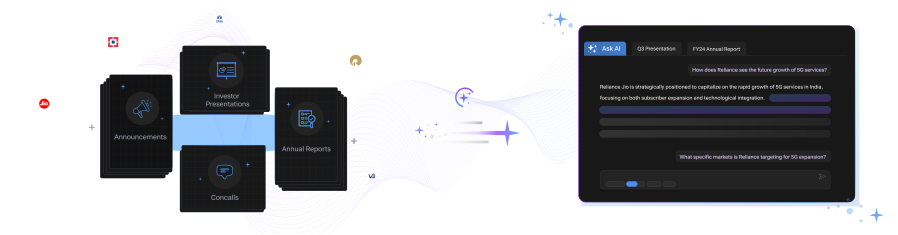
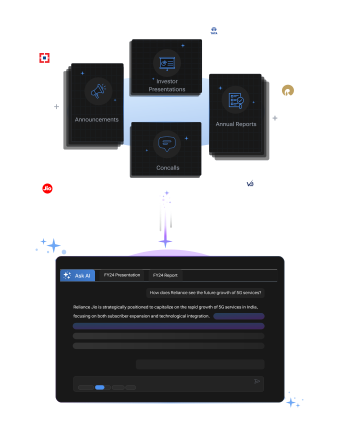
Get instant AI-powered insights about company performance, financials, and strategy. Ask questions about trends, competition, and developments while receiving responses backed by official documents and market data, with clear attribution to source documents.



 Discovery themes featuring this stock


Investor Presentation
Q1 FY27
Investor Presentation
Q4 FY26
Investor Presentation
Q3 FY26
Investor Presentation
Q2 FY26
Investor Presentation
Q3 FY25
| Symbol | Watchlist | Price | Market Cap | P/E | P/B | Div Yield (%) | ROE (%) | ROCE (%) | ROA (%) |
41.05 | 59 Cr | 5.78 | 0.55 | 2.44 | 9.69 | 11.36 | 3.44 | ||
126.40 | 57 Cr | -87.11 | 5.52 | 0.00 | -6.06 | -7.72 | -6.58 | ||
165.55 | 57 Cr | 7.16 | 0.69 | 0.91 | 9.29 | 11.20 | 6.13 | ||
2.42 | 54 Cr | 46.41 | 0.81 | 0.00 | 1.10 | 3.47 | 1.26 | ||
2.03 | 52 Cr | 43.31 | 1.95 | 0.00 | 2.81 | 2.84 | 4.49 | ||
10.57 | 51 Cr | 19055.56 | 3.19 | 0.00 | 13.75 | 16.35 | 17.25 | ||
4.32 | 51 Cr | -0.49 | 1.01 | 0.00 | -220.88 | -20.03 | -26.84 | ||
| Median: 7 Co. | — | 10.57 | 54 Cr | 7.16 | 1.01 | 0.00 | 2.81 | 3.47 | 3.44 |




DhanSafal Finserve Limited is a listed RBI-registered NBFC focused on retail financial services, primarily serving MSMEs and individual clients with loan products such as Loan Against Property, MSME loans, and short-term business finance, operating across Maharashtra, Rajasthan, Uttar Pradesh and Madhya Pradesh after a May 2025 rebranding and strategic pivot to focused lending.
The company delivered striking operating growth in Q3 FY25-26: revenue increased 185% from ₹301.66 lakh to ₹859.09 lakh year-on-year, reflecting stronger origination and interest income as lending volumes scaled rapidly during the period.
Balance-sheet scale materially improved: AUM rose 141% to ₹8,045.91 lakh and the loan book expanded 116% to ₹7,187.00 lakh year-on-year, while net worth strengthened 43%, indicating both growth and capital accretion supporting further lending activity.
Operational momentum is evident — disbursements more than doubled from ~280 to 670+ cases and branches now cover nine live locations with plans for additional outlets, complemented by management-driven initiatives like LOS/LMS automation, smaller-ticket products, and brand-building to broaden customer acquisition.
Management emphasizes a prudent capital and debt strategy to fund growth, combining own funds and borrowings, while targeting process automation and product diversification to scale originations and improve margins and operational efficiency across its retail lending franchise.
Finance
Non Banking Financial Company (NBFC)
54 Cr
Moderate Risk
46.4
18.0
-0.0
0.8
4.65
1.91
Sales CAGR
Profit CAGR
ROE
ROCE

Dhansafal Finserve Ltd (LUHARUKA) is currently trading at 2.39 per share. Stock prices fluctuate during market hours on NSE and BSE based on demand, company updates, and overall market conditions. Refer to the live price chart above for the most recent price movement.
DhanSafal Finserve Limited is a listed RBI-registered NBFC focused on retail financial services, primarily serving MSMEs and individual clients with loan products such as Loan Against Property, MSME loans, and short-term business finance, operating across Maharashtra, Rajasthan, Uttar Pradesh and Madhya Pradesh after a May 2025 rebranding and strategic pivot to focused lending. The company delivered striking operating growth in Q3 FY25-26: revenue increased 185% from ₹301.66 lakh to ₹859.09 lakh year-on-year, reflecting stronger origination and interest income as lending volumes scaled rapidly during the period. Balance-sheet scale materially improved: AUM rose 141% to ₹8,045.91 lakh and the loan book expanded 116% to ₹7,187.00 lakh year-on-year, while net worth strengthened 43%, indicating both growth and capital accretion supporting further lending activity. Operational momentum is evident — disbursements more than doubled from ~280 to 670+ cases and branches now cover nine live locations with plans for additional outlets, complemented by management-driven initiatives like LOS/LMS automation, smaller-ticket products, and brand-building to broaden customer acquisition. Management emphasizes a prudent capital and debt strategy to fund growth, combining own funds and borrowings, while targeting process automation and product diversification to scale originations and improve margins and operational efficiency across its retail lending franchise.
Over the past 52 weeks, Dhansafal Finserve Ltd has traded between a low of ₹1.91 and a high of ₹4.65. The 52-week high and low indicate the stock’s price range over the last year and help investors understand its volatility and recent trading levels.
Dhansafal Finserve Ltd has a market capitalization of approximately 53.83. Market capitalization represents the total value of a company’s outstanding shares and helps investors understand its size, stability, and relative risk compared to other listed companies.
Dhansafal Finserve Ltd’s investment profile depends on its business fundamentals, valuation, and long-term outlook. The stock currently trades at a PE ratio of 46.41 and operates in the its sector sector. Investors typically assess financial performance, growth prospects, and individual risk tolerance before making investment decisions.
Based on its market capitalization of 53.83 Cr, Dhansafal Finserve Ltd is classified as a Small Cap stock. Large-cap stocks are generally more stable, while mid-cap and small-cap stocks tend to offer higher growth potential along with higher price volatility.
Dhansafal Finserve Ltd operates in the its sector sector. Sector classification matters because companies in the same sector are often affected by similar economic conditions, regulatory changes, and competitive dynamics, which can influence overall stock performance.
The Price-to-Earnings (PE) ratio of Dhansafal Finserve Ltd is 46.41. The PE ratio compares a company’s share price to its earnings and is commonly used to assess valuation. Comparing the PE ratio with sector peers and historical levels provides better context.
Dhansafal Finserve reported net profit after tax of ₹57.97 lakh for the quarter ended June 30, 2026, up from ₹14.93 lakh a year earlier.


Bearish
2
Neutral
8
Bullish
4
Bearish
22
Neutral
13
Bullish
11
Bearish
20
Neutral
5
Bullish
7
Bearish
2
Neutral
8
Bullish
4
Bearish
2
Neutral
8
Bullish
4
Bearish
20
Neutral
5
Bullish
7
Bearish
20
Neutral
5
Bullish
7
Bearish
20
Neutral
5
Bullish
7