Actions
Action Type



Welcome to Multibagg AI
Log in to access personalized features


Portfolio

Alerts

Ask Iris

Discovery

Timeline
Multibagg AI is an AI powered stock research and analysis platform. We provide data, information, content, and analytics for publicly traded Indian companies listed on NSE and BSE. AI can make mistakes, check important information.
Prices might be delayed by a few minutes.
Join our Exclusive Community


Join our Exclusive Community
Made with 💙 in India. © Finsky Technologies Pvt Ltd. 2026


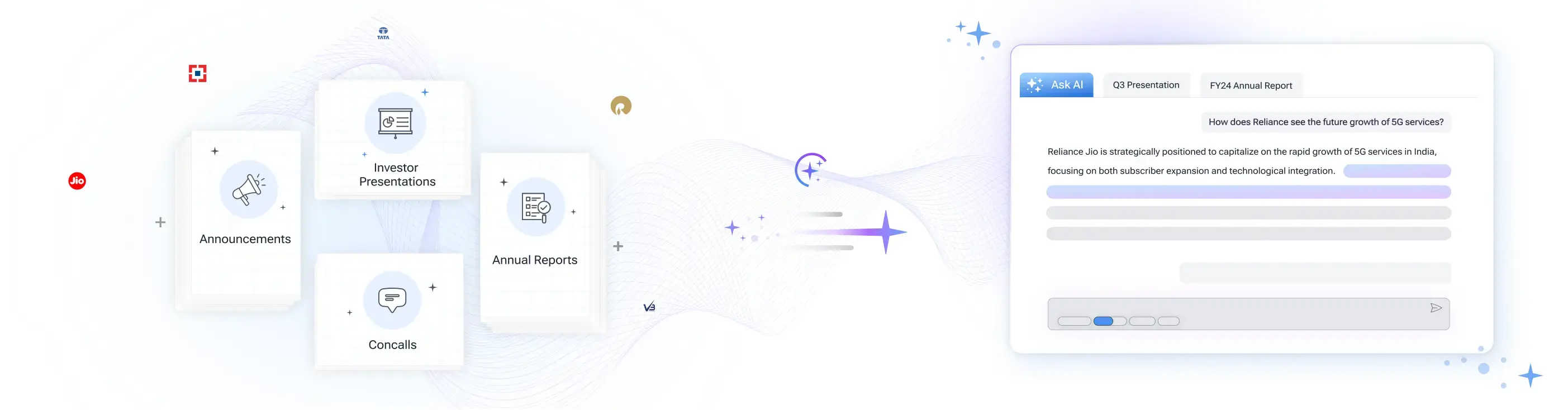
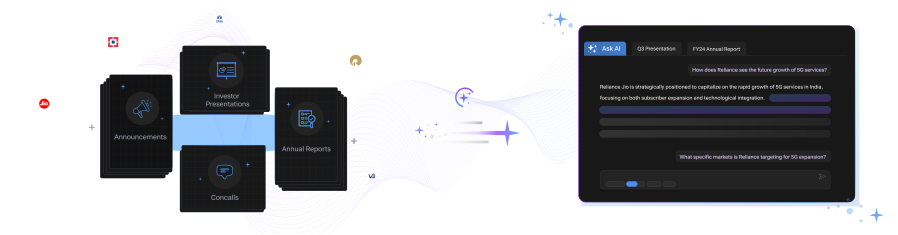
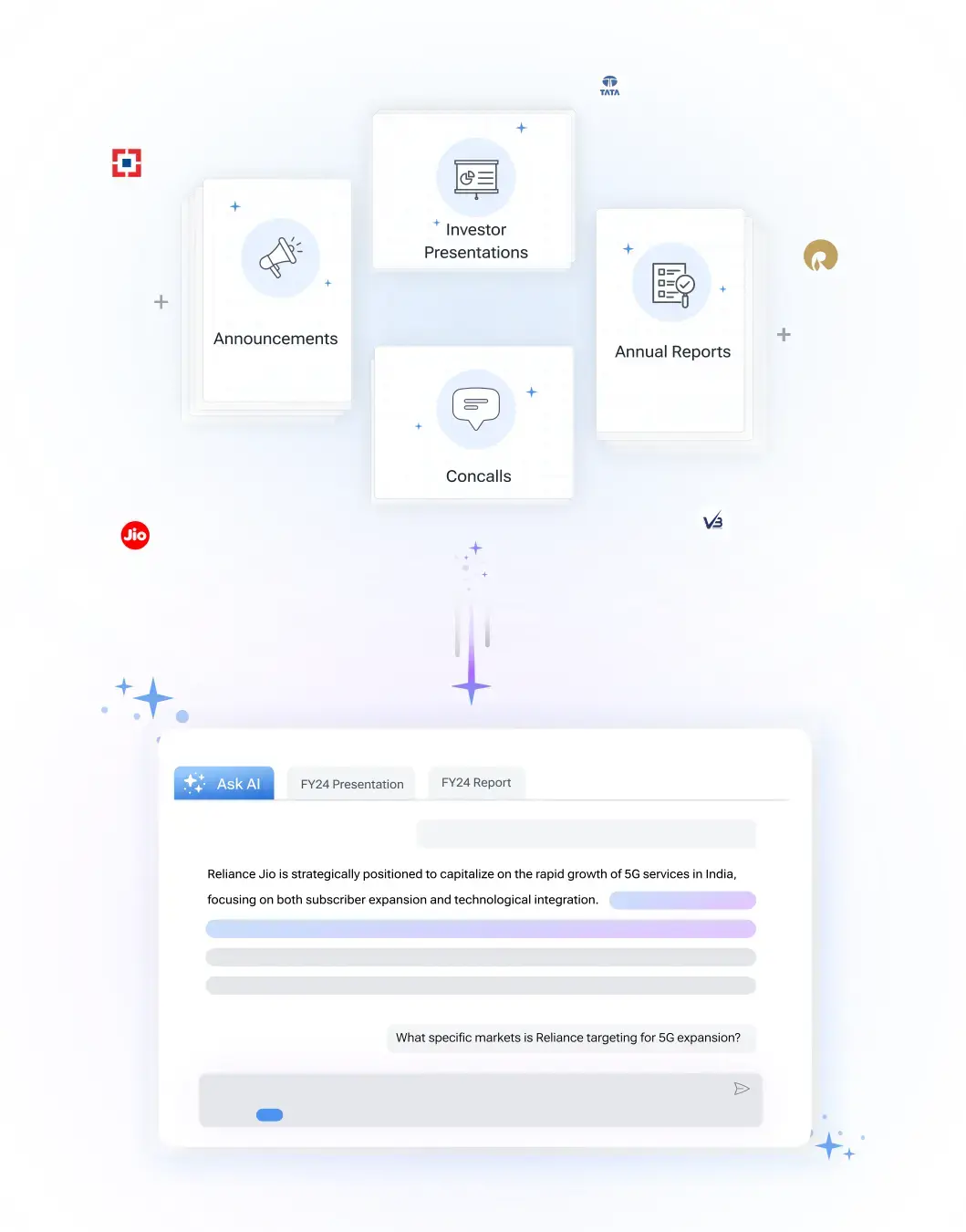
Get instant AI-powered insights about company performance, financials, and strategy. Ask questions about trends, competition, and developments while receiving responses backed by official documents and market data, with clear attribution to source documents.

 Discovery themes featuring this stockDiscovery themes featuring this stock
| Symbol | Watchlist | Price | Market Cap | P/E | P/B | Div Yield (%) | ROE (%) | ROCE (%) | ROA (%) |
683.60 | 1,803 Cr | 17.11 | 1.99 | 1.83 | 14.69 | 18.90 | 8.33 | ||
19.37 | 1,788 Cr | 27.91 | 1.38 | 0.00 | 6.55 | 8.36 | 4.69 | ||
20.16 | 1,133 Cr | 37.84 | 3.26 | 0.00 | 9.36 | 12.24 | 5.42 | ||
490.90 | 1,032 Cr | 45.86 | 12.40 | 0.00 | 27.03 | 33.41 | 27.34 | ||
83.50 | 937 Cr | 44.08 | 4.85 | 0.00 | 10.60 | 14.60 | 7.85 | ||
153.15 | 828 Cr | -77.38 | 1.90 | 0.00 | -2.50 | -4.66 | -1.96 | ||
236.25 | 486 Cr | 37.90 | 2.42 | 0.00 | 7.03 | 8.76 | 49.60 | ||
| Median: 7 Co. | — | 153.15 | 1,032 Cr | 37.84 | 2.42 | 0.00 | 9.36 | 12.24 | 7.85 |


Subex Limited is a telecom-focused Business Support Systems (BSS) software vendor that provides revenue assurance, fraud management, analytics, ROC (Revenue Operations Centre) solutions and managed services to communications service providers globally, with core product development and R&D based in Bangalore and commercial presence across EMEA, APAC, Americas and the Middle East.
Q3 FY26 showed visible bottom‑line recovery: Subex reported revenue of INR 70.79 crores, normalized EBITDA improved to INR 9.29 crores with a 13.1% margin, normalized PAT turned positive at INR 7.68 crores, DSO declined materially and cash & equivalents rose to INR 154.12 crores, reflecting strengthened liquidity and operational discipline at Subex.
Subex is executing a clear AI-first transformation: management rebranded the company, commercialized FraudZap within a year, is running customer-funded GenAI agent PoCs and reports AI as a top RFP requirement, positioning Subex to shift revenue mix toward faster-converting AI-led solutions and platformized offerings like FraudZap.
The company operates a high-annuity business model with around 70% recurring revenue and ~95% customer retention, supports 150+ global customers and claims extensive telco data connectors processing hundreds of billions of records daily, creating high switching costs and defensible domain advantage for Subex.
Order momentum and global reach are improving: recent Q3FY26 wins span Europe, Middle East and APAC — including tier‑1 operators and managed‑service renewals — which combined with a healthier pipeline suggests potential revenue acceleration for Subex in coming quarters.
IT - Software
Software Products
1,133 Cr
High Risk
37.8
17.0
0.2
3.3
21.86
6.63
Sales CAGR
Profit CAGR
ROE
ROCE
View Standalone
View Standalone
View Standalone
View Standalone
View Standalone
View Standalone
View Standalone
View Standalone
Subex Ltd (SUBEXLTD) is currently trading at 19.62 per share. Stock prices fluctuate during market hours on NSE and BSE based on demand, company updates, and overall market conditions. Refer to the live price chart above for the most recent price movement.
Subex Limited is a telecom-focused Business Support Systems (BSS) software vendor that provides revenue assurance, fraud management, analytics, ROC (Revenue Operations Centre) solutions and managed services to communications service providers globally, with core product development and R&D based in Bangalore and commercial presence across EMEA, APAC, Americas and the Middle East. Q3 FY26 showed visible bottom‑line recovery: Subex reported revenue of INR 70.79 crores, normalized EBITDA improved to INR 9.29 crores with a 13.1% margin, normalized PAT turned positive at INR 7.68 crores, DSO declined materially and cash & equivalents rose to INR 154.12 crores, reflecting strengthened liquidity and operational discipline at Subex. Subex is executing a clear AI-first transformation: management rebranded the company, commercialized FraudZap within a year, is running customer-funded GenAI agent PoCs and reports AI as a top RFP requirement, positioning Subex to shift revenue mix toward faster-converting AI-led solutions and platformized offerings like FraudZap. The company operates a high-annuity business model with around 70% recurring revenue and ~95% customer retention, supports 150+ global customers and claims extensive telco data connectors processing hundreds of billions of records daily, creating high switching costs and defensible domain advantage for Subex. Order momentum and global reach are improving: recent Q3FY26 wins span Europe, Middle East and APAC — including tier‑1 operators and managed‑service renewals — which combined with a healthier pipeline suggests potential revenue acceleration for Subex in coming quarters.
Over the past 52 weeks, Subex Ltd has traded between a low of ₹6.63 and a high of ₹21.86. The 52-week high and low indicate the stock’s price range over the last year and help investors understand its volatility and recent trading levels.
Subex Ltd has a market capitalization of approximately 1,133.00. Market capitalization represents the total value of a company’s outstanding shares and helps investors understand its size, stability, and relative risk compared to other listed companies.
Subex Ltd’s investment profile depends on its business fundamentals, valuation, and long-term outlook. The stock currently trades at a PE ratio of 37.84 and operates in the its sector sector. Investors typically assess financial performance, growth prospects, and individual risk tolerance before making investment decisions.
Based on its market capitalization of 1,133.00 Cr, Subex Ltd is classified as a Small Cap stock. Large-cap stocks are generally more stable, while mid-cap and small-cap stocks tend to offer higher growth potential along with higher price volatility.
Subex Ltd operates in the its sector sector. Sector classification matters because companies in the same sector are often affected by similar economic conditions, regulatory changes, and competitive dynamics, which can influence overall stock performance.
The Price-to-Earnings (PE) ratio of Subex Ltd is 37.84. The PE ratio compares a company’s share price to its earnings and is commonly used to assess valuation. Comparing the PE ratio with sector peers and historical levels provides better context.
Subex reported Q4 FY26 revenue of INR 72.96 crore, up from INR 70.79 crore in Q3 FY26, a 3% sequential increase.
The most direct impact is the simplification of direct tax rules for the IT sector. This includes a unified category for IT services, a common safe harbor margin of 15.5%, and a higher threshold, which reduces compliance costs and tax uncertainty.



Bearish
3
Neutral
7
Bullish
4
Bearish
11
Neutral
7
Bullish
28
Bearish
8
Neutral
0
Bullish
24
Bearish
3
Neutral
7
Bullish
4
Bearish
3
Neutral
7
Bullish
4
Bearish
8
Neutral
0
Bullish
24
Bearish
8
Neutral
0
Bullish
24
Bearish
8
Neutral
0
Bullish
24