










What is book value per share in 2026?
Quick Answer: Book value per share is a company's net assets divided by its shares outstanding, taken from the balance sheet rather than from the market. Comparing it to the share price gives the price-to-book ratio. On 8 September 2026 the Nifty Bank traded at a P/B of 1.71 and the Nifty Midcap Select at 4.42.
Two answers exist to the question of what a share is worth. The accountant gives one, drawn from the balance sheet; everyone else gives the other, and it is called the market price. They rarely agree. That gap is exactly what the price-to-book ratio sets out to measure.
What does book value per share mean?
Book value per share, usually shortened to BVPS, takes the net assets belonging to ordinary shareholders and spreads them across every ordinary share in issue.
Total assets minus total liabilities gives net assets, which appears on the balance sheet as the shareholders' equity line. Divided across the share count, it gives the accounting value standing behind each share, and because it is a recorded figure rather than a market one, it moves when the company reports and not when the price does.
What is the book value per share formula?
Book value per share = (total assets − total liabilities − preference capital) ÷ ordinary shares outstanding.
Preference capital comes out first because those holders rank ahead. That slice was never the ordinary shareholder's to begin with. Every input here is drawn from a reported balance sheet, so the figure is only ever as current as the last set of results.
Face value is not book value. Face value, or par value, is the nominal amount fixed on a share at issue — ₹1, ₹2, ₹5 or ₹10 in common Indian practice — and it stays put through every year of retained profit. Book value moves as reserves build, which is why a ₹1 face value routinely sits under a book value hundreds of times larger. Where face value earns its keep is the share count: paid-up equity share capital divided by face value gives the shares outstanding.
A worked example: HDFC Bank Ltd
In its audited results for the year ended 31 March 2026, HDFC Bank Ltd (NSE: HDFCBANK) reported equity share capital of ₹1,539.34 crore at a face value of ₹1 each — so 1,539.34 crore ordinary shares in issue — and standalone net worth of ₹5,46,325.46 crore.
₹5,46,325.46 crore ÷ 1,539.34 crore shares = ₹354.91 of book value per share.
That is the whole calculation: net assets on top, the share count underneath, both read off one filing. The same two inputs sit behind every BVPS figure on Multibagg's screener, which is why a price-to-book screen is only ever as fresh as the last results reported.
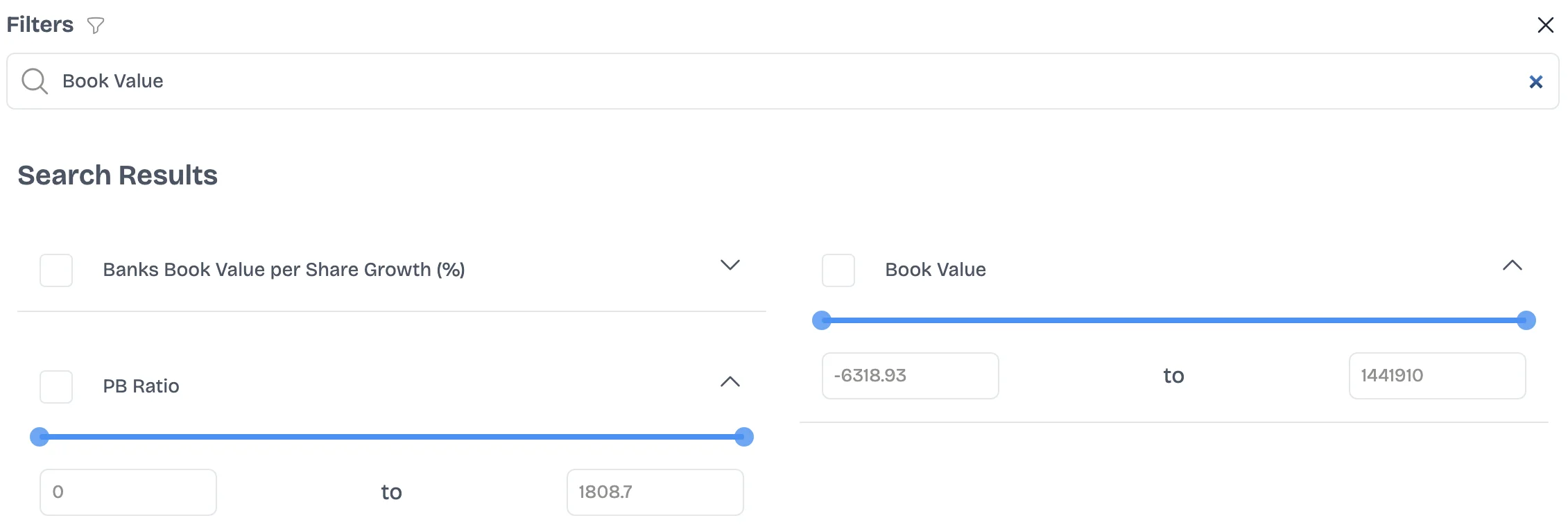
Book value and the price-to-book ratio are separate filter fields on the screener. Screenshot taken 15 September 2026.
Tangible book value
Tangible book value strips out intangible assets, chiefly goodwill and acquired brands, before the division is done. Goodwill arises when one company buys another for more than the net assets it acquires, and the excess sits on the balance sheet until it is written down. Because it cannot be sold separately from the business, anyone testing what the assets would actually realise takes it out first. The gap is widest at companies built through acquisitions, which is why two firms with identical reported net assets can be far apart on what those assets are worth.
How is book value different from market value?
One records what assets cost, adjusted over time. The other reflects what buyers will pay today.
They diverge for a structural reason. Most assets are carried at historical cost less depreciation, so a factory bought twenty years ago sits at a fraction of its replacement cost. Internally built intangibles are largely absent: a brand or an in-house software platform can generate most of a company's profit and appear nowhere in its net assets.
Set side by side, the two measures disagree on almost every axis that matters.
| Book value | Market value | |
|---|---|---|
| Source | Balance sheet | Stock exchange |
| Basis | Historical cost less depreciation | What buyers will pay today |
| Updates | When results are reported | Every trading second |
| Internally built brands and software | Largely excluded | Priced in |
| Set by | Accounting standards | Supply and demand |
| Can it fall below zero | Yes, if liabilities exceed assets | No, a share price floors at zero |
| Per-share form | Book value per share (BVPS) | Share price |
The same distinction shapes index weighting: NSE Indices has computed the Nifty 50 on free-float market capitalisation since 26 June 2009, so weights follow market value rather than anything on a balance sheet.
What is the price to book ratio?
Price to book, written P/B and also called the price-to-book ratio, is the share price divided by book value per share. It states how many times the accounting value the market is paying.
At a P/B of 1 the market is paying exactly the net assets on the books. Above that, it is paying a premium for something the balance sheet never captured, usually earning power. Below it, the market is paying less than recorded net assets. That can reflect doubt about whether those assets are really worth their carrying value.
What is a good price to book ratio?
There is no single number: the sector sets the range. The conventional textbook marker is a P/B under 1, on the reasoning that the market is paying less than recorded net assets, and in Indian practice asset-heavy businesses such as banks are commonly discussed in a band of roughly 1 to 3, while asset-light businesses routinely sit well above it.
Three caveats do most of the work. The spread within one market on one day is wide enough to make any universal threshold meaningless — across the NSE indices in the table below, published P/B ran from 1.71 to 4.42 on 8 September 2026. A low ratio is not automatically a low price, because the denominator is overstated if the recorded assets will not realise their carrying value. And the ratio is close to useless where the book is small by construction, which covers most software, consumer-brand and services companies. Read a P/B against the same company's own history and against direct sector peers, and not much else.
What does price to book look like in India in 2026?
It varies by more than a factor of two across indices drawn from the same market on the same day.
Each index below is shown at its settled close with the price-to-book ratio NSE publishes against it.
| Index | Close, 7 September 2026 | P/B |
|---|---|---|
| Nifty Bank | 57,088.30 | 1.71 |
| Nifty Financial Services | 25,935.60 | 2.40 |
| Nifty 50 | 23,779.15 | 2.88 |
| Nifty 100 | 24,902.60 | 2.94 |
| Nifty Next 50 | 72,575.75 | 3.23 |
| Nifty Midcap Select | 14,650.70 | 4.42 |
Closes: NSE, as of 7 September 2026. P/B: NSE, as of 8 September 2026.
There is deliberately no book-value-per-index-unit column. Dividing a close by a P/B would produce one, but NSE does not state which level its ratio is struck against, so the figure would rest on an assumption.
The Nifty Bank's 1.71 against the Nifty Midcap Select's 4.42 is not a statement that banks are cheaper. Banks hold financial assets carried close to realisable value, which makes their book values large and meaningful against the share price.
A midcap set weighted toward businesses whose worth sits in brands and processes will always show a higher multiple of a smaller book. The ratio is doing different work in each case. Current levels are published on NSE's index tracker, the benchmark's constituents on Multibagg's Nifty 50 index page.
Is a high or low book value per share better?
Neither, on its own. Book value per share depends on the share count, so it is not comparable between companies at all.
Fewer shares outstanding, identical net assets, and book value per share looks larger. Earnings per share behaves the same way. What is comparable is the price-to-book ratio, and even that holds only within a sector where the assets are of a similar type.
Set a bank's P/B beside a software company's and you are comparing two accounting situations, not two valuations. Both fields can be filtered side by side on a screen, with per-company figures on the stocks hub.
Why do book values matter most when there is no market price?
Because when no traded price exists, the balance sheet is one of the few anchors available.
For a listed company the market supplies a price every second, and book value serves as a cross-check on it. For an unlisted one there is nothing to check against at all. That absence is why valuation arguments over private businesses lean so heavily on assets, earnings and comparables instead. Disputes over what a private company is worth are arguments about which anchor to trust.
The same problem appears just before a listing, when a price is being set rather than observed. That is what makes pre-listing valuation ranges contested, and why the earnings underneath them get argued over just as hard.
Common Mistakes
Four errors account for most misread book-value figures.
- Comparing book value per share between companies. Share counts differ, so the comparison measures share structure rather than assets.
- Reading a P/B below 1 as a bargain. It can equally reflect doubt that the recorded assets are worth their carrying value.
- Comparing P/B across sectors. The Nifty Bank sat at 1.71 and the Nifty Midcap Select at 4.42 on 8 September 2026 because their assets are of different kinds.
- Treating book value as current. It updates when results are reported, not when the price moves, so it can be months old.
Frequently Asked Questions
Can book value per share be negative?
Yes. If total liabilities exceed total assets, net assets turn negative and so does book value per share. It usually follows sustained losses that have eaten through accumulated reserves. The price-to-book ratio then stops being meaningful, because dividing a positive share price by a negative book produces a figure that cannot be compared with anything.
How does a bonus issue or a stock split change book value per share?
Both raise the share count without adding net assets, so book value per share falls in proportion. A one-for-one bonus issue roughly halves it; a five-for-one split divides it by five. Nothing about the underlying business has changed, which is why historical BVPS series are restated whenever either event occurs.
Does a share buyback increase book value per share?
It depends on the price paid. A buyback removes both cash and shares, so book value per share rises only where shares are bought below the existing book value and falls where they are bought above it. The share count shrinks either way, which is why earnings per share and book value per share can move in opposite directions.
Is book value per share the same as net asset value?
They are the same arithmetic applied to different things. Net asset value is the standard term for a mutual fund or an ETF, where holdings are marked to market daily, so NAV tracks current prices. Book value per share describes an operating company, where assets sit at historical cost and update only at results.
How often is book value per share updated?
Once a quarter for a listed Indian company, when results are filed with the exchanges under Regulation 33. Between those filings the figure is fixed while the share price moves continuously, so a price-to-book ratio quoted today is a live numerator divided by a denominator that may be almost three months old.
Where can I find book value per share for an Indian listed company?
The primary source is the company's own quarterly or annual results filed with NSE and BSE, which carry net worth and equity share capital. Screening platforms compute the ratio from those filings. Always check which period the figure refers to, because a stale denominator is the most common source of a wrong P/B.
Disclaimer
Disclaimer: This article is for informational and educational purposes only and is not investment, financial, legal or tax advice. Multibagg AI does not recommend whether to buy, sell or hold any security. Figures are as of the dates stated and may change. Consult a SEBI-registered investment adviser before making any investment decision.


Aaditya Aanand is the founder and CEO of Multibagg AI. An IIT Kanpur alumnus, he has worked across technology and financial markets at Goldman Sachs and American Express. His writing explores investing, markets and AI.