










3B BlackBio says NGS and dPCR sales remain nominally low
Key highlights
- 3B BlackBio says TRUNGS® NGS customer traction is very low and it does not expect major immediate revenue from the segment.
- 3B BlackBio commercially launched dPCR products in Q3 FY 2025-26, with sales described as nominal.
- More than 15 reagent-rental contracts have 2-3 year commitments and are projected to contribute 20%-25% of total revenue.
- 3B BlackBio hopes to place 1-2 sample-to-answer systems in Q4, subject to successful customer onboarding.
powered by IRIS
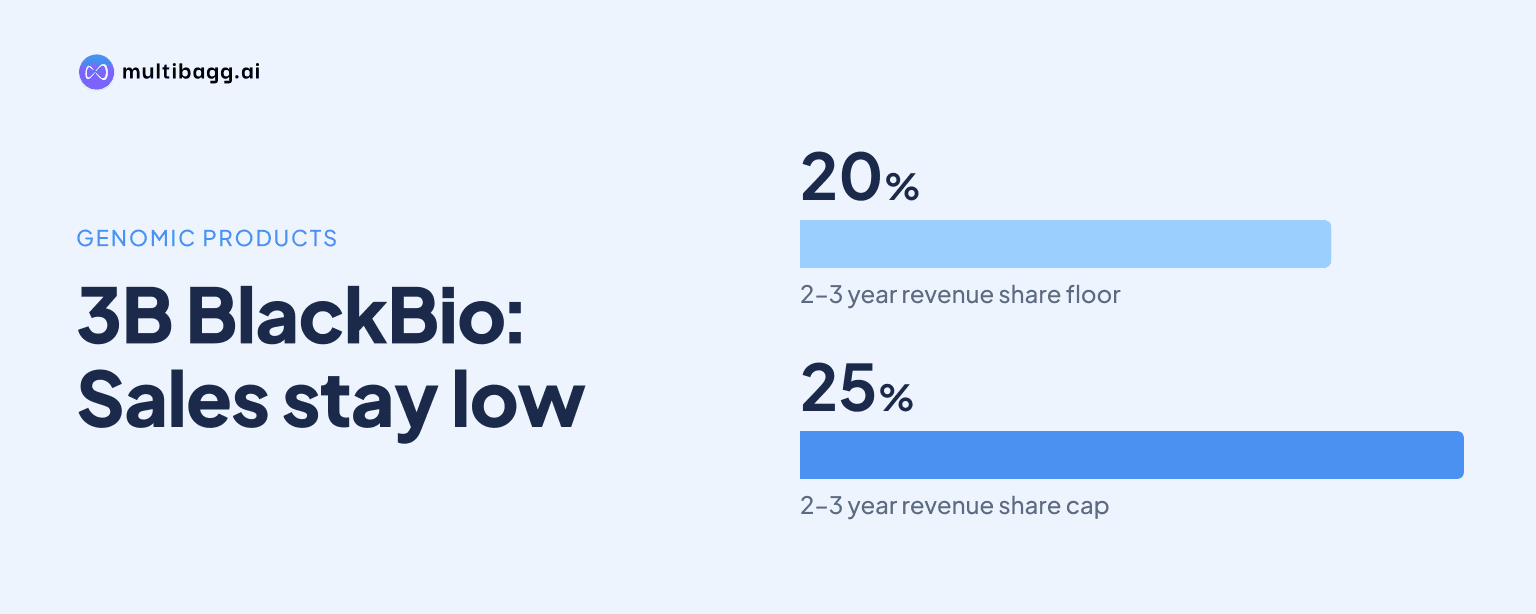
3B BlackBio says dPCR sales were nominal after the Q3 FY 2025-26 commercial launch, while customer traction for its TRUNGS® next-generation sequencing assays remains very low. Its clearest stated commercial base is more than 15 reagent-rental contracts, which management projects will contribute 20%-25% of total revenue.
Know 3B Blackbio DX inside out
Results, valuation, peers and who's buying, in one view.
Why are 3B BlackBio's NGS sales still low?
3B BlackBio says NGS sales remain very low because the market is nascent, competition is high and laboratories often make their own kits. The company has started receiving some customer traction for TRUNGS® assays, but says the vertical was intended to ensure it could offer molecular diagnostic solutions under one roof rather than generate major immediate revenue.
The company identifies laboratories' use of internally made, or homebrew, kits as a commercial constraint, noting that this established methodology is also used in polymerase chain reaction, or PCR, testing. TRUNGS® is therefore focused on niche products rather than broad NGS categories such as whole-genome sequencing, whole-exome sequencing and non-invasive prenatal testing. Management expects revenue and growth from NGS to build gradually.
3B BlackBio launched the TRUNGS® Solid Tumor Panel last year for genes associated with lung, gastrointestinal or colorectal, breast, liver and ovarian tumours. It now says it will commercially launch a BRCA Plus Kit for germline and somatic mutations associated with breast, ovarian and prostate cancers, alongside an MTB-MDR NGS Kit for targeted sequencing of tuberculosis drug resistance. The presentation gives no revenue target or launch date for either planned kit.
What does nominal dPCR sales mean for 3B BlackBio?
3B BlackBio says its digital PCR, or dPCR, products were commercially launched in Q3 of FY 2025-26, but sales are nominal because the segment is at a very initial stage. The dPCR technology enables absolute quantification of target nucleic acids, while the presentation does not disclose a revenue amount, customer count or sales volume for the new product line.
3B BlackBio describes dPCR as an R&D route for developing assays for healthcare and biotechnology, including disease detection, treatment monitoring and research. This is a product-development opportunity rather than a commercial forecast. Compared with NGS, TRUNGS® already has some customer traction and a Solid Tumor Panel launched last year, whereas dPCR only entered commercial launch in Q3 FY 2025-26.
Got a follow-up? Ask IRIS
How does TRUElute® change 3B BlackBio's platform strategy?
3B BlackBio says TRUElute® moves it beyond an original equipment manufacturer, or OEM, approach because the automated nucleic-acid extraction system was designed, developed and manufactured entirely in-house. The company says it owns the system's design, engineering, development and manufacturing, replacing its earlier OEM-based approach with an indigenous platform.
TRUElute® is being offered through a reagent-rental model that combines instrument placement with recurring reagent and consumable sales. This mechanism links an installed extraction system with future consumable demand rather than only a one-time instrument sale. 3B BlackBio says the approach supports long-term deployment and recurring revenue opportunities, although it does not disclose the number of TRUElute® placements.
3B BlackBio has also validated an OEM sample-to-answer system in-house and began offering it to a few laboratories in Q3. Management says it hopes to place 1-2 systems in Q4 to begin business in that segment, subject to successful onboarding at customer sites. This is an earlier and more conditional disclosure than the more than 15 contracts already in place under the wider reagent-rental model.
Can 3B BlackBio enter the government sample-to-answer market soon?
3B BlackBio says entry into the major government tender market for sample-to-answer systems depends on completing in-vitro diagnostic, or IVD, registration with the Central Drugs Standard Control Organisation, or CDSCO. Following positive validation results, management says it will initiate the registration process in Q4, which it estimates could take about one year depending on external factors.
The stated sequence is in-house validation, an offer to a few laboratories in Q3, and a possible 1-2 system placement in Q4 before access to government tenders. The Q4 placement objective is therefore an initial commercial step rather than a forecast of broad tender revenue. Both the customer placement and the timing of the CDSCO process remain conditional.
3B BlackBio's contract base provides the presentation's more measurable recurring-revenue route. The company says it has more than 15 reagent-rental contracts carrying customer commitments of 2-3 years, and management projects these contracts will provide 20%-25% of total revenue. That is a management projection rather than reported revenue, but it is the stated benchmark for the newer NGS, dPCR and sample-to-answer lines.
Conclusion
3B BlackBio is building a broader diagnostics platform, but its newest technologies have not yet made a material sales contribution in the presentation. NGS has very low customer traction, dPCR sales are nominal after the Q3 FY 2025-26 launch, and TRUElute®, sample-to-answer systems and oncology and tuberculosis sequencing products add platforms and potential recurring consumables demand.
The next disclosed items to watch are the commercial launches of the BRCA Plus and MTB-MDR NGS kits, management's hoped-for placement of 1-2 sample-to-answer systems in Q4, and initiation of CDSCO registration that management estimates could take about one year. Delivery of the projected 20%-25% revenue contribution from more than 15 reagent-rental contracts is also a stated measure of the model's progress.