










3M India Q2 revenue rises 14.7% while profit drops 17.2%
Key highlights
- 3M India’s Q2 revenue from operations rose 14.7% year on year to Rs 1,452.49 crore.
- 3M India’s Q2 profit after tax declined 17.2% year on year to Rs 158.48 crore.
- Q2 purchases of stock-in-trade increased 41.7% to Rs 377.55 crore.
- Transportation & Electronics Q2 revenue increased 23.4% to Rs 536.61 crore.
powered by IRIS
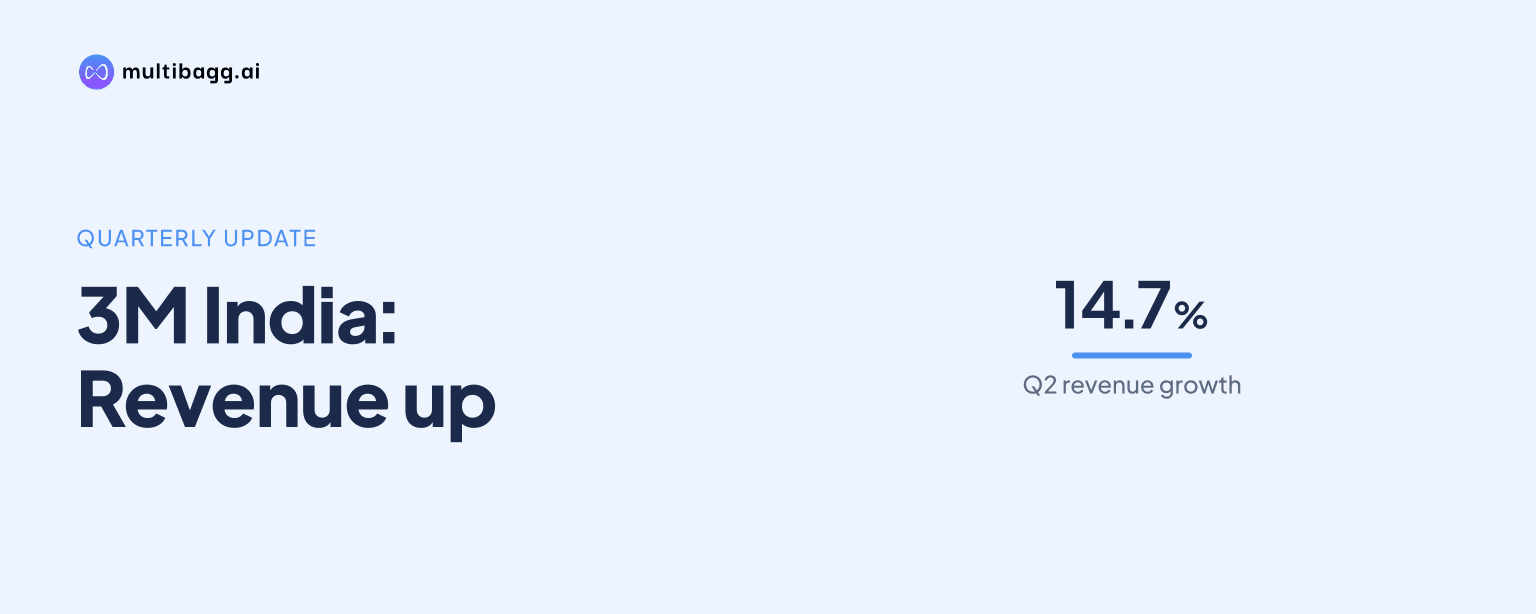
3M India Limited reported revenue from operations of Rs 1,452.49 crore for the quarter ended 30 September 2026, up 14.7% year on year, but profit after tax fell 17.2% to Rs 158.48 crore. Total expenses rose 21.7% to Rs 1,251.34 crore, outpacing revenue growth and reducing profit before tax to Rs 212.32 crore.
Know 3M India inside out
Results, valuation, peers and who's buying, in one view.
Why did 3M India’s Q2 profit decline despite revenue growth?
3M India’s quarterly profit declined because expenses grew faster than sales in the three months ended 30 September 2026. Revenue from operations increased by Rs 186 crore from Rs 1,266.49 crore a year earlier, while total expenses increased by Rs 223.34 crore from Rs 1,028 crore. Profit before tax consequently decreased 15.3% from Rs 250.81 crore to Rs 212.32 crore.
Purchases of stock-in-trade rose 41.7% to Rs 377.55 crore, while cost of materials consumed increased 19.6% to Rs 526.12 crore. Employee benefit expenses rose to Rs 127.38 crore from Rs 120.92 crore, other expenses increased to Rs 199.74 crore from Rs 184.53 crore, and finance costs rose to Rs 4.27 crore from Rs 2.32 crore. The financial statements do not attribute the quarterly profit decline to rupee depreciation, the Middle East crisis or input-cost inflation.
Which 3M India segments increased revenue in Q2?
All four principal operating segments recorded higher revenue year on year in the September 2026 quarter, led by Transportation & Electronics. Transportation & Electronics revenue increased 23.4% to Rs 536.61 crore from Rs 434.89 crore, making it 3M India’s largest segment by quarterly revenue. Safety & Industrial followed with revenue of Rs 452.31 crore.
Consumer posted the fastest growth among the four principal segments, with revenue rising 19.5% to Rs 170.84 crore from Rs 142.96 crore. Safety & Industrial revenue rose 11.8% to Rs 452.31 crore, while HealthCare increased 4.1% to Rs 278 crore. Revenue reported under Others fell 13.9% to Rs 14.73 crore, compared with Rs 17.10 crore a year earlier.
How did segment results change during 3M India’s Q2?
Segment results fell in two of 3M India’s largest businesses despite their higher revenue. Safety & Industrial’s segment result decreased to Rs 31.24 crore from Rs 68.21 crore, while Transportation & Electronics declined to Rs 76.72 crore from Rs 83.43 crore. Together, these two segments accounted for Rs 988.92 crore of quarterly revenue.
HealthCare’s segment result increased to Rs 60.22 crore from Rs 59.70 crore, and Consumer’s result rose to Rs 29.44 crore from Rs 24.06 crore. Total segment results nevertheless declined 14.7% to Rs 205.42 crore from Rs 240.81 crore. After adding other income of Rs 11.17 crore and deducting finance costs of Rs 4.27 crore, 3M India reported profit before tax of Rs 212.32 crore.
Got a follow-up? Ask IRIS
How did 3M India perform in the six months ended September 2026?
3M India’s revenue from operations for the six months ended 30 September 2026 rose 16.8% to Rs 2,875.70 crore from Rs 2,462.46 crore in the corresponding period a year earlier. Reported profit after tax increased 6.1% to Rs 391.55 crore from Rs 369.02 crore, but the period included a Rs 73.13 crore exceptional gain from a land sale.
Profit before exceptional items and tax declined 10% to Rs 441.35 crore from Rs 490.20 crore. Over the six months, cost of materials consumed increased to Rs 1,075.88 crore from Rs 871.32 crore, purchases of stock-in-trade rose to Rs 767.80 crore from Rs 525.22 crore, and total expenses increased 22.9% to Rs 2,457.16 crore.
The exceptional gain related to the sale of land at Pimpri, Pune, where the conveyance deed was executed on 29 June 2026 for total consideration of Rs 82 crore. The Rs 73.13 crore reported gain was net of the asset’s cost and related expenses. This gain was recorded in the quarter ended 30 June 2026, when profit after tax was Rs 233.07 crore, compared with Rs 158.48 crore in the September quarter.
What changed in 3M India’s cash and balance sheet?
3M India generated net operating cash flow of Rs 299.87 crore in the six months ended 30 September 2026, compared with Rs 282.18 crore a year earlier. Cash generated from operations rose to Rs 493.10 crore from Rs 418.25 crore, while income tax paid increased to Rs 193.23 crore from Rs 136.07 crore.
Cash and cash equivalents were Rs 597.33 crore at 30 September 2026, down from Rs 812.14 crore at 31 March 2026. Financing activities used Rs 583.43 crore, including Rs 570.01 crore of dividend payments. During the September quarter, 3M India paid Rs 506 per equity share, comprising a final dividend of Rs 160 and a special dividend of Rs 346 for the year ended 31 March 2026.
Total assets stood at Rs 2,976.38 crore at 30 September 2026, compared with Rs 3,137.25 crore at 31 March 2026. Inventories declined to Rs 801.46 crore from Rs 822.96 crore, but trade receivables increased to Rs 874.21 crore from Rs 838.60 crore. The statutory auditor issued an unmodified review conclusion on the unaudited results dated 6 November 2026.
Conclusion
3M India delivered sales growth across its four principal segments in the September 2026 quarter, but that growth did not result in higher earnings. Revenue increased by Rs 186 crore, while expenses rose by Rs 223.34 crore, with notably higher purchases of stock-in-trade and materials costs. Lower segment results in Safety & Industrial and Transportation & Electronics contributed to the 17.2% decline in quarterly profit after tax.
The next results will show whether costs and segment profitability change as revenue continues to grow. Investors can also watch the proposed amendments to agreements related to 3M India’s HealthCare business, whose key commercial terms were approved by the board on 26 October 2026 and remain subject to agreed conditions. The company said the amendments would terminate certain rights and obligations for specified products in exchange for a one-time consideration.