










Aakaar returns to H1 profit, but gross margin retreats
Key highlights
- Aakaar reported H1 FY27 revenue from operations of Rs 43.72 crore, up 72.64% from Rs 25.30 crore in H1 FY26.
- Aakaar reported H1 FY27 PAT of Rs 3.54 crore, compared with a Rs 80 lakh loss in H1 FY26.
- Gross margin was 51.39% in H1 FY27, down from 57.88% in H2 FY26.
- Marketing expenditure was Rs 3.40 crore in H1 FY27, above the Rs 2.76 crore spent in all of FY26.
powered by IRIS
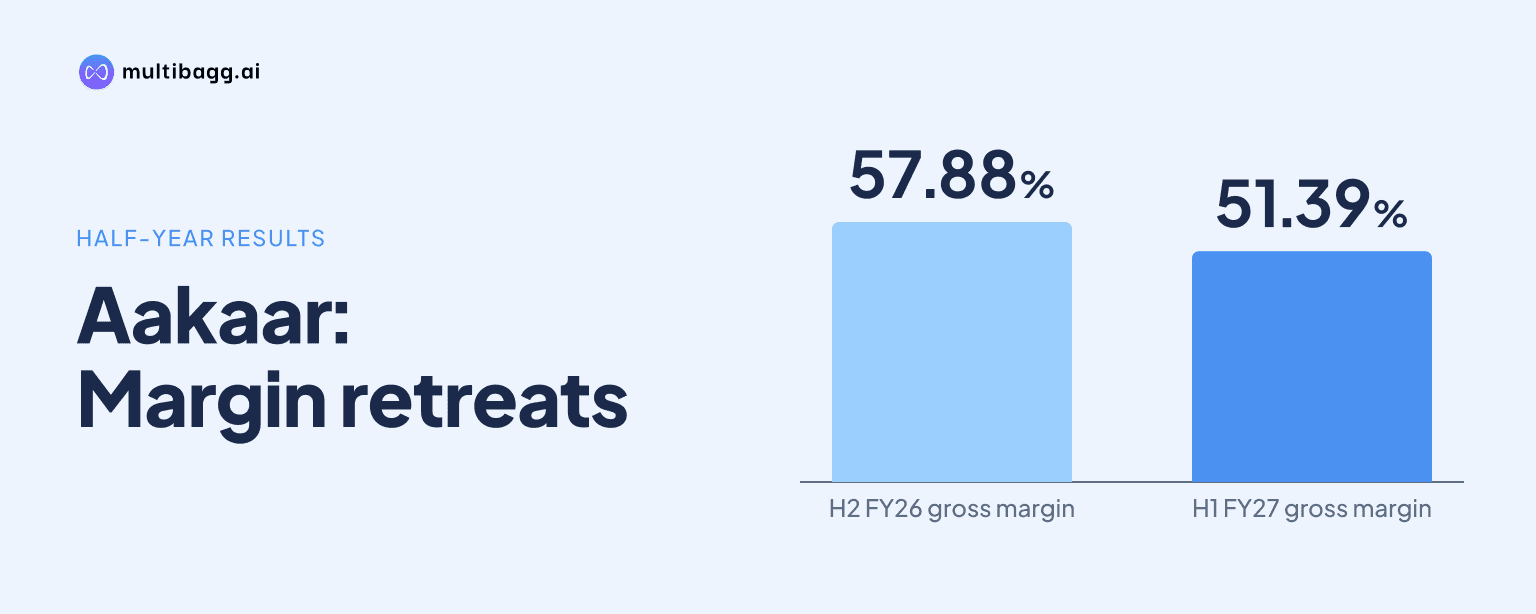
Aakaar Medical Technologies Limited returned to profit in H1 FY27 with profit after tax of Rs 3.54 crore, versus a Rs 80 lakh loss a year earlier, as revenue from operations rose 72.64% to Rs 43.72 crore. Gross margin, however, declined to 51.39% from 57.88% in H2 FY26.
Know Aakaar Medical Technologies inside out
Results, valuation, peers and who's buying, in one view.
How did Aakaar return to H1 profit?
Aakaar returned to H1 profit through higher sales, reporting H1 FY27 revenue from operations of Rs 43.72 crore, up from Rs 25.30 crore in H1 FY26 and 5% above H2 FY26. Profit after tax was Rs 3.54 crore, giving an 8.05% margin, compared with a Rs 80 lakh loss in the previous first half.
Earnings before interest, tax, depreciation and amortisation, or EBITDA, reached Rs 5.59 crore in H1 FY27, representing a 12.71% margin, compared with Rs 2 lakh in H1 FY26. Management also cited overall sales of Rs 43.99 crore, while the chief financial officer specified revenue from operations of Rs 43.72 crore for the 72.64% year-on-year comparison.
Management attributed the H1 increase to procurement linked to confirmed orders and demand visibility, alongside a doctor and practitioner base of 6,300. Aakaar’s own brands contributed Rs 14.90 crore, or 34% of H1 revenue, which the managing director said was already about two-thirds of the previous full-year own-brand revenue.
The turnaround followed what management described as a softer prior-year period, but the comparison also shows the scale of the sales recovery. Revenue from operations increased by Rs 18.42 crore year on year, while PAT moved by Rs 4.34 crore from a Rs 80 lakh loss to a Rs 3.54 crore profit.
Why did Aakaar’s gross margin decline?
Aakaar’s gross margin declined because H1 FY27 included higher marketing spending, a distributor-billing transition and a greater sales contribution from imported brands. Gross margin was 51.39% in H1 FY27, down 6.49 percentage points from 57.88% in H2 FY26, the period management described as benefiting from a higher own-brand share.
Marketing expenditure was Rs 3.40 crore in the first half, exceeding the Rs 2.76 crore spent in all of FY26. Management said this spending supported customer awareness in the business-to-business channel, the FAHA conference and MICA, or Masterclass in Contouring Aesthetic, workshops, with FAHA intended to become an annual activity.
Portfolio mix also changed during the half. Own brands represented 34% of revenue in H1 FY27, versus about 38% to 39% in FY26, as management saw greater demand for imported brands. It explicitly linked the lower own-brand ratio to the gross-margin outcome and said it was working to increase own-brand revenue.
The reported margin comparison is sequential rather than year on year, because the 57.88% figure relates to H2 FY26. Management did not provide a numerical H2 FY27 gross-margin target, but said margins could improve if foreign-exchange and cost-of-goods pressures soften and if own-brand sales rise under its sales planning.
Got a follow-up? Ask IRIS
What is Aakaar changing in distribution and collections?
Aakaar is shifting from direct doctor billing to a distributor-led model to improve last-mile coverage and collections, after completing its migration to Novacare in August. The company had appointed more than 40 distributors by the call and plans to expand the network to at least 100 over the next two years.
Management said the model is designed to make distributors responsible for payment to Aakaar, rather than relying on doctor-level stockkeeping and billing. It is pushing for 60-day collection at the doctor level and has an internal objective to reduce average debtor days to about 130 days, or to a 130-to-150-day range by the FY27 close or, at the latest, H1 of the next year.
That target follows a worsening reported collection cycle. Debtor days stood at 219 in September 2026, compared with 206 in March 2026, while cash and cash equivalents were Rs 1.05 crore versus Rs 16.20 crore in March 2026. Management called the reduction of debtor days its first priority and identified distributor billing as a mechanism to improve collections.
Aakaar is not planning headcount growth or additional territory expansion during FY27, despite a field force of more than 120 people. Instead, management said it had relocated and reorganised teams at some headquarters and expects to rearrange divisions and portfolios in the coming year to improve productivity by doctor and brand.
Which growth plans could affect Aakaar next?
Aakaar is expanding its portfolio, clinic participation and customer reach, with management targeting 8,000 to 9,000 customers built in FY27 after adding more than 4,700 in the first half. Its cumulative customer base was about 12,000 customers who had bought at least once, and management’s stated focus is higher sales per doctor and per brand.
The company launched five international products, including LETYBO, a United States Food and Drug Administration-approved botulinum toxin, and FotoFinder devices for dermatoscopy and trichoscopy. Management said FotoFinder Medicam and FotoFinder ATBM could add revenue if pipeline deals close, while noting that higher-value device sales generally carry less recurring revenue than products or subscriptions.
Recurring revenue accounted for about 92% of revenue according to the managing director, while the chief executive said the FY26 ratio was 93% and remained broadly similar. Management said FotoFinder Skin has a subscription model, whereas DermLite did not have a subscription at the time of the call but could have one in future, potentially changing the recurring-revenue mix.
Aakaar had onboarded more than 70 doctors to Xelix, its doctor-owned and doctor-operated aesthetic platform, and plans to increase performance-marketing spending after reaching 100 onboarded doctors. Management also said it had completed more than 75 workshops and attended almost 20 conferences, alongside a soft launch of Xelix digital and paid marketing.
Conclusion
Aakaar’s H1 FY27 result marked a return from a Rs 80 lakh loss to Rs 3.54 crore of profit as revenue from operations rose 72.64% to Rs 43.72 crore. The same period showed the cost of the current growth plan: Rs 3.40 crore of marketing expenditure, a distribution transition and a 34% own-brand sales mix coincided with gross margin falling to 51.39% from the H2 FY26 level of 57.88%.
The next disclosures should show whether the distributor model reduces debtor days from 219 and whether own-brand sales recover toward the FY26 share of about 38% to 39%. Management is targeting 8,000 to 9,000 customers in FY27, at least 100 distributors within two years, and more aggressive Xelix marketing after 100 doctors are onboarded.