










Aakaar targets receivable days below 130 through distributor payment model
Key highlights
- Aakaar said receivable days rose to about 220 from 160 last year.
- Management wants receivable days at 180 to 160 by end-H2 and has an aggressive internal target below 130.
- Gross margin fell to about 51% from 61% as Aakaar-brand share declined to 34% from 39%.
- Aakaar's new collection model had started with 40 distributors, with benefits expected within 6 to 12 months.
powered by IRIS
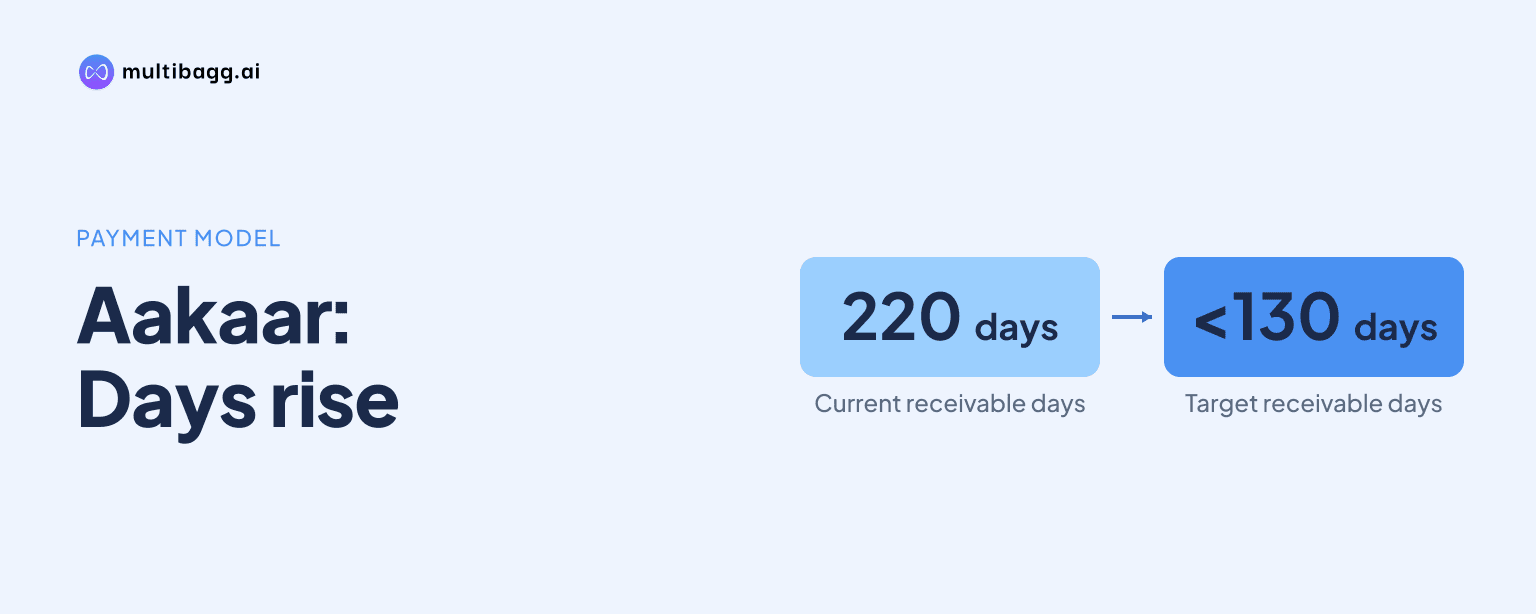
Aakaar Medical Technologies Limited said receivable days had climbed to about 220 from 160 last year and management is internally targeting less than 130 by the end of H2, although it described that goal as aggressive. Aakaar has started a distributor model with 40 distributors to improve collections over the next six to 12 months.
Know Aakaar Medical Technologies inside out
Results, valuation, peers and who's buying, in one view.
Why did Aakaar's receivable days rise to about 220?
Aakaar's receivable days rose to about 220 from 160 last year because its migration with Novacare had only just been completed and its distributor model was newly launched. Management said the ultimate customer remains the doctor, meaning the collection benefits from moving to distributors had not yet been fully realised.
Imported brands also create sizeable working-capital needs for Aakaar, which said 64% to 65% of its portfolio remained international. Management cited minimum order quantities, freight, foreign-exchange exposure and the need to maintain adequate stock during supply disruption. It said the imported products have shelf lives of three to four years, allowing inventory to be held but tying up capital.
Aakaar said doctor-level demand is less predictable than broad retail demand, so it has sought a wider distribution network and larger doctor base. Management said the industry has broadly similar working-capital requirements, but expects its ratios to improve as distributor payments and collection policies become established.
How does Aakaar plan to reduce receivable days?
Aakaar plans to reduce receivable days through agreements under which distributors pay the company irrespective of their own collections from doctors. Management said the model had begun with 40 distributors and should start showing results within six to 12 months, shifting part of the collection burden away from direct doctor transactions.
Management's nearer-term objective is to bring receivable days to 180 to 160 by the end of H2, followed by a further reduction in H1 of the next year. It called an end-H2 outcome below 130 an aggressive internal target, and said even 180 days would be an improvement from about 220 days.
The same execution is central to operating cash flow. Management said it intends to make operating cash flow positive every month, but linked a better overall cash-flow position to distributor expansion and collection recognition in H2 and H1 of the next year. Inventory must still support the 60% to 65% of sales represented by imported products, it said.
What caused Aakaar's gross margin to fall to 51%?
Aakaar said gross margin fell to about 51% from 61% in the prior half because of foreign exchange, higher European supply costs, doctor sampling and product mix. Management identified changes in euro and dollar rates, alongside increased goods costs from European suppliers, as the largest factors affecting the first-half margin.
Sampling also raised cost of goods sold. Aakaar conducted workshops and conferences in the first half and provided samples to doctors to build its market, with those costs included in goods costs. Management said sampling would be lower in the second half, which could enable some margin improvement if the other cost pressures also ease.
The product mix changed as Aakaar-brand sales declined to 34% in the first half from 39% previously, while doctors purchased more imported brands. Management said imported products carry higher selling prices, allowing revenue growth through fewer stock-keeping units, or SKUs, but the shift reduced the contribution of the higher-margin local portfolio.
Got a follow-up? Ask IRIS
Can Aakaar's brand mix support margin recovery?
Aakaar's own-brand mix can support margin recovery if sales rise because management put local-brand gross margins at around 70%, compared with about 20% to 30% for global-brand devices and 40% to 50% for international brands. Management said it wants internal brands to become larger, while acknowledging that doctor and consumer demand determines the final mix.
Aakaar intends to maintain an imported-versus-own-brand mix of about 60:40 and wants Aakaar brands to reach 36% to 37% by year-end, versus 34% in the first half. Management did not give a specific second-half gross-margin target, saying margins might be slightly better if foreign-exchange conditions soften and Aakaar-brand sales improve.
Marketing spending has accompanied the effort to increase doctor-facing sales and brand awareness. Management cited advertising and marketing expense of Rs 3.34 crore in the first half, compared with Rs 2.78 crore for the whole prior year, and said Rs 1 crore to Rs 1.2 crore of the current spending was non-recurring, including FAHA activity and one or two other activities.
What else could change Aakaar's sales mix and collections?
Aakaar is building Xelix as a doctor-owned, doctor-operated clinic platform that supports participating doctors while selling products to them. Management said it expects minimum product-purchase revenue of Rs 2 lakh to Rs 3 lakh per doctor after large-scale marketing begins, without requiring doctors to buy a specified brand.
Aakaar had about 70 Xelix clinics and management said its personal ambition was to reach 100 before the end of December. The company has not assigned a revenue figure to potential franchise fees, software charges or allied platform income, saying it first wants 100 clinics and a performance-marketing pilot to assess lead generation.
Management also outlined plans to retain prescribed-product sales that might otherwise be lost after a doctor visit. Aakaar currently has no direct-to-consumer or direct retail sales, but has begun soft-listing its brands on e-commerce portals and expects full-fledged listing by the end of the year. It said it would not spend heavily as an e-commerce brand unless greater sales became visible.
Conclusion
Aakaar's disclosed plan connects collections, inventory and product mix. Receivable days rose by about 60 days to roughly 220, while gross margin declined by about 10 percentage points to 51% as foreign exchange, European sourcing costs, sampling and a fall in Aakaar-brand mix to 34% affected profitability. Distributor payments and a larger own-brand contribution are management's stated mechanisms for addressing those pressures.
The next measures to watch are whether the 40-distributor model takes receivable days toward the 180-to-160-day end-H2 objective and then the internal below-130-day goal. Management also aims for Aakaar brands to reach 36% to 37% by year-end, expects lower second-half sampling costs, and plans to reach 100 Xelix clinics before conducting its marketing pilot.