










Aarti Pharmalabs Limited Q2 Revenue Reaches Record Rs 613 Crore
Key highlights
- Aarti Pharmalabs reported record Q2 FY27 revenue of Rs 613 crore, up 47% year on year.
- EBITDA increased 84% year on year to Rs 136 crore, with margin rising to 22.2% from 17.7%.
- Profit after tax increased to Rs 66 crore from Rs 24 crore in Q2 FY26.
- The CDMO and CMO business had 59 active projects and a stated revenue target of Rs 1,000 crore.
powered by IRIS
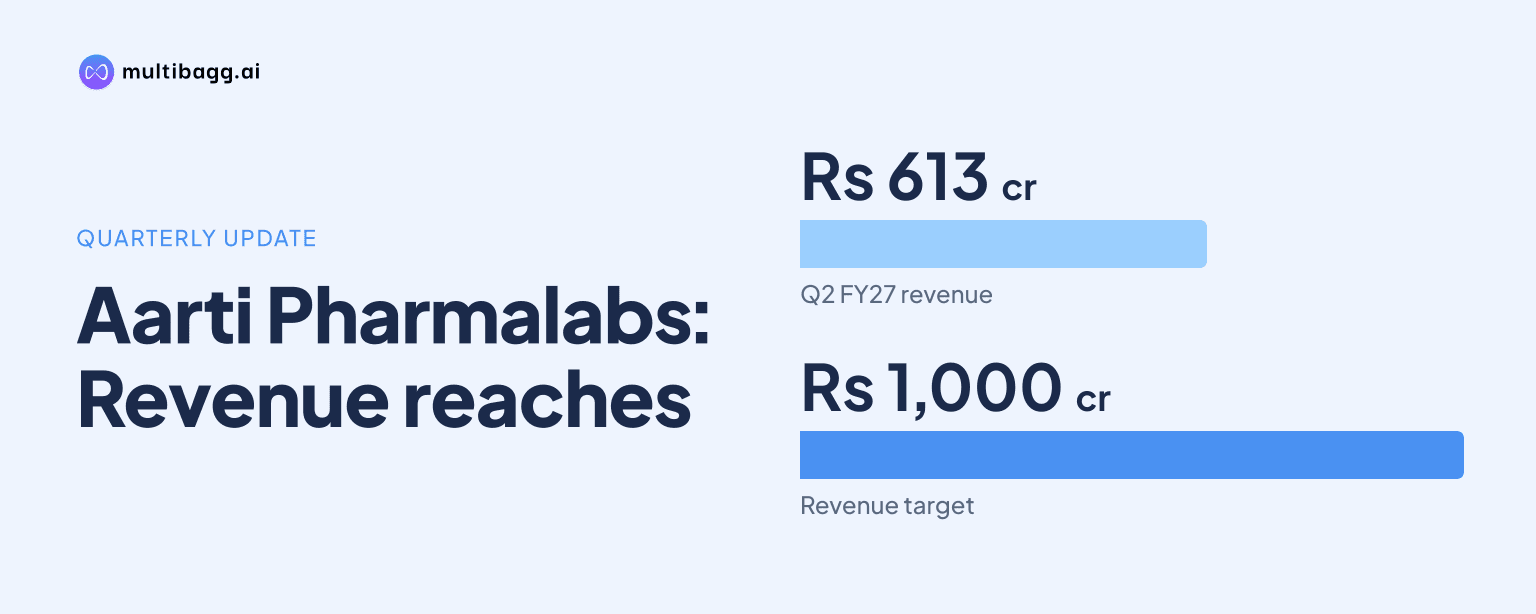
Aarti Pharmalabs Limited reported its highest-ever quarterly revenue of Rs 613 crore in Q2 FY27, up 47% year on year, while EBITDA rose 84% to Rs 136 crore and profit after tax increased to Rs 66 crore from Rs 24 crore. The result reflects higher xanthine volumes, recovery in API and intermediates, and CDMO growth.
Know Aarti Pharmalabs inside out
Results, valuation, peers and who's buying, in one view.
What did Aarti Pharmalabs report for Q2 FY27?
Aarti Pharmalabs reported a record quarterly revenue of Rs 613 crore for the quarter ended September 30, 2026. Revenue was Rs 417 crore in the corresponding quarter of the previous year, resulting in 47% year-on-year growth. The company described the quarter as its strongest so far across its operating businesses.
Operating profitability increased faster than revenue. EBITDA rose 84% year on year to Rs 136 crore from Rs 74 crore, and the EBITDA margin improved to 22.2% from 17.7%. Profit after tax rose 2.75 times to Rs 66 crore, compared with Rs 24 crore a year earlier. The reported consolidated revenue from operations for the quarter was Rs 610.45 crore.
Which businesses supported Aarti Pharmalabs' growth?
Aarti Pharmalabs said xanthine derivatives and allied products contributed 50% of quarterly turnover, making this its largest reported business contributor. Within the segment's volume mix, beverages accounted for 62% and other applications accounted for 38%. Management linked the quarterly performance to higher volumes in xanthine derivatives.
The API and intermediates business contributed 30% of turnover. The company cited a recovery in API and intermediate sales as another factor behind the improved quarter. Export sales accounted for 59% of revenue, while domestic sales represented 41%, underlining the importance of overseas pharmaceutical supply chains to its business mix.
Management also noted that raw material costs remained elevated because of geopolitical turmoil. It said the company was passing higher raw material costs on to customers. This commentary is relevant for margins because the Q2 improvement occurred despite continued input-cost pressure.
What is Aarti Pharmalabs' CDMO expansion plan?
Aarti Pharmalabs said its CDMO and CMO segment is on track for 40% to 50% revenue growth for the full year. The company reported 59 active projects in this business, including 39 commercial projects and 20 development projects. It has identified a revenue target of Rs 1,000 crore for the segment.
The project mix indicates that the CDMO platform includes both established commercial work and programmes that remain in development. Commercial projects contribute to current activity, while development projects can progress through customer qualification and scale-up stages. The company did not provide quarter-specific CDMO revenue in the disclosed material.
Management also discussed its Atali facilities. According to the Managing Director, Atali Phase 1B is a smaller line intended for early work on newer projects, while Atali Phase 1A is the commercial scale-up line. He said the company expects to fully utilise the Atali asset in the second half of the current financial year.
Got a follow-up? Ask IRIS
How is the xanthine derivatives capacity programme progressing?
Aarti Pharmalabs expects xanthine derivatives volumes to grow by 15% to 20% during the current year. Management described the business as a cash-generating segment with a dominant market position, supported by its established product base and contribution to quarterly turnover.
Capacity expansion in xanthine derivatives is progressing, with full utilisation expected by FY28, according to the company. That timeline is important because xanthine derivatives accounted for half of Q2 turnover and were specifically identified as a driver of quarterly volume growth.
The reported product mix also shows the role of beverages in the segment. Beverages represented 62% of xanthine volume, while the remaining 38% came from other uses. The disclosed data does not provide product-level pricing, capacity figures, or the capital expenditure amount for the expansion programme.
Why do the Q2 FY27 results matter to investors?
The Q2 performance matters because revenue, EBITDA, margin and profit all improved materially from the prior-year quarter. Revenue growth of 47% was accompanied by an EBITDA increase of 84%, allowing the margin to expand by 4.5 percentage points. Profit after tax grew from Rs 24 crore to Rs 66 crore.
For investors, the business mix is also relevant. Xanthine derivatives supplied 50% of turnover, API and intermediates supplied 30%, and CDMO remains a stated expansion area. Export sales at 59% of revenue show that results are influenced by international demand as well as domestic pharmaceutical customers.
The company scheduled its Q2 FY27 earnings conference call for October 28, 2026, and subsequently made its investor presentation available. The disclosures provide management's stated targets for CDMO growth, xanthine volume growth and Atali utilisation, but they do not provide a detailed financial forecast for future quarters.
Conclusion
Aarti Pharmalabs delivered a record Q2 FY27 with revenue of Rs 613 crore, EBITDA of Rs 136 crore and profit after tax of Rs 66 crore. The result was supported by xanthine derivatives, recovering API and intermediate sales, and CDMO activity, while the company maintained a 22.2% EBITDA margin despite elevated raw material costs.
The next points to watch are management's progress toward 40% to 50% CDMO revenue growth for the year, utilisation of the Atali asset in the second half, and the planned xanthine capacity ramp-up toward full utilisation by FY28. Investors will also track whether raw material cost pass-through continues to support profitability.