










ABLBL Q2 profit more than doubles as margin reaches 17.2%
Key highlights
- ABLBL’s Q2 FY27 PAT rose 126% year on year to Rs 53 crore from Rs 23 crore.
- Q2 FY27 revenue increased 11% to Rs 2,266 crore, while EBITDA rose 15% to Rs 390 crore.
- Consolidated EBITDA margin expanded to 17.2% from 16.6%, marking the fifth consecutive quarter of improvement.
- ABLBL’s store network reached 3,434 outlets across more than 800 cities and towns as of September 2026.
powered by IRIS
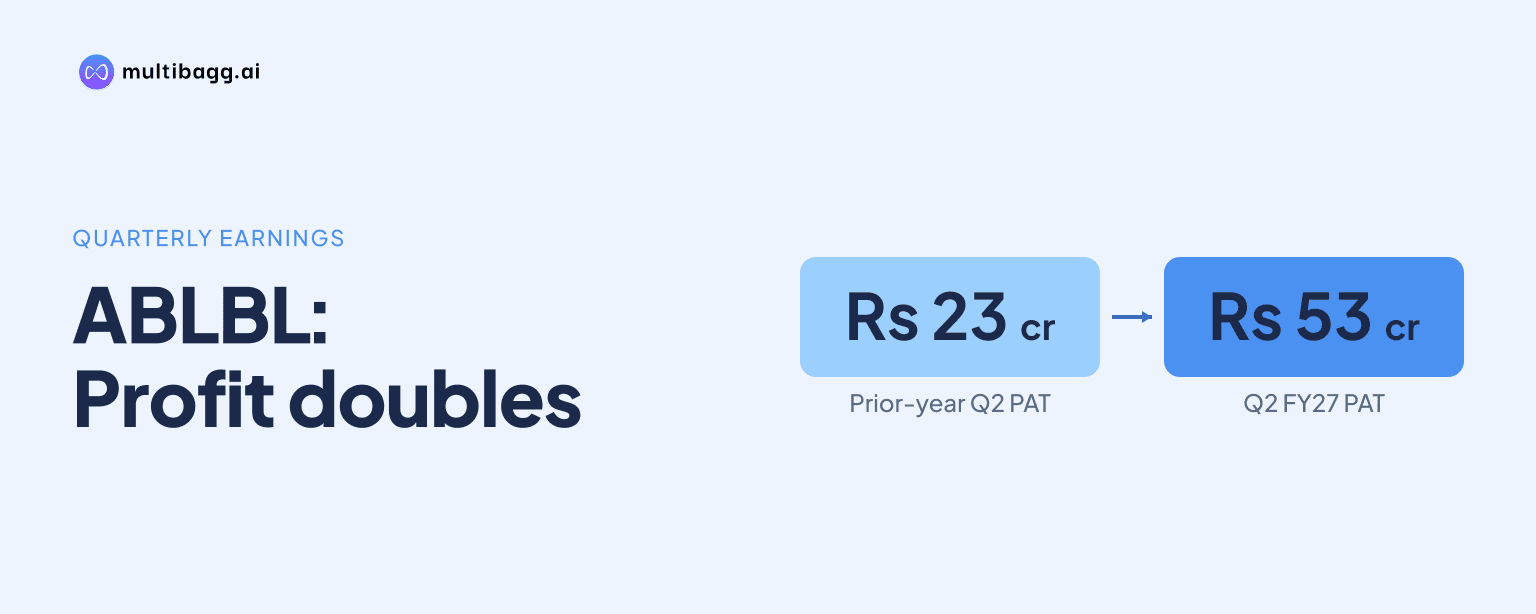
Aditya Birla Lifestyle Brands Ltd reported profit after tax of Rs 53 crore in the second quarter of financial year 2027 (Q2 FY27), up 126% year on year, as revenue increased 11% to Rs 2,266 crore. ABLBL said earnings before interest, tax, depreciation and amortisation (EBITDA) rose 15% to Rs 390 crore and its EBITDA margin expanded to 17.2% from 16.6%.
Know Aditya Birla Lifestyle Brands inside out
Results, valuation, peers and who's buying, in one view.
How did ABLBL’s Q2 FY27 profit change?
ABLBL’s profit after tax (PAT) rose to Rs 53 crore in Q2 FY27 from Rs 23 crore in Q2 FY26, an increase of 126%. Profit before tax increased 127% to Rs 70 crore from Rs 31 crore, while earnings before interest and tax (EBIT) climbed to Rs 167 crore from Rs 129 crore. Profit growth therefore outpaced the company’s 11% revenue growth during the quarter.
Revenue increased to Rs 2,266 crore in Q2 FY27 from Rs 2,038 crore a year earlier, an increase of Rs 228 crore. EBITDA increased by Rs 52 crore to Rs 390 crore from Rs 338 crore. EBITDA grew 15%, four percentage points faster than revenue, which ABLBL attributed to operating leverage.
What drove ABLBL’s EBITDA margin increase?
ABLBL’s consolidated EBITDA margin reached 17.2% in Q2 FY27, compared with 16.6% in Q2 FY26. The approximately 60-basis-point expansion was the company’s fifth consecutive quarter of margin expansion, according to the presentation. One basis point is one-hundredth of a percentage point, making the change a 0.6-percentage-point increase in operating margin.
The margin expansion accompanied an 11% rise in revenue and a 15% rise in EBITDA, with ABLBL identifying operating leverage as the reason operating earnings rose faster than sales. The company also reported double-digit growth in wholesale and e-commerce, while retail like-to-like (L2L) growth was 5.3%. L2L measures sales growth at comparable stores.
ABLBL described Q2 FY27 as its fourth consecutive quarter of double-digit overall growth. The company said a shift in the festive calendar deferred occasion-led purchases into Q3, affecting year-on-year comparability, although Lifestyle Brands revenue increased 9%. It also reported good Onam business and a good start to Pujo.
Which ABLBL segment contributed most to Q2 growth?
Lifestyle Brands remained ABLBL’s largest segment, generating Rs 1,906 crore of revenue in Q2 FY27, up 9% from Rs 1,754 crore in Q2 FY26. Its EBITDA rose by Rs 33 crore to Rs 371 crore, and its EBITDA margin increased to 19.5% from 19.3%. The segment provided most of the consolidated revenue increase of Rs 228 crore.
Emerging Business grew faster than Lifestyle Brands, with revenue rising 27% to Rs 371 crore from Rs 292 crore. Its EBITDA increased to Rs 25 crore from Rs 4 crore, while its margin expanded by 530 basis points to 6.8% from 1.5%. ABLBL attributed the performance to an 11% portfolio LTL result and distribution expansion across channels.
Emerging Business delivered the higher revenue growth rate and the larger margin increase, although its 6.8% margin remained below the 19.5% reported by Lifestyle Brands. Consolidated results also included eliminations of Rs 11 crore in revenue and Rs 6 crore in EBITDA in Q2 FY27, compared with Rs 8 crore and Rs 5 crore respectively a year earlier.
Got a follow-up? Ask IRIS
How did ABLBL perform in the first half of FY27?
ABLBL reported first-half (H1) FY27 revenue of Rs 4,311 crore, up 11% from Rs 3,878 crore in H1 FY26. EBITDA rose 15% to Rs 717 crore from Rs 623 crore, lifting the H1 EBITDA margin to 16.6% from 16.1%. The first-half results therefore also showed operating earnings increasing faster than sales.
H1 FY27 PAT increased 73% to Rs 82 crore from Rs 48 crore, while profit before tax rose 85% to Rs 110 crore from Rs 59 crore. EBIT increased to Rs 289 crore from Rs 242 crore. The 73% H1 PAT increase was lower than the 126% increase reported for Q2, based on the respective reported periods.
Lifestyle Brands generated Rs 3,631 crore of H1 FY27 revenue, 9% above Rs 3,324 crore a year earlier, and increased its EBITDA margin to 19.0% from 18.7%. Emerging Business revenue rose 23% to Rs 703 crore from Rs 571 crore, while its margin expanded to 5.6% from 1.7%. ABLBL said H1 retail LTL growth at Lifestyle Brands was 6%, while Emerging Business benefited from double-digit retail LTL and e-commerce performance.
What does ABLBL’s store expansion mean for the second half?
ABLBL added more than 100 new stores in Q2 FY27, compared with about 70 in Q1 FY27, marking its highest quarterly gross store addition in more than two years. For H1 FY27, gross additions exceeded 180 stores and net additions were 86 stores. The additions expanded the company’s physical distribution reach during the first half.
The company’s network stood at 3,434 brand stores across more than 800 cities and towns as of September 2026, including more than 560 stores in small towns. Its footprint was 5.1 million square feet and it had a presence in more than 190 malls. ABLBL said growth momentum was stronger in lower-tier markets, alongside this small-town store presence.
Conclusion
ABLBL’s Q2 FY27 outcome combined 11% revenue growth with faster increases in EBITDA, profit before tax and PAT. Lifestyle Brands provided the larger revenue and operating-profit base, while Emerging Business delivered the higher growth rate and a 530-basis-point margin increase. Together, those movements lifted consolidated EBITDA margin to 17.2% and PAT to Rs 53 crore.
The next results will show the effect of festive demand that ABLBL said had shifted into Q3 and the contribution from more than 180 gross store additions in H1 FY27. The company also identified rising input prices, minimum wages, logistics and sourcing expenses as cost pressures, while reporting a positive start to the festive season through Onam and Pujo.