










Adani Green Q2 FY27 EBITDA Rises 51% to Rs 3,835 Crore
Key highlights
- Adani Green Energy’s Q2 FY27 power supply revenue rose 45% year-on-year to Rs 4,019 crore.
- Q2 FY27 EBITDA from power supply increased 51% year-on-year to Rs 3,835 crore, with a 92% margin.
- H1 FY27 energy sales rose 32% to 25.7 billion units as the operational portfolio reached 20.8 GW.
- Adani Green commissioned 3 GWh of battery storage at Khavda in Q2 FY27, taking installed storage capacity to 6.6 GWh.
powered by IRIS
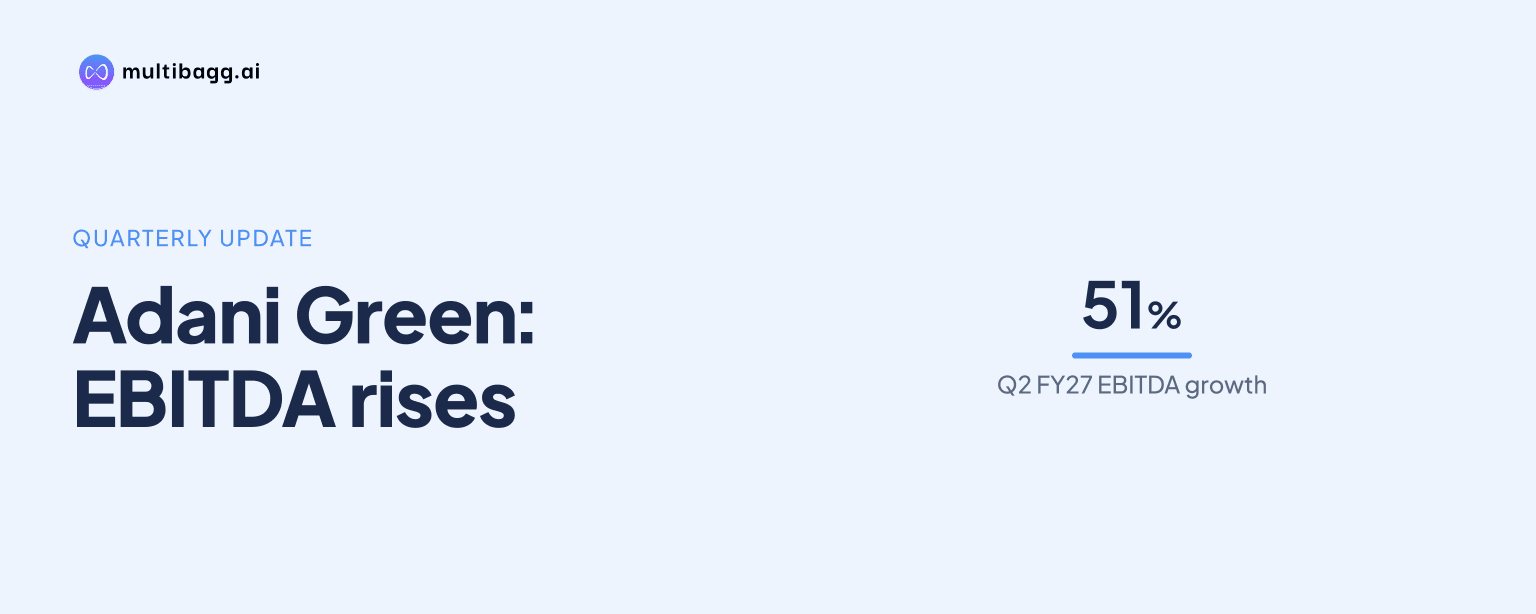
Q2 performance reflects higher power supply income
Know Adani Green Energy inside out
Results, valuation, peers and who's buying, in one view.
Adani Green Energy reported stronger operating and financial performance for the second quarter of FY27, led by growth in power supply revenue and EBITDA. Revenue from power supply rose 45% year-on-year to Rs 4,019 crore in Q2 FY27. EBITDA from power supply increased 51% year-on-year to Rs 3,835 crore. The company reported an EBITDA margin of 92% for the quarter. The figures were discussed by Ashish Khanna, chief executive officer of Adani Green Energy, during the company’s Q2 FY27 earnings call. The performance comes as India continues to expand renewable generation and electricity transmission capacity. Rising electricity consumption from industrial activity, electrification, electric mobility and data centres formed part of the wider demand backdrop described by management.
H1 revenue and EBITDA also increased
For the first half of FY27, Adani Green Energy’s revenue from power supply rose 36% year-on-year to Rs 8,299 crore. EBITDA from power supply grew 41% to Rs 7,957 crore during the six-month period. The company said the corresponding EBITDA margin was 93%. Total EBITDA for H1 FY27 stood at Rs 8,276 crore. Management said total EBITDA would have been close to Rs 9,000 crore if there had been no curtailment. This indicates that generation constraints affected the amount of renewable electricity that could be supplied to the grid during the period. The company did not provide a separate quantified financial impact of curtailment beyond this comparison.
Energy sales gain with capacity additions
Energy sales increased 32% year-on-year to 25.7 billion units in H1 FY27. Adani Green attributed the increase to a 24% year-on-year rise in greenfield capacity additions. Its operational portfolio crossed the 20 GW milestone during the first half. The company reported operational capacity of 20.8 GW. According to management, this portfolio supplied clean power equivalent to the requirements of more than 4.4 million homes. It also said the portfolio helped avoid 17.5 million tonnes of carbon dioxide emissions during the period. These operating measures show the scale of the company’s generation platform alongside its reported financial growth.
Q2 FY27 financial and operating snapshot
Storage becomes a larger part of operations
Battery energy storage was a key operational development during the quarter. Adani Green commissioned 3 GWh of battery energy storage system capacity at Khavda in Q2 FY27. This took its total installed storage capacity to 6.6 GWh. Management described energy storage as the next major pillar of the company’s growth. Storage can support the integration of renewable generation by shifting the availability of stored electricity to periods when it is needed. The reported commissioning is therefore relevant to the company’s ability to operate a larger renewable portfolio alongside grid conditions.
Got a follow-up? Ask IRIS
Curtailment remains a relevant operating factor
The H1 EBITDA comparison provided by management places curtailment among the factors investors may track. The company said H1 total EBITDA of Rs 8,276 crore could have been close to Rs 9,000 crore without curtailment. Renewable generators can face curtailment when grid availability or transmission constraints limit dispatch. Adani Green’s commentary also linked the sector backdrop to the rapid expansion of renewable energy and electrification in India. As renewable capacity grows, transmission infrastructure and storage deployment remain important for converting available generation into delivered power. The company’s additional battery capacity at Khavda is one operational response within that setting.
What the numbers mean for investors
The results show that power supply revenue grew faster than energy sales in the first half, with revenue up 36% and energy sales up 32%. In Q2, EBITDA from power supply grew faster than revenue from power supply, at 51% versus 45%. The reported 92% Q2 EBITDA margin and 93% H1 margin remain important indicators for assessing operating profitability in the power supply business. At the same time, the company’s curtailment disclosure highlights that capacity growth alone does not eliminate grid-related constraints. Investors will also monitor the pace at which newly commissioned generation and storage assets contribute to energy sales and earnings.
Broker commentary flags grid-connectivity timing
A Markets Today post on X said ICICI Securities maintained an Add rating on Adani Green Energy and revised its target price to Rs 1,430 from Rs 1,650. The post said the valuation was based on 14 times locked-in EBITDA. It also highlighted a delay of at least one quarter beyond December 2026 in the commissioning of 7 GW of grid connectivity lines as a near-term monitorable. This information was presented in the social-media post and not as a statement from Adani Green in the supplied earnings transcript. The reported delay is relevant because grid connectivity can determine when renewable assets can supply electricity and generate revenue.
Operational growth and grid execution will remain in focus
Adani Green Energy’s Q2 FY27 update combined higher power supply revenue, improved EBITDA and further expansion in energy storage. Its operating portfolio stood at 20.8 GW, while H1 energy sales reached 25.7 billion units. The company’s reported financial performance was supported by capacity additions, although management also identified curtailment as a factor affecting potential earnings. The next disclosures will be watched for the progress of storage deployment, greenfield capacity additions and grid connectivity. These factors will help determine how the company converts its installed renewable portfolio into electricity sales and EBITDA.