










Adani Enterprises Signs Jabil MoU for AI Hardware JV in India
Key highlights
- Adani Enterprises and Jabil Inc signed a non-binding MoU for a proposed 50:50 AI and data-centre hardware venture in India.
- The proposed venture would cover AI racks, servers, storage, networking equipment, PDUs and liquid-cooling systems.
- Google's planned Visakhapatnam AI campus has an initial capacity of 1 GW and is part of a $15 billion India investment programme over five years.
- AdaniConneX has reported more than 960 MW of tied-up data-centre capacity after securing a 400 MW hyperscale order in Vizag.
powered by IRIS
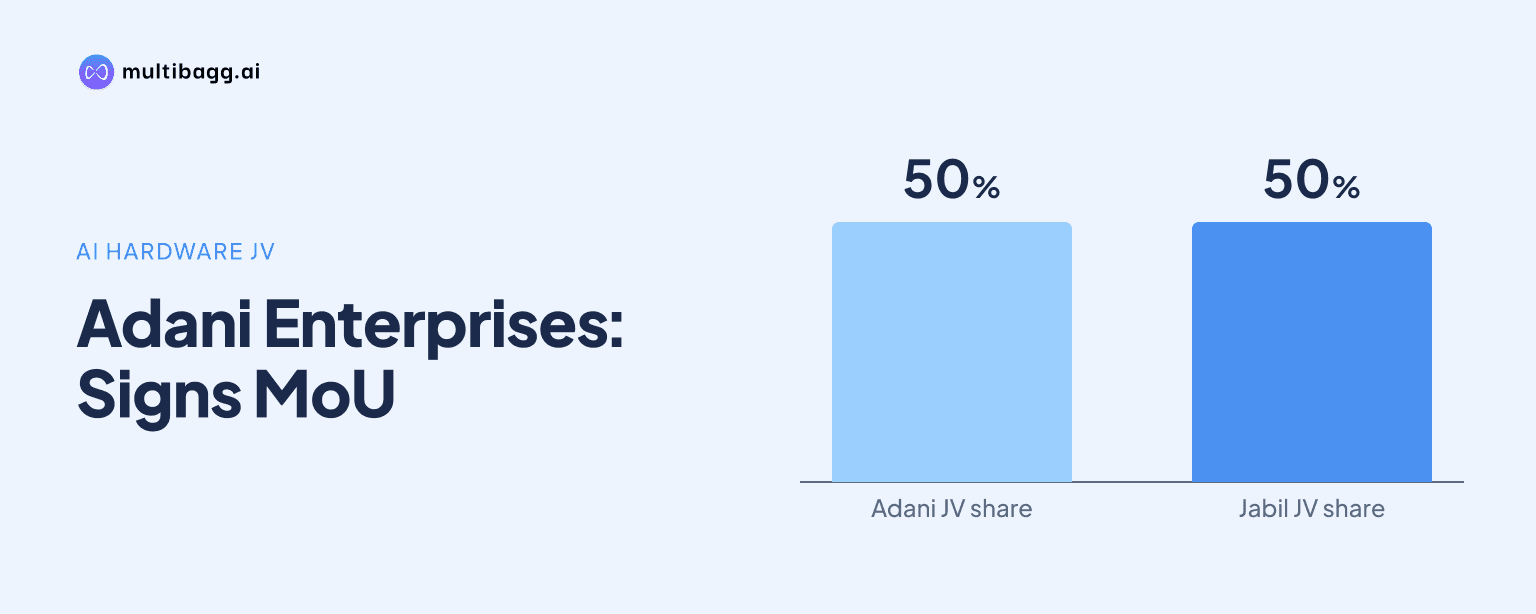
Adani Enterprises Limited has signed a non-binding memorandum of understanding with Jabil Inc to form a proposed 50:50 venture for manufacturing and assembling artificial intelligence and data-centre equipment in India. The planned platform would cover multi-gigawatt AI rack capacity and adds a hardware manufacturing layer to Adani Enterprises' expanding data-centre infrastructure plans.
Know Adani Enterprises inside out
Results, valuation, peers and who's buying, in one view.
What does the Adani Enterprises-Jabil agreement cover?
Adani Enterprises Limited and Jabil Inc have agreed through a non-binding MoU to explore a 50:50 joint venture for AI and data-centre hardware manufacturing in India. The proposed venture is intended to manufacture and assemble equipment used in AI computing and data-centre operations, subject to definitive agreements and regulatory approvals.
The stated scope includes AI racks, servers, storage systems, networking equipment, power distribution units and liquid-cooling systems. The companies have outlined plans for multi-gigawatt AI rack manufacturing capacity, although the material provided does not specify a capital investment, commissioning schedule, plant location or expected financial contribution from the proposed entity.
Jabil is a global engineering, supply-chain and manufacturing company listed on the New York Stock Exchange. Its proposed partnership with Adani Enterprises would combine Jabil's manufacturing capabilities with Adani Enterprises' presence in infrastructure and its expanding data-centre business.
Because the agreement is non-binding, it does not by itself establish an operating joint venture. The final structure, commercial terms, funding commitments and project implementation remain dependent on future definitive documentation and approvals.
How does the proposed venture fit Adani Enterprises' data-centre plans?
The proposed hardware venture complements Adani Enterprises' efforts to build data-centre infrastructure through AdaniConneX, its 50:50 joint venture with US-based EdgeConneX. AdaniConneX was formed in February 2021 to develop and operate hyperscale data centres across India.
The platform began with plans for facilities in Chennai, Navi Mumbai, Noida, Visakhapatnam and Hyderabad, alongside scalable edge data centres across the country. AdaniConneX has described its network as being largely powered by renewable energy, linking the data-centre buildout to the group's broader energy and transmission capabilities.
Visakhapatnam has emerged as a central location in this strategy. AdaniConneX is developing data-centre campuses at Mudasarlova and Tarluvada as part of a proposed development of about 1 GW. The planned facilities are expected to use air-cooled systems rather than water-based evaporative cooling, with dedicated industrial water connections instead of municipal water supplies.
The proposed Jabil venture could place equipment assembly closer to the domestic data-centre deployment pipeline. However, the companies have not disclosed whether the hardware from the proposed venture would be supplied to AdaniConneX projects, sold to third parties, or both.
Got a follow-up? Ask IRIS
What is the connection with the Google AI hub in Visakhapatnam?
AdaniConneX is partnering with Google and Bharti Airtel on a proposed AI data-centre hub in Visakhapatnam, which Google has said is part of a $15 billion investment programme in India over five years. The campus is planned with an initial capacity of 1 GW and is intended to scale to multiple gigawatts.
AdaniConneX and Airtel are expected to build supporting infrastructure for the hub, including a new international subsea gateway in Visakhapatnam. The wider plan also includes investments in renewable energy generation, energy storage and transmission lines in Andhra Pradesh.
The development connects Adani Enterprises' data-centre strategy with rising demand for cloud capacity, AI computing and digital services. The Jabil MoU is separate from the Google infrastructure announcement, but both initiatives are focused on the equipment and facilities required for large-scale AI workloads.
Visakhapatnam's data-centre ambitions predate the Google project. In January 2019, the Government of Andhra Pradesh signed an MoU with the Adani Group to build data-centre parks of up to 5 GW in and around the city over 20 years, with the project presented as being powered by renewable energy.
Why does domestic AI hardware manufacturing matter for investors?
Domestic manufacturing of AI and data-centre hardware matters because large computing campuses require integrated racks, servers, networking, power equipment and cooling systems in significant volumes. The proposed platform would seek to address those equipment requirements within India, though its operating scale and commercial economics have not yet been disclosed.
For Adani Enterprises, the MoU broadens the group’s stated data-centre strategy from developing sites and power infrastructure to potentially participating in hardware assembly. The arrangement is still at an exploratory stage, so investors do not yet have information on order commitments, revenue expectations, margins, investment outlay or the timeline for production.
The announcement also comes alongside continued buildout in Visakhapatnam. Adani Enterprises has reported that AdaniConneX secured a 400 MW hyperscale data-centre order in Vizag, taking its total tied-up capacity to more than 960 MW. This indicates that its data-centre platform has identified demand, although tied-up capacity is not the same as completed or operational capacity.
The broader sector requires dependable electricity, transmission infrastructure, international connectivity and efficient cooling. The planned renewable generation, storage, transmission lines and subsea cable gateway associated with the Google-linked hub illustrate the range of infrastructure needed beyond the data-centre buildings themselves.
Conclusion
The Adani Enterprises-Jabil MoU sets out a proposed equal venture to manufacture AI and data-centre equipment in India, covering components from AI racks and servers to power distribution and liquid cooling. It aligns with Adani Enterprises' data-centre expansion through AdaniConneX and with the development of large AI infrastructure in Visakhapatnam.
The next developments to watch are the signing of definitive agreements, receipt of any required approvals, disclosure of investment and manufacturing locations, and details on customer supply arrangements. Progress on the 1 GW Visakhapatnam campus, related transmission and clean-energy infrastructure, and the broader Google-led programme will also provide context for the scale of demand addressed by the proposed platform.