










Aditya Birla Sun Life AMC Q2 FY27 Profit Falls 8.4%
Key highlights
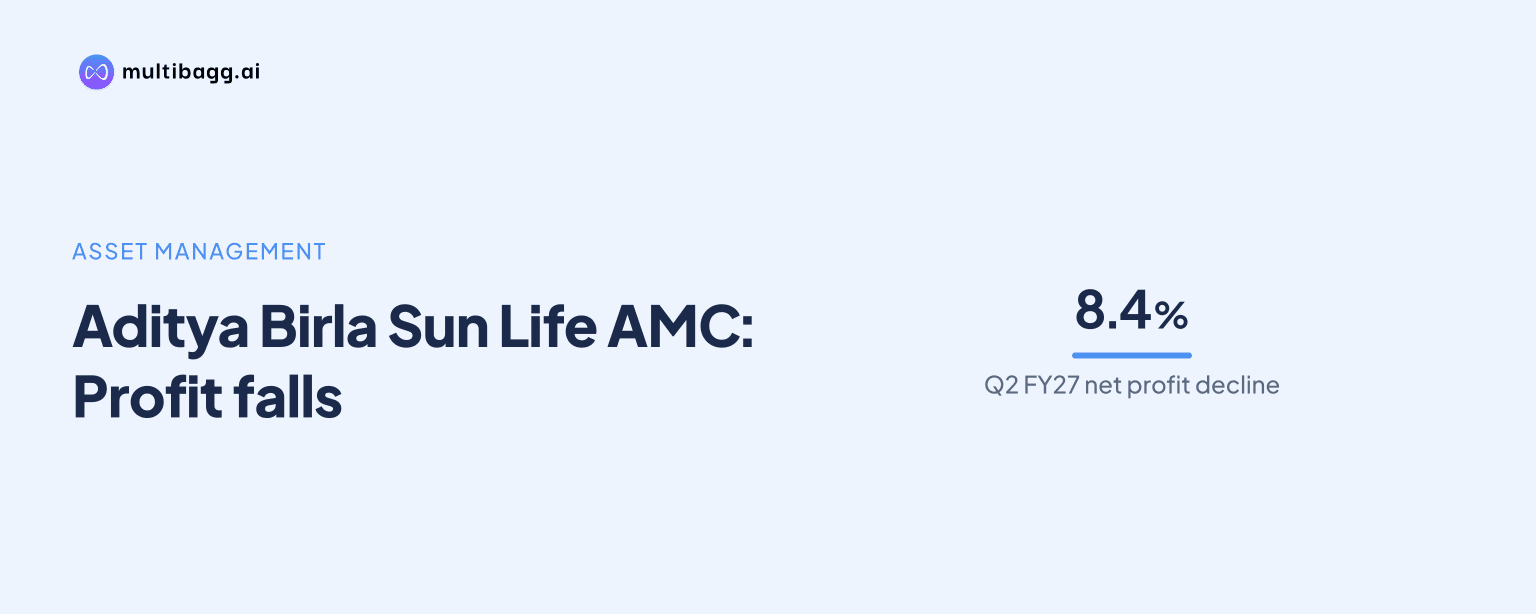
- Aditya Birla Sun Life AMC reported Q2 FY27 net profit of ₹220.98 crore, down 8.43% year-on-year.
- Revenue from operations rose 4.88% year-on-year to ₹483.81 crore in Q2 FY27.
- Total expenses increased 21% year-on-year to ₹230 crore, outpacing revenue growth.
- Quarterly average AUM reached ₹4.42 lakh crore, up 4% from a year earlier, while EBITDA margin fell to 55.4% from 61.3%.
powered by IRIS
Q2 FY27 earnings at a glance
Aditya Birla Sun Life Asset Management Company reported a mixed financial performance for the quarter ended September 30, 2026. Revenue from operations increased, supported by growth in average assets under management and a higher yield. However, profit declined year-on-year and sequentially as expenses rose at a faster pace than operating revenue. The company reported consolidated revenue from operations of ₹483.81 crore for Q2 FY27. Net profit stood at ₹220.98 crore, or about ₹221 crore. The results were released on October 21, 2026, followed by an earnings conference call. The September quarter figures show that growth in the asset-management franchise did not fully offset the increase in employee and other operating costs.
Know Aditya Birla Sun Life AMC inside out
Results, valuation, peers and who's buying, in one view.
Revenue from operations rises 4.9% year-on-year
Revenue from operations was ₹483.81 crore in Q2 FY27, compared with ₹461.32 crore in the corresponding quarter of the previous year. This represented year-on-year growth of 4.88%. Revenue also rose 4.50% from ₹462.96 crore in the June 2026 quarter. Separately, management referred to total revenue of about ₹526 crore in the earnings call, compared with about ₹506 crore in Q2 FY26. The difference reflects the distinction between revenue from operations and total revenue as presented in the available disclosures. Operating revenue growth was broadly in line with the reported increase in average assets under management. For the first half of FY27, revenue grew 4% year-on-year.
Profit declines despite top-line growth
Profit before tax was ₹296.19 crore in Q2 FY27, down 6.15% year-on-year from about ₹316 crore. It fell 27.06% sequentially from ₹406.07 crore in Q1 FY27. Net profit declined 8.43% year-on-year from ₹241.32 crore to ₹220.98 crore. It was also 28.60% lower than ₹309.49 crore reported in the preceding quarter. The sharp quarter-on-quarter movement in profit before tax and profit after tax was accompanied by a decline in profit before depreciation and tax. PBDT was ₹309.29 crore, down 26.16% sequentially and 5.25% year-on-year. The company reported H1 FY27 profit after tax of ₹530 crore.
Expenses and employee costs weigh on margins
Total expenses increased 21% year-on-year to ₹230 crore during the September quarter, compared with ₹191 crore a year earlier. Management attributed the increase in employee-related costs to several factors. CFO Pradeep Sharma cited ESOP costs of about ₹12-13 crore in the quarter. He also pointed to a ₹6 crore provision reversal in the prior-year base, annual increments and additions to headcount, including in the passive investment team. Operating profit was ₹268.05 crore, up 4.04% sequentially from ₹257.63 crore, but down 5.14% year-on-year. EBITDA was reported at about ₹270 crore, down 5% year-on-year. The EBITDA margin was 55.4%, compared with 61.3% in Q2 FY26.
Cost-to-income ratio moves higher
The cost-to-income ratio rose to 44.6% in Q2 FY27 from 38.7% in the year-ago quarter. This change reflects the faster rise in operating expenditure relative to operating revenue. The company said the quarterly impact of a newly launched scheme was about ₹3.5 crore. Existing schemes are expected to involve expenditure of about ₹55-60 crore annually over the next two years. The new scheme is expected to add about ₹14-15 crore annually. These figures provide context for the continuing cost base cited during the call. They also help explain why revenue growth did not translate into a corresponding rise in quarterly profit.
Got a follow-up? Ask IRIS
Average AUM records year-on-year growth
Quarterly average assets under management reached ₹4.42 lakh crore in Q2 FY27. This was 4% higher than the level reported a year earlier. The company also said its overall average AUM, including alternate assets, crossed ₹11 lakh crore, with growth of 14%. AUM is a key operating measure for an asset manager because management fees are linked to the assets managed across funds and other products. The reported operating revenue growth and the increase in quarterly average AUM were therefore closely connected. The company also reported a quarterly yield of 43.8 basis points. This was higher than 43.4 basis points in Q2 FY26 and 43.3 basis points in Q1 FY27.
Key financial metrics
Other income supports reported profit
The earnings commentary noted that other income contributed to the reported profit after tax outcome. It described reported profit after tax of about ₹220 crore as a 15% beat against the referenced estimate. Core profit after tax for the quarter was about ₹190 crore, down 8% year-on-year. The distinction between reported and core profit is relevant because it separates the impact of other income from the operating performance of the fund-management business. Even with this support, the company’s reported net profit remained lower than the year-ago level. Investors assessing the quarter will therefore be focused on the pace of revenue growth, cost trends and AUM movement together.
What the results mean for investors
The Q2 FY27 results show an asset manager with growing operating revenue and AUM but a higher expense base. Revenue from operations grew nearly 5% year-on-year, while total expenses increased 21%. This divergence resulted in lower EBITDA margin, a higher cost-to-income ratio and an 8.43% fall in net profit. The higher quarterly yield provides a positive operating data point, while the increase in average AUM indicates continued expansion in the asset base. At the same time, management’s comments on ESOP costs, workforce additions and scheme-related expenses show the factors that affected profitability during the period. The next quarterly disclosure will provide an updated view of costs, AUM and the progress of the company’s operating margins.