










Aditya Vision Limited Q2 revenue rises 28% to ₹586 crore
Key highlights
- Aditya Vision Limited's Q2 FY27 revenue rose 28.1% year on year to ₹586.23 crore.
- Q2 FY27 PAT increased 45.2% year on year to ₹18.47 crore, with PAT margin at 3.2%.
- H1 FY27 revenue reached ₹1,778.91 crore, up 27.3%, while same-store sales growth was 18%.
- AVL operated 214 stores at September 30, 2026, up from 188 stores a year earlier.
powered by IRIS
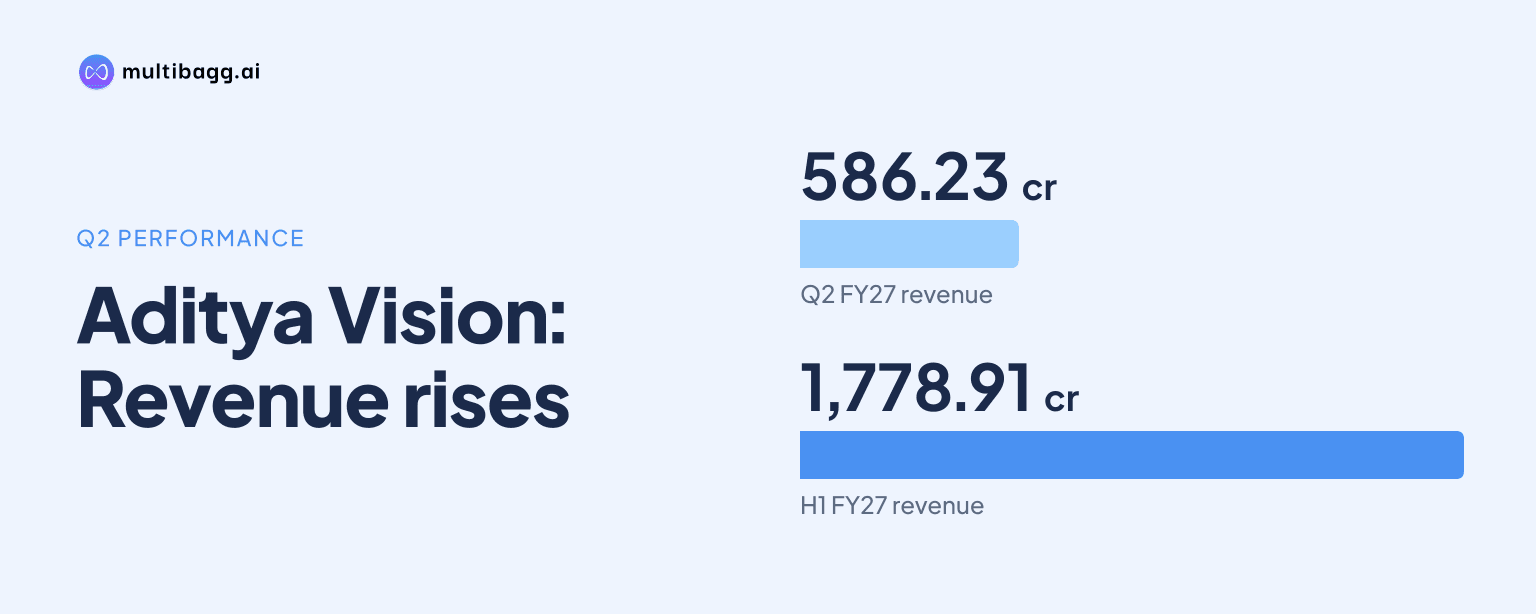
Aditya Vision Limited reported Q2 FY27 revenue of ₹586.23 crore, up 28.1% year on year, while profit after tax increased 45.2% to ₹18.47 crore. The retailer also recorded 18% same-store sales growth, indicating higher sales from its established stores alongside network expansion.
Know Aditya Vision inside out
Results, valuation, peers and who's buying, in one view.
What did AVL report for Q2 FY27?
AVL reported its best-ever second-quarter performance, with revenue rising to ₹586.23 crore for the quarter ended September 30, 2026. Gross profit grew 38.8% year on year to ₹95.59 crore, and gross margin expanded by 125 basis points to 16.3%.
EBITDA increased 31.6% to ₹45.65 crore, with the EBITDA margin improving by 21 basis points to 7.8%. Profit before tax rose 45.3% to ₹24.26 crore, while PAT reached ₹18.47 crore. The PAT margin improved by 37 basis points to 3.2%.
The company attributed the quarter's performance to business execution and customer demand. Management said air conditioners led growth during the quarter, supported by an extended summer season, followed by mobile phones and refrigerators.
How did AVL perform in the first half of FY27?
AVL's H1 FY27 revenue rose 27.3% year on year to ₹1,778.91 crore. This growth was supported by 18% same-store sales growth, compared with 2% in H1 FY26, showing a substantial improvement in sales at stores that were already operating.
Gross profit for the six months increased 34.9% to ₹287.42 crore, taking the gross margin to 16.2%, up 91 basis points. EBITDA rose 36.8% to ₹170.13 crore and the EBITDA margin improved by 66 basis points to 9.6%.
H1 profit before tax increased 41.1% to ₹127.08 crore. PAT grew 41% to ₹95.69 crore, while PAT margin expanded by 52 basis points to 5.4%. These figures indicate that profit growth exceeded revenue growth during the first half.
What drove the margin improvement and what is management's guidance?
AVL said the Q2 gross-margin expansion was partly aided by original equipment manufacturer price increases. Management estimated that these price increases contributed about 50 to 80 basis points of the 125-basis-point increase, with the remaining improvement coming from regular trading activity.
Management did not treat the price-hike benefit as permanent and retained gross-margin guidance of 15% to 15.5%. The stated guidance is below the 16.3% gross margin reported in Q2, reflecting management's view that margins may normalise when prices remain constant.
Indirect expenses rose 64% year on year from ₹17 crore to ₹28 crore in Q2. AVL linked the increase to financing costs, credit-card costs, cash-management service charges, freight and expenses related to 30 new stores added during the year.
Got a follow-up? Ask IRIS
Where is AVL expanding its retail network?
AVL operated 214 stores as of September 30, 2026, compared with 188 stores a year earlier, an increase of 13.8%. Its retail footprint was approximately 9.51 lakh square feet, up 18.3% year on year.
The company had 120 stores across all 38 districts of Bihar, 56 stores across 32 of Uttar Pradesh's 75 districts, 33 stores across 22 of Jharkhand's 24 districts and five stores across three of Chhattisgarh's 33 districts. During calendar year 2026, AVL entered Chhattisgarh, Madhya Pradesh and West Bengal.
Bihar remained the largest contributor, accounting for about 73% of Q2 revenue. Uttar Pradesh contributed 15%, Jharkhand 11% and Chhattisgarh 1%. This mix shows that the business continues to be heavily concentrated in Bihar even as it expands into newer markets.
What should investors watch after AVL's Q2 results?
AVL reduced borrowings to ₹293 crore at the end of September 2026 from ₹331 crore at the end of March 2026. Inventory stood at ₹865 crore, which management said was intended to support festive-season demand and anticipated price increases.
For investors, the key operating measures remain same-store sales, gross-margin performance and expansion in newer states. The 18% same-store sales growth and higher margins supported the first-half profit increase, while elevated indirect expenses and the company's stated normalised margin guidance provide important context for assessing future results.
Conclusion
AVL delivered higher revenue and faster profit growth in Q2 and H1 FY27, supported by strong same-store sales, category demand and a larger retail network. The quarterly results also showed improved gross, EBITDA and PAT margins, although management identified a temporary contribution from OEM price increases to gross-margin expansion.
The next disclosed operating milestone is the company's plan to close FY27 with around 230 to 235 stores. Management also expects to add another 35 stores in the following year, taking the network to roughly 270 stores; execution in new states, inventory management and progress towards the 15% to 15.5% gross-margin guidance remain relevant factors to watch.