










AETL sees $250 million probiotics market after FY26 revenue fell
Key highlights
- AETL estimates a $250 million probiotics addressable market over the next five years, growing at 14%.
- Probiotics revenue fell to $2.4 million in FY26 from $4.3 million in FY25, reducing its revenue share to 3% from 6%.
- Animal nutrition is AETL’s largest stated opportunity at $800 million, while food bio-processing is valued at $385 million.
- AETL filed 3 GRAS dossiers with the US FDA in 2026 and incorporated Advanced Nutrazyme to expand its nutrition and wellness presence.
powered by IRIS
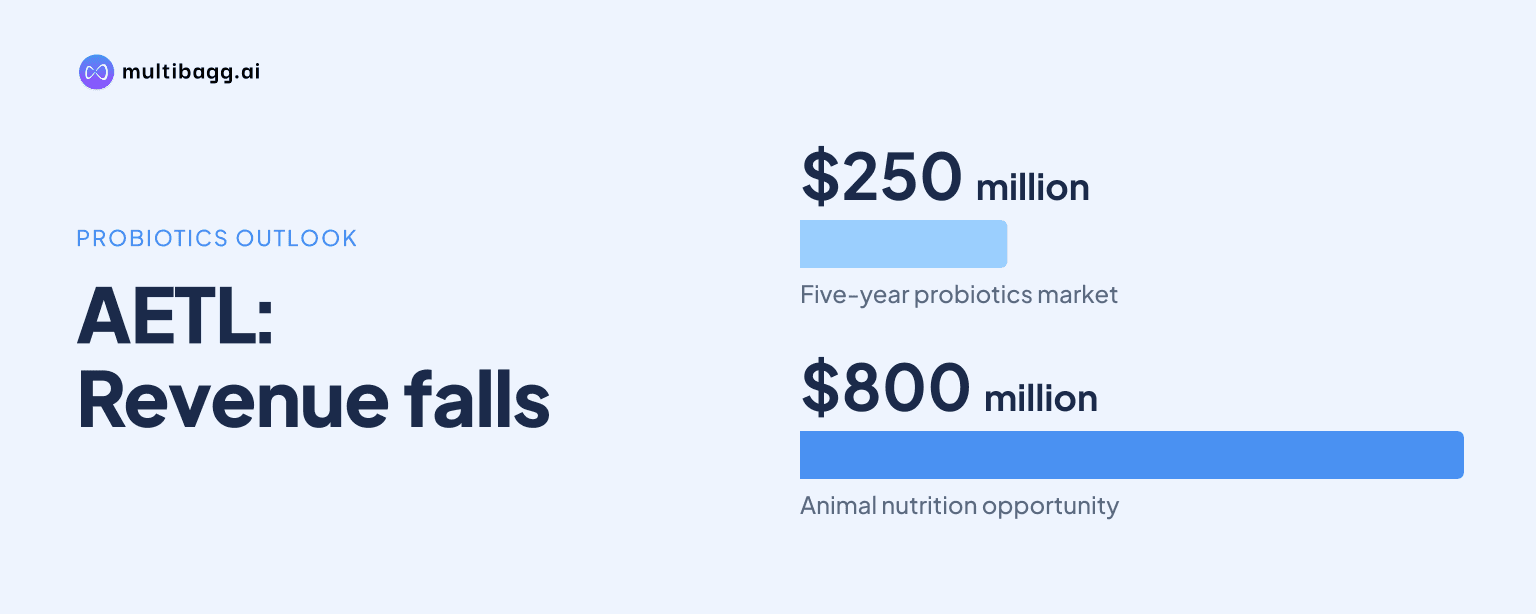
Advanced Enzyme Technologies Limited, referred to as AETL, estimates a $250 million probiotics addressable market over the next five years, while probiotics supplied $2.4 million, or 3%, of FY26 revenue. That revenue was down from $4.3 million and 6% in FY25, placing its largest human-nutrition opportunity alongside a smaller current sales contribution.
Know Advanced Enzyme Technologies inside out
Results, valuation, peers and who's buying, in one view.
How large is AETL’s probiotics opportunity?
AETL estimates its addressable probiotics market at $250 million over the next five years. The company assigns a 14% growth rate to this opportunity, which is higher than the 6% rates shown for pharma/API and bio-catalysis, the 8% rates shown for nutrition and animal nutrition, and the 7% rates shown for food and non-food bio-processing.
The presentation puts the global probiotics market at $13 billion and projects a 14.12% compound annual growth rate, or CAGR, from calendar year 2024 to 2029. Human probiotics represent $12 billion, or 93%, of that market, compared with $1 billion, or 7%, for animal probiotics; AETL presents its $250 million estimate within human nutrition.
Within AETL’s human-nutrition categories, probiotics is the largest stated five-year addressable market. Its $250 million estimate exceeds the $200 million nutrition estimate by $50 million, the $60 million bio-catalysis estimate by $190 million and the $50 million pharma/API, or active pharmaceutical ingredient, estimate by $200 million.
AETL labels both opportunity-size figures and addressable-market figures as its own estimates. The $250 million figure is therefore a management estimate of the market AETL could address over five years, not a disclosed forecast for probiotics revenue, profit or market share.
How much revenue does AETL earn from probiotics?
AETL reported $2.4 million of probiotics revenue in FY26, equal to 3% of total revenue. This was lower than $4.3 million, or 6% of revenue, in FY25, meaning both reported sales and the segment’s share of revenue declined year on year.
The FY26 mix shows that pharma/API generated $24.90 million and represented 29% of revenue, compared with $18.04 million and 24% in FY25. Nutrition remained the other larger disclosed human-nutrition line, but its revenue fell from $23.45 million to $22.78 million and its revenue share fell from 31% to 27%.
Bio-catalysis increased from $2.1 million in FY25 to $2.8 million in FY26, while retaining a 3% revenue share. The contrast with probiotics is that both lines represented 3% in FY26, but probiotics had declined from $4.3 million whereas bio-catalysis had increased from $2.1 million.
Got a follow-up? Ask IRIS
How does probiotics compare with AETL’s other target markets?
AETL’s largest overall stated five-year addressable market is animal nutrition at $800 million, rather than probiotics at $250 million. Food bio-processing follows at $385 million, while nutrition is $200 million, non-food bio-processing is $100 million and specialized manufacturing is also $100 million.
Animal nutrition generated $10.7 million, or 13% of FY26 revenue, versus $9.0 million and 12% in FY25. Food bio-processing generated $10.95 million and 13% in FY26, up from $9.57 million while retaining a 13% share, showing that these two larger addressable categories had a greater current revenue contribution than probiotics.
The opportunity-size figures are not uniform across AETL’s categories. The company lists an underlying $2 billion animal-nutrition opportunity and an $11 billion food bio-processing opportunity, compared with $13 billion for probiotics, yet its addressable-market estimates are $800 million, $385 million and $250 million respectively.
AETL places bio-catalysis at a $60 million addressable market over the next five years against a $316 million opportunity size. It adds that this bio-catalysis estimate currently considers only India, an explicit scope constraint not stated for the $250 million probiotics estimate.
Which companies does AETL identify across probiotics and enzymes?
AETL lists Danone, Yakult, Novonesis, Sabinsa, Kerry, Lallemand and Unique Biotech in probiotics, a market it values at $13 billion globally. In nutraceuticals, it names Novonesis, DSM and Archer Daniel Midland, while Anthem Biosciences is listed in pharmaceuticals.
For animal nutrition, where AETL estimates an $800 million five-year addressable market, the company names Novonesis, DSM, Kemin, Novus, Alltech, Cargill, BASF SE and Biomin. Its bio-catalysis list includes Codexis, Cambrex, Sigma-Aldrich, Lonza, Biosyntia, BASF SE and Amano Enzymes, as well as other regional players.
AETL identifies AB Enzymes, DSM, Novonesis and Kerry Foods in food bio-processing, and Novonesis, DuPont, DSM, AB Enzymes and Amano Enzymes in non-food bio-processing. The presentation places food enzymes at $2.5 billion and non-food enzymes at $8 billion within a $16 billion global enzymes market projected to grow at a 7.80% CAGR through 2029.
AETL describes its platform as covering research and development, manufacturing, and marketing and distribution. Its stated research activities include enzyme and probiotic discovery and process scale-up, while its operating profile includes more than 400 products and more than 700 customers worldwide.
Conclusion
AETL’s presentation identifies a sizeable gap between its probiotics market estimate and its present revenue exposure. Management estimates that it can address $250 million of probiotics demand over five years at a stated 14% growth rate, but the line accounted for $2.4 million and 3% of FY26 revenue after declining from $4.3 million and 6% in FY25.
What to watch next is whether AETL discloses a probiotics sales target, customer conversion timetable or commercialization milestone for that five-year opportunity. The presentation records three GRAS, or Generally Recognized as Safe, dossiers filed with the US Food and Drug Administration in 2026 and the incorporation of Advanced Nutrazyme Private Limited to expand nutrition and wellness presence, but it does not connect either development to a stated probiotics revenue target.