








AF Enterprises Limited gets audit qualification over Rs 23.43 crore
MAX Plan at ₹4,999/yr

Find your next multibaggerBe a Pro Investor
Research stocks and track your picks on the go. Download the app.
Key highlights
- AF Enterprises received a qualified consolidated audit opinion for the year ended March 31, 2026.
- The subsidiary reported Rs 23.43 crore of trade receivables outstanding for more than three years.
- The subsidiary reported Rs 22.98 crore payable to Morpheus Care Limited without third-party confirmation.
- The subsidiary’s current liabilities exceeded net assets by Rs 1.77 crore at March 2026.
powered by IRIS
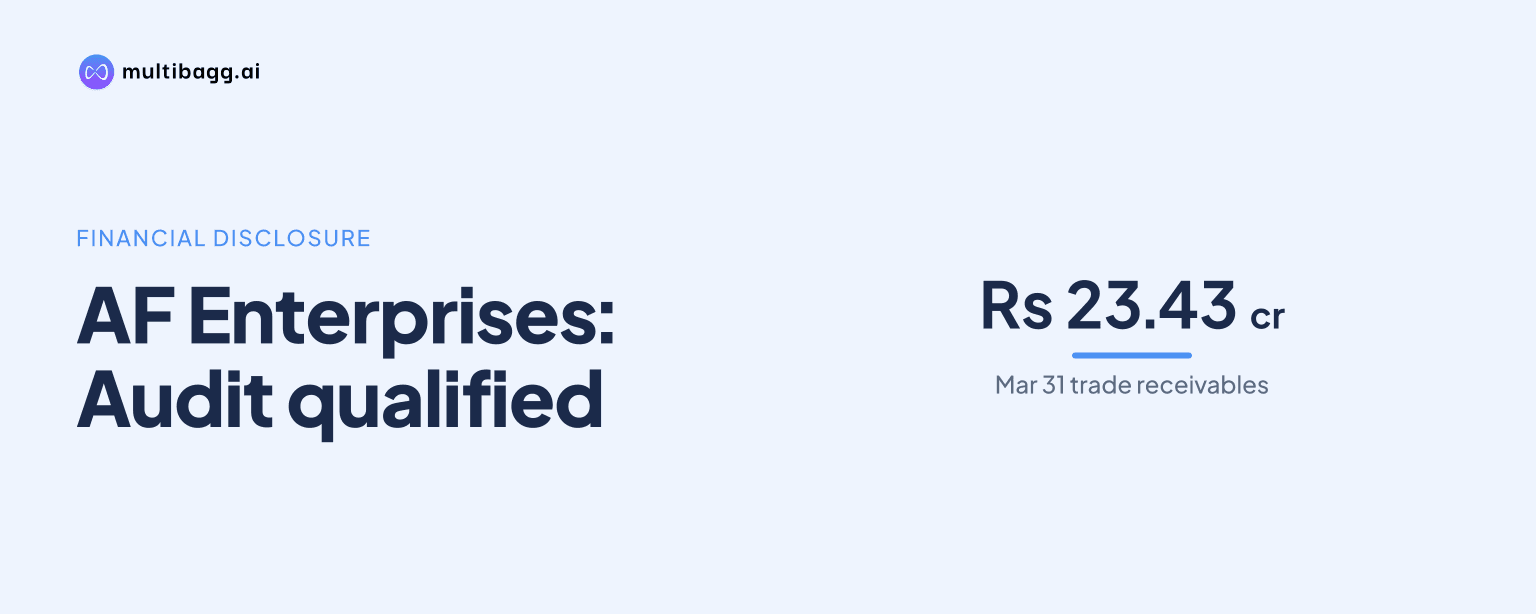
AF Enterprises Limited received a qualified opinion on its consolidated results for the year ended March 31, 2026, after auditors could not obtain sufficient evidence for Rs 23.43 crore of a subsidiary’s trade receivables outstanding for more than three years. The subsidiary also reported Rs 22.98 crore of unconfirmed trade payables.
Know A F Enterprises inside out
Results, valuation, peers and who's buying, in one view.
Why did AF Enterprises receive a qualified audit opinion?
AF Enterprises received the qualification because the subsidiary’s separate auditors issued a disclaimer of opinion for the year ended March 31, 2026, which HKG Associates cited in its report on the group’s consolidated financial results. HKG Associates said the annual results gave a true and fair view except for the possible effects of matters described in its basis for qualified opinion.
The consolidated report includes the financial results of Aunik IT Private Limited, identified as the subsidiary, whose statements showed total assets of Rs 23.73 crore at March 31, 2026. The subsidiary had nil revenue during 2025-26 and a net cash outflow of Rs 0.73 lakh, according to the group auditor’s report.
HKG Associates said it had not audited the subsidiary’s individual financial statements and considered its separate auditors’ report dated August 4, 2026. For the quarter ended March 31, 2026, HKG Associates conducted a limited review and said that, except for the possible effects of the same matters, nothing had come to its attention indicating a material misstatement or non-compliance with Regulation 33 of the Securities and Exchange Board of India, or SEBI, Listing Regulations.
Which subsidiary balances could require adjustment?
The balances that could require adjustment are Rs 23.43 crore of trade receivables from two parties and Rs 22.98 crore of trade payables to Morpheus Care Limited at March 31, 2026. The subsidiary’s auditors said they received no third-party confirmation for either balance and lacked sufficient evidence on the reliability of the receivable recoveries and the payable claim.
The receivables had been outstanding for more than three years and the subsidiary had made no provision against them. Management represented that it expected to recover the receivables and settle the Morpheus Care payable from those recoveries, but said the settlement had been put on hold as the recovery process was taking time.
The auditors also said their Ministry of Corporate Affairs, or MCA, portal check showed Morpheus Care had not filed returns from March 2020 onward. They concluded that the matters could require material adjustments to the recorded values of assets and liabilities, rather than determining the amount of any such adjustment.
Got a follow-up? Ask IRIS
Why did auditors raise a going-concern uncertainty?
The subsidiary’s auditors said a material uncertainty existed over its ability to continue as a going concern at March 2026. They cited accumulated losses of Rs 2.48 crore, fully eroded net worth and current liabilities exceeding net assets by Rs 1.77 crore, while the financial statements continued to use the going-concern basis.
The report also noted that the subsidiary did not have Goods and Services Tax, or GST, registration during the year under consideration. Management said it was identifying new business plans to improve performance, but the auditors said no concrete plan had been placed on record to support the financial statements’ going-concern assessment.
During 2025-26, the subsidiary had unsecured loans of Rs 2.12 crore from director Sourabh Khowal, including Rs 1.69 crore presented as an opening balance. The auditors said the opening amount was taken during 2023-24 in violation of Section 73(2) of the Companies Act, 2013, and stated that the director had provided the loan from borrowed funds, which they also described as a violation of that provision.
How do the subsidiary issues compare with AF Enterprises’ standalone results?
The qualification concerns AF Enterprises’ consolidated results and the subsidiary, rather than the parent’s standalone balances. In standalone operations, revenue fell to Rs 89.24 lakh in the year ended March 31, 2026 from Rs 9.75 crore in the year ended March 31, 2025, while loss before tax narrowed to Rs 2.58 crore from Rs 2.78 crore.
Trading in plastic moulded components generated Rs 88.16 lakh of standalone revenue in 2025-26, compared with Rs 7.79 crore a year earlier. Unallocable revenue declined to Rs 1.09 lakh from Rs 1.96 crore, meaning the overall fall was recorded in both the plastic-moulded-components segment and the unallocable category.
Standalone trade receivables were Rs 92.18 crore at March 31, 2026, compared with Rs 92.46 crore a year earlier, while trade payables increased to Rs 46.05 crore from Rs 45.97 crore. These standalone balances are separate from the subsidiary’s Rs 23.43 crore receivables and Rs 22.98 crore payables that underpin the consolidated audit qualification.
AF Enterprises reported standalone closing cash and cash equivalents of Rs 74.59 lakh at March 31, 2026, up from Rs 38.09 lakh at March 31, 2025. Net operating cash outflow narrowed to Rs 26.79 lakh from Rs 17.21 crore, with the prior-year cash-flow statement recording a Rs 15.05 crore decrease in trade payables.
Conclusion
The qualification in AF Enterprises’ 2025-26 consolidated audit centres on the subsidiary’s aged balances: Rs 23.43 crore of receivables lacked confirmation and provisioning, while Rs 22.98 crore of payables lacked third-party confirmation. The near-matched balances do not resolve the audit issue because the proposed payable settlement depends on recoveries that the auditors could not substantiate.
The next disclosed matter to watch is whether the subsidiary produces the concrete business plan management said it was identifying, alongside evidence supporting receivable recovery. Progress on the recovery-linked settlement of the Rs 22.98 crore payable, the GST-registration position and the Rs 1.77 crore excess of current liabilities over net assets will remain relevant to the going-concern uncertainty.

