










Alembic Pharmaceuticals lifts FY27 revenue growth outlook to 20%-25%
Key highlights
- Alembic Pharmaceuticals raised FY27 consolidated revenue-growth guidance to 20%-25% from the mid-teens.
- Q2 FY27 consolidated revenue increased 36% year on year to Rs 2,603 crore.
- U.S. generics grew 72% in Q2 FY27, while the base portfolio rose 23% excluding new launches.
- API grew 39% in Q2 FY27, and management expects at least high-teens growth for FY27.
powered by IRIS
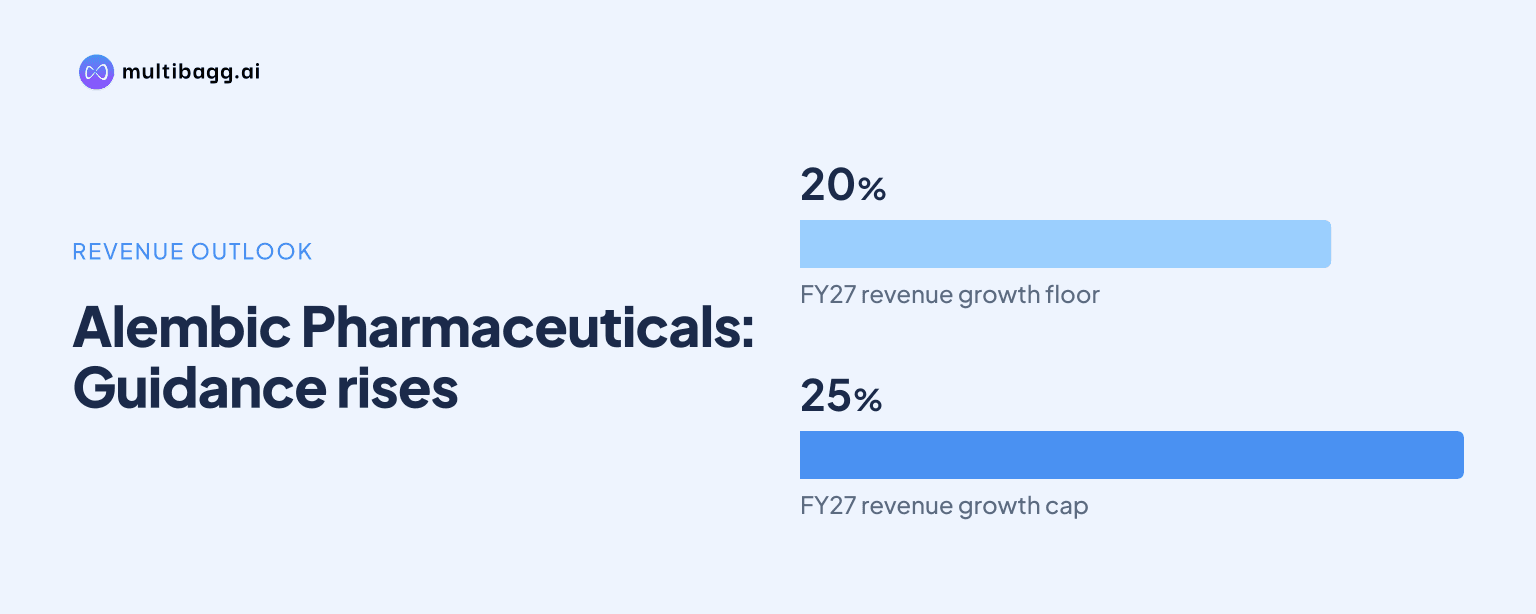
Alembic Pharmaceuticals Limited raised its FY27 consolidated revenue-growth guidance to 20%-25% from the mid-teens after Q2 FY27 revenue rose 36% year on year to Rs 2,603 crore. Management cited stronger-than-expected U.S. business and active pharmaceutical ingredients, or API, performance, while factoring in normalisation after bosutinib exclusivity ends in November 2026.
Know Alembic Pharmaceuticals inside out
Results, valuation, peers and who's buying, in one view.
Why did Alembic Pharmaceuticals raise FY27 revenue guidance?
Alembic Pharmaceuticals raised guidance because the U.S. business and API business exceeded its earlier expectations in the first half of FY27. Consolidated revenue increased 31% year on year to Rs 4,753 crore in H1 FY27, and management said this performance increased its confidence in the second half.
Management now expects U.S. business growth of up to 40% year on year for FY27, supported by base-portfolio volumes, new launches and specialty products. API is expected to grow at least in the high teens for the full year after delivering 39% volume-led growth in Q2 FY27, including contract manufacturing organisation, or CMO, deliveries to key customers. India branded guidance was unchanged at market-level, or close to market-level, growth, while ex-U.S. markets remain guided for mid-teens growth.
The new 20%-25% range allows for a decline in exclusivity-led sales after bosutinib. Management said bosutinib sales were above expectations and that exclusivity continues until the end of November 2026, but it gave no post-exclusivity sales forecast. The upgraded outlook therefore depends on the wider U.S. portfolio and API growth rather than continued bosutinib sales at the Q2 level.
How is Alembic Pharmaceuticals' U.S. portfolio driving growth?
Alembic Pharmaceuticals' U.S. generics business grew 72% year on year in Q2 FY27, while the base portfolio grew 23% excluding new launches. The gap indicates that bosutinib and other launches lifted quarterly growth, although management said established products also continued to gain from volumes.
During Q2, Alembic Pharmaceuticals launched three generics, filed five abbreviated new drug applications, or ANDAs, and received one approval. Its pipeline supports more than 30 launches over the next 18 months, with about one-quarter classified as first-to-file, or FTF, or shared day-1 opportunities. Management did not forecast revenue from individual products because competition and launch conditions can differ by product.
The expanded DifGen Pharmaceuticals partnership covers more than 20 products, including transdermal patches, complex injectables and ophthalmics, addressing an estimated U.S. reference market of about $5 billion. Management described the arrangement as a licensing and profit-sharing deal: DifGen will develop and manufacture most products, while Alembic Pharmaceuticals will handle U.S. marketing and commercialisation. Contributions are expected to begin in FY28.
Alembic Pharmaceuticals' U.S. branded portfolio contributed close to 3% of U.S. revenue in Q2 FY27. Management said it had about 30 to 35 representatives against a target of 40 to 45, with insurance and Medicaid coverage in place. It expects the branded operation to break even by the end of FY27 or in the first half of FY28, after a planned FY27 margin dilution of 150 to 200 basis points.
Got a follow-up? Ask IRIS
What were Alembic Pharmaceuticals' Q2 profit and margin results?
Alembic Pharmaceuticals reported Q2 FY27 profit after tax of Rs 335 crore, up 81% year on year, alongside Rs 2,603 crore of revenue. Reported earnings before interest, tax, depreciation and amortisation, or EBITDA, increased 78%, and EBITDA margin rose by about 520 basis points to 22.2% from 17.0% in Q2 FY26.
Gross margin expanded by 70 basis points to 73.7%, despite higher solvent costs and geopolitical headwinds. Management retained its 70%-75% gross-margin range, saying product mix and new launches will affect quarterly outcomes. It also cited higher freight, forwarding and logistics costs, which have risen since the March quarter.
Research and development expenditure was 8% of Q2 FY27 revenue, directed towards complex generics, regulatory filings and differentiated products. For H1 FY27, EBITDA grew 51%, EBITDA margin improved by 255 basis points and profit after tax rose about 50%. Management said the first-half EBITDA margin of about 22% should hold in the second half, while also indicating a high-teens full-year EBITDA margin expectation.
Can Alembic Pharmaceuticals sustain India and API momentum?
Alembic Pharmaceuticals' India business grew 14% year on year in Q2 FY27, led by 11% growth in Human Health and 23% growth in Animal Health. Chronic and specialty therapies, including gynecology, cardiology and emerging therapies, supported the improvement. The specialty portfolio grew about 200 basis points faster than the Indian pharmaceutical market, or IPM.
Management aims to reach IPM-level growth over the next two to three quarters without broadly expanding the field-force scale. It cited sharper territory execution, productivity work in chronic therapies, focused brands and priority markets as its main actions. Metro coverage still needs improvement, while the acute portfolio is expected to move towards IPM-level growth over the next couple of quarters.
API's 39% Q2 FY27 growth reflected the breadth of its customer and product base as well as certain CMO deliveries, according to management. The full-year expectation of at least high-teens growth is below the Q2 rate, showing that management has not assumed the quarterly pace will continue unchanged. Ex-U.S. markets grew 12% in Q2 and remain part of the mid-teens growth outlook.
Alembic Pharmaceuticals spent about Rs 250 crore on capital expenditure in H1 FY27 and said its major capex cycle is behind it. Management plans debottlenecking and incremental line additions rather than significant greenfield investment. Net debt was Rs 1,236 crore, while management said longer collection cycles on new U.S. launches had increased working capital and should unwind over the next few quarters.
Conclusion
The FY27 guidance increase combines 72% Q2 growth in U.S. generics, 39% API growth and a 14% increase in India business revenue. Q2 revenue of Rs 2,603 crore and EBITDA margin of 22.2% show the financial effect of recent launches and operating leverage, although bosutinib sales are expected to normalise after exclusivity expires.
The next developments to watch are the market outcome after November 2026 bosutinib exclusivity, execution of more than 30 planned U.S. launches over the next 18 months, and India business progress towards IPM-level growth within two to three quarters. Management also expects DifGen products to start contributing in FY28 and the U.S. branded business to reach break-even by the end of FY27 or in H1 FY28.