










Allcargo Terminals targets 1.345 million TEUs capacity by FY30
Key highlights
- ATL’s FY30 capacity roadmap reaches 1.345 million TEUs, compared with 830,000 TEUs in FY25.
- The listed projects add 515,000 TEUs, including 170,000 TEUs at JNPT.
- Farukhnagar is allocated 120,000 TEUs, with its PFT on track for completion by March 2027.
- ATL handled 190,100 TEUs in Q2FY27, up 12.6%, while EBITDA rose 45.9% to Rs 59 crore.
powered by IRIS
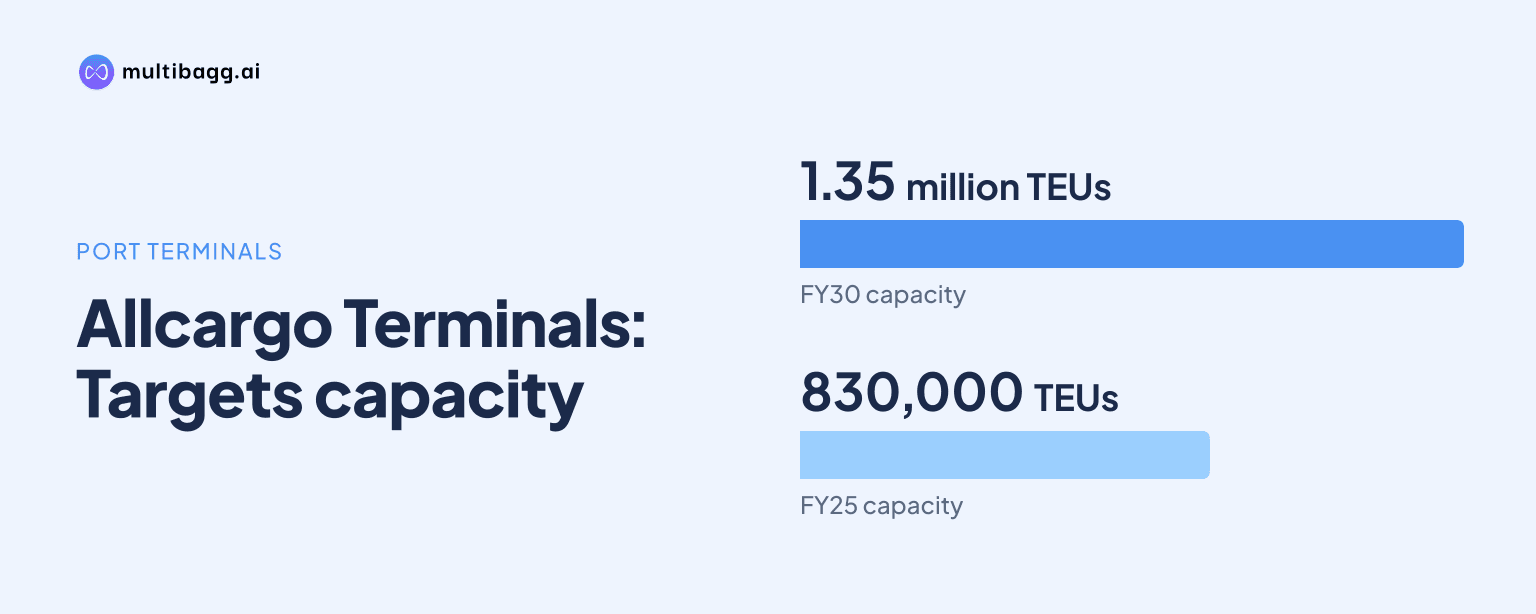
Allcargo Terminals plans capacity of 1.345 million twenty-foot equivalent units (TEUs) by FY30, compared with 830,000 TEUs in FY25, through 515,000 TEUs of listed additions at Mundra, JNPT, Chennai and Farukhnagar. The planned capacity is 345,000 TEUs above management’s FY30 aspiration to manage one million TEUs.
Know Allcargo Terminals Ltd Partly Paidup inside out
Results, valuation, peers and who's buying, in one view.
What capacity is ATL targeting by FY30?
ATL is targeting 1.345 million TEUs of capacity by FY30. Its capacity chart begins with 830,000 TEUs in FY25 and lists 515,000 TEUs of additions, which together equal the FY30 figure. The presentation describes this as capacity creation to fuel growth, rather than a forecast that all capacity will be utilised.
The FY30 figure is 62% above the FY25 base. It also exceeds management’s stated aspiration of managing one million TEUs by FY30 by 345,000 TEUs. Capacity and managed volumes are separate measures: the first is available handling capability, while the second is the operational volume objective disclosed by management.
The 170,000-TEU JNPT expansion is the largest listed addition. Chennai and Farukhnagar contribute 120,000 TEUs each, or 240,000 TEUs combined, while Mundra has separate 50,000-TEU CWC Mundra and 55,000-TEU net post-consolidation line items. The chart specifically labels the latter as net capacity after consolidation.
Which projects form ATL’s FY30 capacity plan?
ATL’s five listed additions comprise 50,000 TEUs at CWC Mundra, 170,000 TEUs at JNPT, 120,000 TEUs at a new Chennai facility, 120,000 TEUs at Farukhnagar and 55,000 TEUs at Mundra after consolidation. Together, these projects add 515,000 TEUs between the FY25 and FY30 capacity points shown in the presentation.
The strategy update separately says tendering for the Speedy JNPT expansion has been completed and that it adds 60,000 TEUs of annual handling capacity. This differs from the 170,000-TEU JNPT capacity addition shown in the FY30 chart. The presentation does not explain the relationship between the 60,000-TEU tendered expansion and the larger charted JNPT figure.
Farukhnagar has a 120,000-TEU capacity allocation in the chart. ATL says construction of the Farukhnagar Private Freight Terminal, or PFT, remains on track for completion by March 2027. It does not give a separate commissioning date for the charted capacity, nor does it disclose project spending for the listed FY30 additions.
How does ATL’s existing network compare with the plan?
ATL reports throughput capacity of one million TEUs per annum across six container freight stations, or CFSs, and one inland container depot, or ICD. The sites are in JNPT, Chennai, Mundra and Kolkata, with the ICD at Dadri. The FY25 capacity point of 830,000 TEUs in the expansion chart is therefore distinct from the one-million-TEU network throughput capacity stated in the company overview.
The site-level table lists Mundra capacities of 80,000 and 140,000 TEUs, Mumbai CFS capacities of 360,000 and 180,000 TEUs, Chennai capacity of 100,000 TEUs, Kolkata capacity of 75,000 TEUs and Dadri capacity of 65,000 TEUs. The 360,000-TEU Mumbai figure includes 170,000 TEUs of capacity initiated in August 2025.
ATL says its CFS facilities had about 90% utilisation before expansion and that its locations serve ports handling more than 80% of India’s container traffic. It reports about 13% market share, describes itself as a market leader in Mundra and JNPT, and says it is among the top three CFS operators in Kolkata and Chennai. The expansion plan adds capacity at existing port markets while also including the Farukhnagar PFT.
Got a follow-up? Ask IRIS
Is ATL’s reported volume growth supporting expansion?
ATL handled 190,100 TEUs in Q2FY27, up 12.6% year on year from 168,755 TEUs in Q2FY26 and 7.7% quarter on quarter from 176,499 TEUs in Q1FY27. Management said the year-on-year increase was achieved despite disruptions arising from the Middle East conflict.
For H1FY27, volume rose 10.0% to 366,599 TEUs from 333,361 TEUs in H1FY26. Revenue increased 18.2% to Rs 466 crore from Rs 394 crore over the same six-month periods, while earnings before interest, tax, depreciation and amortisation, or EBITDA, rose 41.9% to Rs 106 crore from Rs 75 crore.
Q2FY27 revenue rose faster than volumes, while EBITDA and profit before tax, or PBT, increased faster still. Management attributed the profitability improvement to better realisation and a higher share of transshipment container volumes at JNPA. These reported changes provide the operating backdrop to ATL’s capacity plan but do not establish future utilisation levels.
What operating measures accompany ATL’s expansion?
ATL is rolling out a Smart Yard Management System across all locations to improve operational efficiency, asset utilisation and customer service. The presentation does not disclose the system’s cost, completion date or a quantified productivity target, but positions the programme alongside physical capacity creation.
Management’s strategy calls for 20% capacity growth in FY26 to one million TEUs, creating headroom for higher volumes. It also says volume growth is to be pursued while retaining margin through pricing and operational discipline. The FY30 chart then identifies 1.345 million TEUs of capacity, 345,000 TEUs above the one-million-TEU level cited in the strategy.
EBITDA per TEU rose to Rs 3,366 in Q2FY27 from Rs 2,390 in Q2FY26 and Rs 2,898 in Q1FY27. ATL notes that Q1 and Q2 EBITDA per TEU were affected by transshipment volumes, and says the measure has remained above Rs 2,000 for the last eight quarters. The company does not quantify how much of the change came from pricing, technology or the transshipment mix.
Conclusion
ATL’s FY30 roadmap combines a charted FY25 base of 830,000 TEUs with 515,000 TEUs of listed additions to reach 1.345 million TEUs. JNPT accounts for the largest single addition at 170,000 TEUs, while Chennai and Farukhnagar each account for 120,000 TEUs. Q2FY27 volume growth of 12.6% and EBITDA growth of 45.9% show the reported operating performance during the expansion programme.
The next disclosed project milestone is completion of the Farukhnagar PFT by March 2027, which management says remains on track. Other matters to watch are progress on the JNPT expansion after tendering for the 60,000-TEU Speedy project, the Smart Yard Management System rollout, and progress toward management’s one-million-TEU FY30 volume aspiration.