










Alldigi keeps profitable domestic BPM despite 33% decline
Key highlights
- Domestic BPM revenue declined 33% year on year in Q2 FY2027 as Alldigi exited or resized lower-margin work.
- International BPM revenue grew 12.6% year on year and represented about 83% of Q2 FY2027 BPM revenue.
- BPM segment margin rose to 15.6% in Q2 FY2027 from 11.6% in Q2 FY2026.
- Employee cost declined by about Rs 5 crore sequentially in Q2 FY2027, with the full headcount effect expected in Q3 FY2027.
powered by IRIS
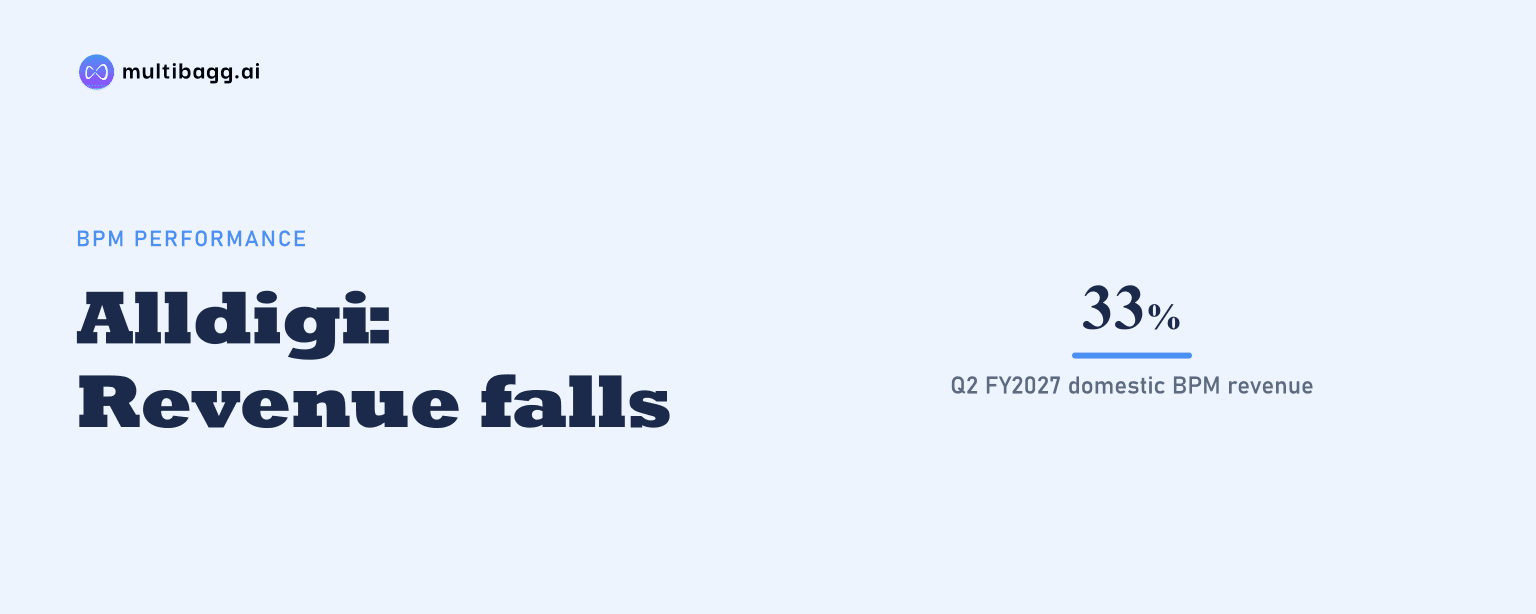
Alldigi Tech will continue shrinking domestic business process management, or BPM, exposure after domestic BPM revenue fell 33% year on year in Q2 FY2027, but it will retain existing accounts that meet margin requirements. The portfolio shift coincided with BPM segment margin rising to 15.6% from 11.6% a year earlier.
Know Alldigi Tech inside out
Results, valuation, peers and who's buying, in one view.
Why is Alldigi reducing domestic BPM revenue?
Alldigi is reducing domestic BPM work because management is exiting or resizing engagements with lower margins. Domestic BPM revenue declined 33% year on year in Q2 FY2027, while international BPM revenue increased 12.6%. Chief financial officer Manish Agarwal said the domestic decline reflected a deliberate effort to reshape the segment’s revenue mix.
The company has made decisions involving a couple of large domestic clients, according to managing director and chief executive officer Natarajan Laxsmanan. Alldigi is not seeking to expand into new domestic BPM clients, while international BPM represented about 83% of Q2 segment revenue of Rs 111.6 crore. The remaining domestic share was therefore about 17% of BPM revenue during the quarter.
The strategy constrained reported BPM growth despite international expansion. BPM revenue rose 1.0% year on year and 1.8% sequentially in Q2 FY2027, compared with 12.6% growth in international BPM. For H1 FY2027, BPM revenue was Rs 221.3 crore, up 1.4% year on year, with management identifying international markets as the segment’s principal growth driver.
Will Alldigi fully exit domestic BPM?
No, Alldigi does not intend to exit every domestic BPM account while an existing client remains profitable from a margin perspective. Laxsmanan said the rationalisation is a continuing exercise that could ultimately eliminate domestic BPM from the company’s books, but profitability is the stated condition for retaining current accounts.
The company has not set a deadline for a full domestic BPM exit or disclosed a target share of revenue for the business. Management said domestic BPM’s percentage of segment revenue will continue to come down, but the timing depends on decisions concerning individual accounts. Q2 FY2027 revenue of Rs 111.6 crore confirms the segment still included domestic operations.
This is a selective resizing strategy rather than an immediate closure of the domestic business. International BPM’s approximately 83% share of Q2 revenue means the segment was already predominantly overseas-facing before any complete elimination of domestic revenue. Management’s stated plan is to avoid new domestic BPM expansion while keeping profitable existing relationships.
The company-wide revenue mix also explains the strategic emphasis. Revenue from operations rose 4.0% year on year to Rs 153.3 crore in Q2 FY2027, while international revenue increased 15.1% and contributed about 70% of total revenue. Growth in international BPM and Tech & Digital was partly offset by the planned reduction in domestic BPM.
How has the domestic BPM strategy affected margins?
Alldigi’s BPM segment margin increased to 15.6% in Q2 FY2027 from 11.6% in Q2 FY2026 and 11.9% in Q1 FY2027. Segment profit reached Rs 17.5 crore in the latest quarter. Management attributed the improvement to the higher international revenue mix, domestic BPM actions, pricing initiatives and operating efficiencies.
For H1 FY2027, BPM segment profit was Rs 30.6 crore and segment margin was about 13.8%. That six-month margin was below Q2’s 15.6%, showing that the latest quarter had a more favourable combined outcome than the first-half average. Management also said quarterly margin can be affected by business mix, currency movements and the timing of client trends.
Agarwal said overall BPM margin should continue to improve as domestic business is reduced. He did not provide a numerical target, saying the scale of any uplift depends on the timing of domestic revenue reduction and other segment factors. This was management’s directional guidance rather than a quantified outlook.
Consolidated profit growth was faster than revenue growth in Q2 FY2027. Earnings before interest, tax, depreciation and amortisation, or EBITDA, rose 28.5% year on year to Rs 46.3 crore, while EBITDA margin expanded to 30.2% from 24.4%. Management cited better revenue mix, lower-margin domestic BPM reduction, operating efficiency and cost discipline.
Got a follow-up? Ask IRIS
What does Alldigi expect for employee costs and headcount?
Alldigi expects employee cost as a proportion of revenue to continue declining as it changes resource deployment and de-prioritises domestic BPM. Employee cost fell by about Rs 5 crore sequentially in Q2 FY2027, or about 7%, although the reduction in employee headcount was not comparable during the same quarter.
Management gave four reasons for the difference: lower replacement costs for new resources, resource optimisation in Manila, a high-cost location, a retirement-benefit valuation true-up, and the timing of workforce reductions. Agarwal said the reduction began in the middle of Q2 FY2027, so the full headcount impact should become visible in Q3 FY2027.
The expected cost change is linked to both hiring and account management. Management said Alldigi will continue seeking appropriate resource deployment across accounts while reducing domestic business and increasing international exposure. It did not disclose a headcount target or a target ratio for employee cost to revenue.
Operating cash flow rose alongside profitability in the same period. Q2 FY2027 operating cash flow was Rs 37.1 crore, equal to about 80% of EBITDA, while H1 operating cash flow increased 31.3% year on year to Rs 70.2 crore. Days sales outstanding improved by three days year on year, according to management.
Where is Alldigi directing BPM growth?
Alldigi is directing BPM growth toward international markets and technology-led service delivery. Management said it revamped leadership in the United States, added sales executives for that market and entered Southeast Asia with dedicated sales resources. It identified international collections, healthcare revenue-cycle management and insurance BPM as focus domains.
The company is embedding technology and artificial intelligence in individual BPM accounts rather than relying solely on manpower-based back-office or contact-centre services. Management said the approach is intended to reduce manual effort, improve accuracy and support customer experience. It also said technology adoption will not immediately determine revenue growth, which remains dependent on sales execution.
Alldigi has started an assisted-captive, or build-operate-transfer, service with one client. Management said that relationship involves more than 1,000 full-time employees and is expected to grow by at least two to three times. The company did not disclose revenue from the account or a timetable for the expected expansion.
Tech & Digital is the other growth segment alongside international BPM. Q2 FY2027 Tech & Digital revenue rose 12.9% year on year to Rs 41.7 crore, compared with 1.0% BPM growth, while its segment margin was 43.9%. In H1 FY2027, Tech & Digital revenue was Rs 82.3 crore, up 12.4%, and segment profit was Rs 35.7 crore.
Conclusion
Alldigi’s 33% domestic BPM revenue decline reflects a managed portfolio shift rather than an unconditional withdrawal from the market. The company is retaining accounts that meet its profitability standard while avoiding new domestic BPM expansion, and the mix change coincided with a 4.0-percentage-point year-on-year increase in Q2 BPM margin to 15.6%.
The next disclosed checkpoint is Q3 FY2027, when management expects the full headcount effect of reductions begun midway through Q2 to appear. Investors can also watch whether international BPM, which grew 12.6% in Q2, continues to offset domestic reductions and whether the more than 1,000-employee assisted-captive relationship begins contributing to reported growth.