










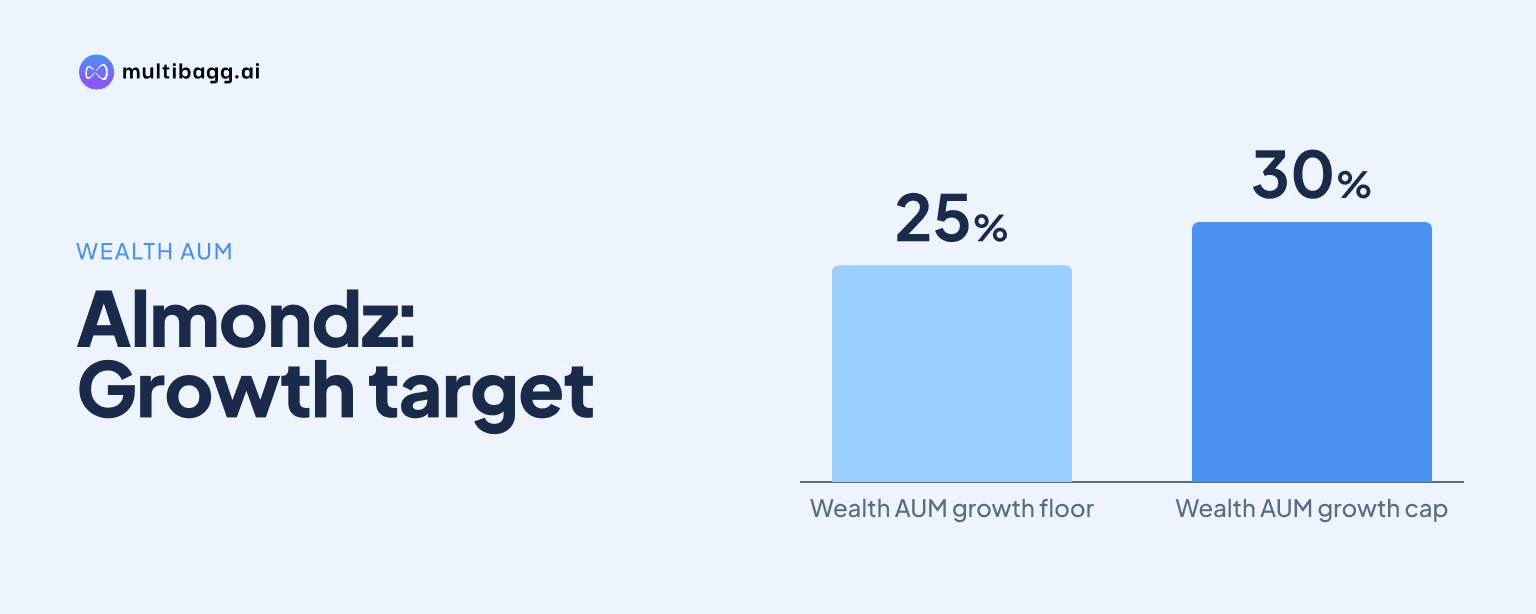
Almondz targets 25%-30% annual wealth AUM growth through advice
Key highlights
- Almondz said its roughly Rs 1,500 crore wealth book is held mainly by no more than 20-25 family offices.
- Management targets 25%-30% annual additions to wealth AUM, with half expected to enter private markets.
- Almondz closed around 4 mandates in the past 2 years and had about 5 mandates under execution on November 11, 2026.
- Q2 FY27 financial-services revenue rose 2.7% year on year to Rs 8.05 crore, while profit was Rs 2.51 crore.
powered by IRIS
Almondz Global Securities Limited said on November 11, 2026, that it targets 25%-30% annual growth in wealth assets under management from a roughly Rs 1,500 crore book, concentrating on 20-25 family offices and linking their private-market allocations to its investment-banking advisory work rather than operating as a retail broker.
Know Almondz Global Securities inside out
Results, valuation, peers and who's buying, in one view.
How will Almondz grow wealth AUM?
Almondz plans to grow wealth assets under management through a family-office-led model connected to its investment-banking franchise. Management said its roughly Rs 1,500 crore wealth book comes mostly from no more than 20 to 25 family offices, and that the company is a high-net-worth individual, or HNI, broker rather than a retail broker.
The operating mechanism is to advise companies on raising equity and to invest the wealth book in companies that Almondz advises. Management said half of annual additions to wealth assets under management is expected to enter private markets, with those companies subsequently potentially taken towards public markets through its advisory business. The company said it intends to continue operating this model with a small team.
Why is Almondz not pursuing retail broking?
Almondz is not pursuing a retail-broking model because management has structured wealth management around the treasury needs of HNIs and family offices connected to advisory mandates. On the November 11 call, management said the broking and wealth operation had been neglected while infrastructure and clean-energy businesses received greater focus, but a strategy developed over the past 2 years is intended to build the segment through investment banking.
Management said the advisory focus is on growth-stage small-cap companies with expected valuations typically between Rs 100 crore and Rs 500 crore. Almondz aims to remain associated with these companies for at least 5 years, initially through private-market capital raising and then, where relevant, through a public-market route. This differs from an account-acquisition strategy based on high-volume retail broking.
The wealth plan is separate from Almondz's own investment book, which management said is divided equally between debt and equity markets. Within the private-equity exposure, management said listed and unlisted stocks are equally represented; its debt activity includes highly rated government, public-sector undertaking and private-sector bonds. Management described private equity as the primary focus for its own investments.
Got a follow-up? Ask IRIS
What supports Almondz's advisory-led wealth model?
Almondz said it had closed around 4 mandates during the previous 2 years and had about 5 mandates under execution as of the November 11, 2026 call. Management expects the assignments in the pipeline to be executed over the next 2 to 3 quarters of the current year and the following year, which it cited as the basis for visibility in fee-based financial-services business.
One completed assignment was for Green Joules, for which management said Almondz had received its fee after a placement involving Singularity, Amazon and Rainmatter. Management said Daalchini was in the final stages of diligence, while another 3 mandates were ongoing. It also identified green energy and infrastructure as the two or three sectors on which the capital-markets advisory operation is concentrating.
Financial services reported Q2 FY27 revenue of Rs 8.05 crore, up 2.7% year on year, while profit was lower at Rs 2.51 crore. That revenue growth trailed Almondz's consolidated revenue growth of 17.9% to Rs 40.09 crore in the same quarter. Management attributed the lower financial-services profit to weak capital markets and lower mark-to-market gains on its own investment portfolio than in the preceding quarter.
What financial-services growth does Almondz expect?
Almondz management said financial services is a priority for the next 3 years and expects 25%-30% annual additions to wealth assets under management. In a separate response on the call, management said each of its three businesses, including financial services, was expected to grow by at least 25% year on year. These are management expectations, not reported results.
Management said financial-services revenue was around Rs 61 crore in the previous year and projected 20%-25% growth in the current year, with a similar outcome expected in the following year. The Q2 FY27 revenue of Rs 8.05 crore shows that management expects a greater contribution from its mandate pipeline in later periods, including fundraisers, rights issues and IP advisory assignments.
An investor asked Almondz to provide quarterly wealth-AUM growth and numbers of new clients in future presentations. Management said it would implement the suggestion. The transcript did not provide an earlier AUM level, client additions, fee yields or a split between market appreciation and fresh inflows, leaving the Rs 1,500 crore wealth book without a disclosed quarterly comparison.
Conclusion
Almondz's stated wealth strategy relies on a concentrated client base rather than retail scale: roughly Rs 1,500 crore of wealth assets under management is held mainly by 20-25 family offices, with half of annual additions intended for private markets. The model links those allocations to capital-raising work for companies typically valued between Rs 100 crore and Rs 500 crore, while financial-services revenue grew 2.7% in Q2 FY27.
The next items to watch are the execution of about 5 mandates over the next 2 to 3 quarters of the current year and the following year, and management's planned addition of quarterly AUM and client-acquisition disclosures. Management has also set a 25%-30% annual wealth-AUM growth expectation and identified financial services as a 3-year priority, but the transcript does not disclose the sources of future AUM additions.