










Amara Raja Energy & Mobility Q2 profit falls 44.8% despite growth
Key highlights
- Amara Raja's Q2 FY27 revenue from operations increased 18.5% year-on-year to ₹4,109 crore.
- Q2 FY27 consolidated net profit fell 44.8% year-on-year to ₹153 crore from ₹277 crore.
- EBITDA margin narrowed by 200 basis points to 8.8% in Q2 FY27.
- The board approved ₹2,320 crore of capex for cell manufacturing expansion within 30 months and declared a ₹4.30-per-share interim dividend.
powered by IRIS
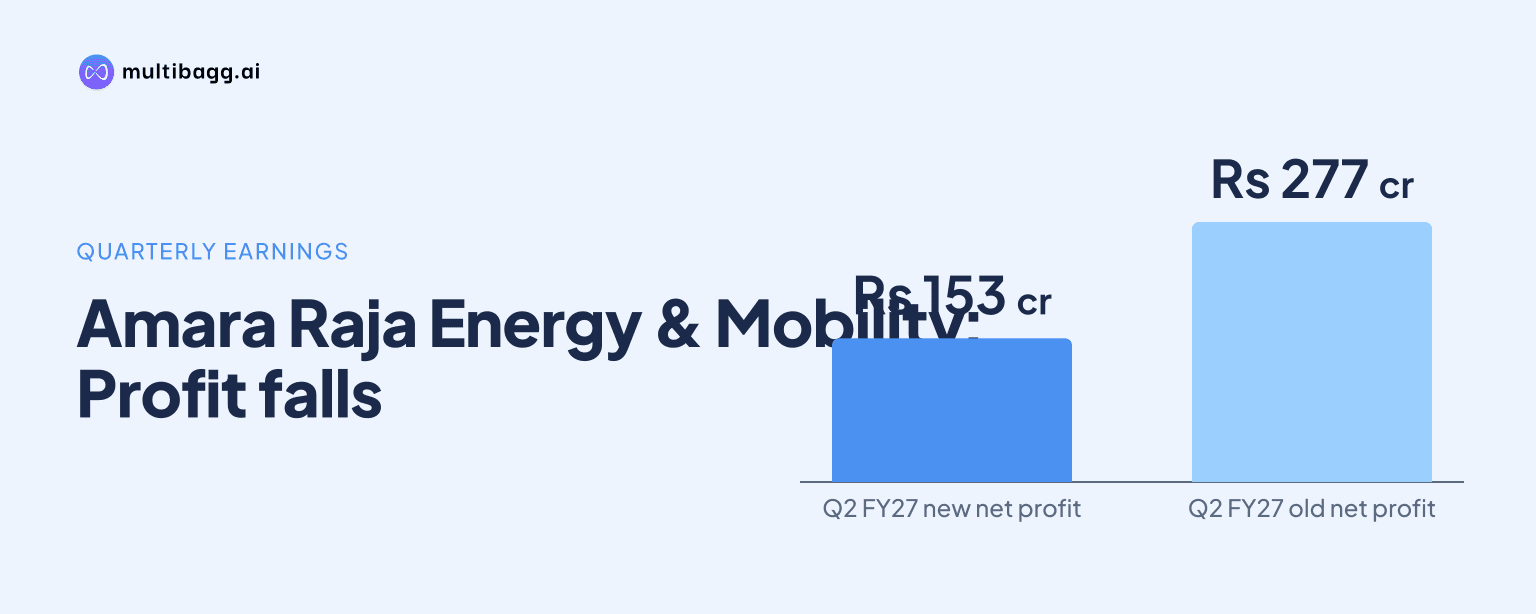
Amara Raja Energy & Mobility Ltd reported a 44.8% year-on-year decline in Q2 FY27 consolidated net profit to ₹153 crore, even as revenue from operations rose 18.5% to ₹4,109 crore. The September-quarter result showed that stronger sales in automotive and energy businesses did not offset pressure on operating profitability.
Know Amara Raja Energy & Mobility inside out
Results, valuation, peers and who's buying, in one view.
Why did Amara Raja's Q2 FY27 profit fall despite revenue growth?
Amara Raja's Q2 FY27 profit fell because operating earnings declined and EBITDA margin narrowed despite higher revenue. Consolidated EBITDA decreased 3.4% year-on-year to ₹361.6 crore from ₹374.3 crore, while the EBITDA margin contracted to 8.8% from 10.8% in the September 2025 quarter.
Revenue from operations increased to ₹4,109 crore from ₹3,467 crore a year earlier. However, net profit declined to ₹153 crore from ₹277 crore. The figures point to a gap between sales growth and profitability during the quarter, with the company reporting the effect of cost pressures and operational challenges on earnings.
The company reported that domestic revenue grew by more than 10%, supported by demand from original equipment manufacturers in the two-wheeler and four-wheeler segments and healthy aftermarket volumes. Its industrial UPS business recorded growth of more than 7%, adding to the revenue performance.
What were Amara Raja's key Q2 FY27 financial numbers?
Amara Raja reported higher revenue but lower EBITDA and profit for Q2 FY27 compared with the corresponding quarter a year earlier. The company also said H1 FY27 revenue rose 21.2% year-on-year, while profit after tax for the first half declined 22.2%.
The Q2 outcome followed a stronger June-quarter revenue comparison. Amara Raja had reported total income of ₹4,234.04 crore for the quarter ended June 2026, compared with ₹3,419.58 crore in June 2025. Reported profit after tax for that quarter was ₹190.94 crore, against ₹164.80 crore a year earlier.
A separate quarterly summary had placed June-quarter revenue at ₹4,234 crore and EBITDA at ₹425.42 crore. The September-quarter EBITDA of ₹361.6 crore was therefore below the June-quarter figure, although the two disclosures use reported quarterly figures from different result summaries.
What dividend has Amara Raja declared for FY27?
Amara Raja declared an interim dividend of ₹4.30 per equity share for FY27, alongside approval of its unaudited Q2 and H1 FY27 results. The dividend is scheduled to be paid by December 1, 2026.
The board fixed November 6, 2026, as the record date to determine shareholders eligible for the interim dividend. The board meeting was held on November 2, 2026, and the company disclosed the outcome at 6:25 pm IST.
The dividend decision comes while the company is also committing capital to expand its new-energy manufacturing operations. The supplied information does not state the total dividend payout, since the number of eligible shares is not provided.
Got a follow-up? Ask IRIS
What does the ₹2,320 crore cell manufacturing capex involve?
Amara Raja approved capital expenditure of ₹2,320 crore to expand cell manufacturing capacity within 30 months. The investment is part of the company's wider plan to build capacity across cells, battery packs and battery energy storage systems, or BESS.
The company is already known for lead-acid automotive and industrial batteries sold under the Amaron brand, while it is building lithium-ion cell and energy-storage capabilities. The approved capex places capacity expansion alongside its established lead-acid business, where OEM and replacement-market demand supported domestic revenue in the quarter.
The disclosure specifies the approved investment amount and the 30-month execution period, but it does not provide the targeted capacity, site-level details, financing structure or commissioning schedule. Those details would be relevant for assessing the timing and execution of the manufacturing expansion.
How do the results affect investors and Amara Raja's operations?
For investors, the Q2 result presents a combination of revenue growth, weaker margins and a shareholder payout. Revenue expanded by 18.5%, but the 44.8% drop in net profit and 200-basis-point EBITDA margin contraction show that the improved sales base did not translate into higher quarterly earnings.
The interim dividend of ₹4.30 per share provides a defined near-term return for shareholders on the November 6 record date. At the same time, the ₹2,320 crore capex approval indicates that the company is directing significant resources towards cell manufacturing expansion over the next 30 months.
For operations, growth in two-wheeler and four-wheeler OEM demand, aftermarket volumes and industrial UPS sales supported the domestic business. But the September-quarter numbers also make margin performance a key reported metric, as EBITDA declined even while revenue increased.
Conclusion
Amara Raja Energy & Mobility delivered an 18.5% increase in Q2 FY27 revenue to ₹4,109 crore, supported by automotive OEM, aftermarket and industrial UPS demand. Yet EBITDA fell to ₹361.6 crore, margin narrowed to 8.8%, and net profit dropped 44.8% to ₹153 crore, making profitability the central feature of the quarter.
The next disclosed event is the company's virtual investor call on November 3, 2026, at 4:00 pm IST, where the CFO and Head of Corporate Finance are scheduled to discuss Q2 and H1 FY27 results. Investors will also watch for further disclosure on the scope, capacity and execution timeline of the ₹2,320 crore cell manufacturing expansion.