










Ansal Housing Limited reports ₹9.39 crore Q2 consolidated loss
Key highlights
- Ansal Housing reported a ₹9.39 crore consolidated net loss in Q2 FY27.
- Standalone profit after tax was ₹1.48 crore on revenue from operations of ₹29.37 crore.
- Consolidated Q2 FY27 expenses of ₹45.65 crore exceeded total income of ₹35.52 crore.
- Consolidated operating activities recorded a ₹39.40 crore net cash outflow in the September quarter.
powered by IRIS
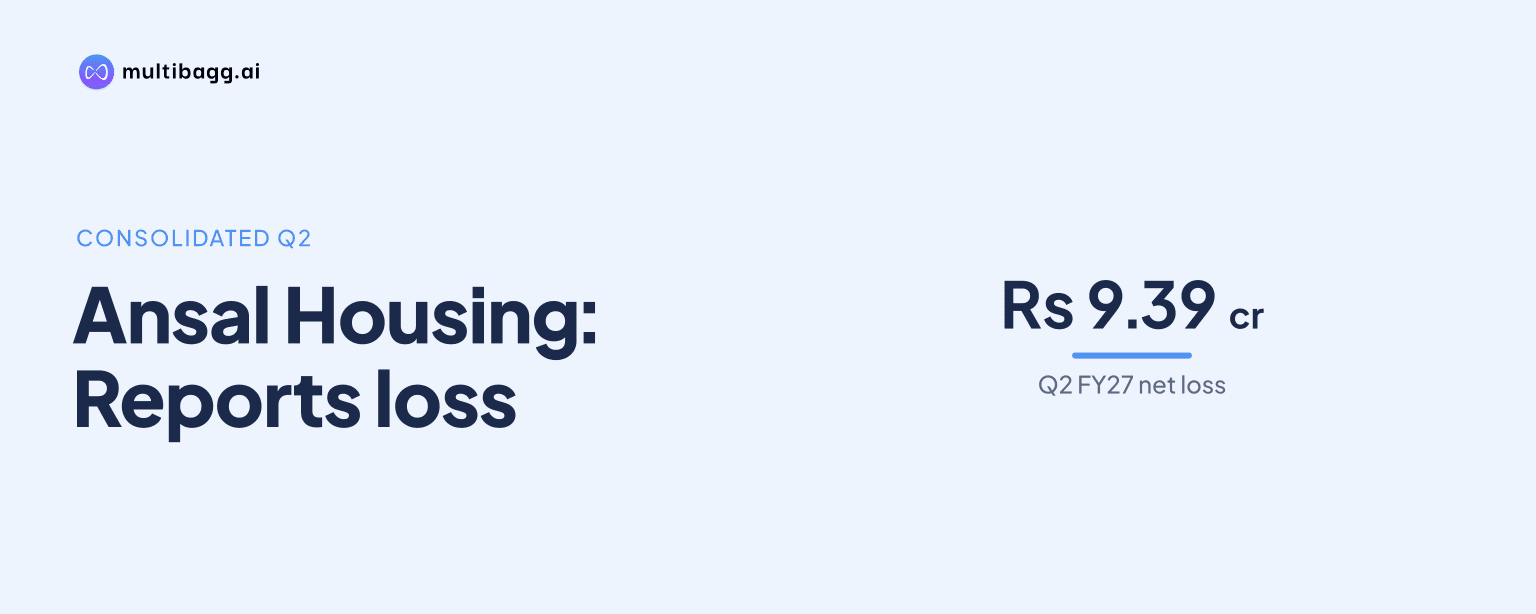
Ansal Housing Limited reported a consolidated net loss of ₹9.39 crore for the quarter ended September 30, 2026. The result contrasts with standalone profit after tax of ₹1.48 crore, as consolidated expenses of ₹45.65 crore exceeded total income of ₹35.52 crore during the quarter.
Know Ansal Housing inside out
Results, valuation, peers and who's buying, in one view.
What did Ansal Housing report for Q2 FY27?
Ansal Housing reported unaudited standalone and consolidated financial results for the quarter and half-year ended September 30, 2026, after approval by its Board of Directors on November 14, 2026. The approval also covered the Limited Review Report issued by statutory auditor M/s Dewan P N Chopra & Co.
On a standalone basis, the company recorded revenue from operations of ₹29.37 crore in the September quarter and other income of ₹0.79 crore. Total standalone expenses were ₹26.61 crore, while profit before tax was ₹1.85 crore. Profit after tax stood at ₹1.48 crore and total comprehensive income was ₹1.44 crore. Diluted earnings per share were ₹0.21.
The consolidated result was weaker. Total income was ₹35.52 crore, against total expenses of ₹45.65 crore, resulting in a net loss after tax of ₹9.39 crore. Consolidated total comprehensive loss was ₹9.42 crore for the quarter.
How did the September quarter compare with the previous year?
The standalone profit after tax of ₹1.48 crore for the September 2026 quarter was higher than the ₹0.62 crore profit stated for the corresponding quarter of the previous year. This comparison indicates a higher reported standalone quarterly profit, although the supplied information does not provide a like-for-like comparison of revenue, expenses or margins for the prior-year quarter.
The figures supplied for the half-year contain an inconsistency that investors should note. One disclosure states standalone profit after tax of ₹2.10 crore for the half-year ended September 30, 2026, while the detailed financial-summary section states half-year profit after tax of ₹0.62 crore, with profit before tax of ₹0.81 crore and total comprehensive income of ₹0.59 crore. The company-provided material does not explain the difference, so the figures should not be reconciled without referring to the underlying filing.
The detailed standalone half-year data states total income of ₹62.79 crore and total expenses of ₹57.47 crore. It also reports diluted earnings per share of ₹0.09 for the six-month period. These numbers indicate that the period-level result requires careful reading alongside the quarterly numbers and the full financial statements.
What do the consolidated half-year results show?
The consolidated financial statements show a net loss after tax of ₹13.01 crore for the half-year ended September 30, 2026. Total comprehensive loss was ₹13.07 crore, while consolidated income was ₹83.68 crore and expenses were ₹95.64 crore.
The September-quarter loss accounted for a substantial part of the reported six-month consolidated loss. The supplied data also records net cash outflow from operating activities of ₹39.40 crore for the September quarter. Operating cash flow is distinct from accounting profit or loss, but it is relevant because it reflects cash movement from the company’s operating activities.
The difference between standalone profitability and the consolidated loss is material for shareholders because consolidated accounts include the financial performance of the company and its relevant group entities. The disclosed numbers do not provide a segment-wise breakdown or a specific explanation for the consolidated loss.
Got a follow-up? Ask IRIS
What issues did the statutory auditors highlight?
The statutory auditor’s review drew attention to matters concerning dealings with Samyak Projects Private Limited, pending litigation, and the net recoverable value of advances for land acquisition. The auditor stated that management estimates and technical judgments were relied upon for these assessments.
The review also referred to ongoing projects, recognition of revenue and expenses, and the realizable value of costs already incurred. These matters are important in real estate financial reporting because project costs, receivables, land advances and revenue recognition can materially influence reported results.
The supplied report describes these as emphasis-of-matter and related notes rather than providing quantified adjustments to the September-quarter results. Investors assessing the filing would therefore need to consider the detailed notes and the auditor’s limited-review report alongside the headline profit and loss figures.
What does the result mean for investors and operations?
The results provide an updated view of Ansal Housing’s financial position after its FY26 performance. For FY26, the company had reported standalone profit of ₹1.52 crore, down from ₹19.14 crore in the preceding year, while consolidated operations recorded a loss of ₹37.37 crore. Standalone revenue for FY26 declined 24.66% to ₹289.29 crore.
Against that background, the ₹1.48 crore standalone quarterly profit is a positive reported outcome, but the ₹9.39 crore consolidated quarterly loss and operating cash outflow of ₹39.40 crore remain central data points for investors. The supplied information does not include management guidance, a turnaround target, project-completion schedule or a forward financial outlook.
The Board had announced the November 14 meeting on November 3, 2026, and said the trading window for designated persons would remain closed until 48 hours after declaration of results. Earlier, shareholders adopted the FY26 financial statements at the company’s 42nd annual general meeting held through video conferencing on September 29, 2026.
Conclusion
Ansal Housing’s September-quarter filing shows a clear divergence between its standalone and consolidated performance. Standalone operations reported ₹1.48 crore profit after tax, while the consolidated accounts recorded a ₹9.39 crore loss as expenses exceeded income. The auditor’s references to land advances, litigation, project accounting and recoverable values add context to the financial statements.
The next points to watch are any clarification of the conflicting standalone half-year profit figures, the detailed notes to the limited-review report, and future disclosures on operating cash flow, project costs and pending litigation. The supplied filing contains no forward target or scheduled operational milestone, so subsequent statutory disclosures will be the main source of updates.