










Apollo Tyres India Revenue Rises 25.6% as Margin Falls
Key highlights
- Apollo Tyres standalone India revenue rose 25.6% year on year to Rs 5,921.7 crore in Q2 FY27.
- Apollo Tyres India EBITDA margin declined 423 basis points to 11.1% from 15.3% in Q2 FY26.
- Apollo Tyres standalone raw-material expense increased to Rs 4,045.3 crore from Rs 2,921.2 crore in Q2 FY26.
- Apollo Tyres reported net debt of Rs 3,300 crore at September 2026, with net debt to EBITDA at 0.9 times.
powered by IRIS
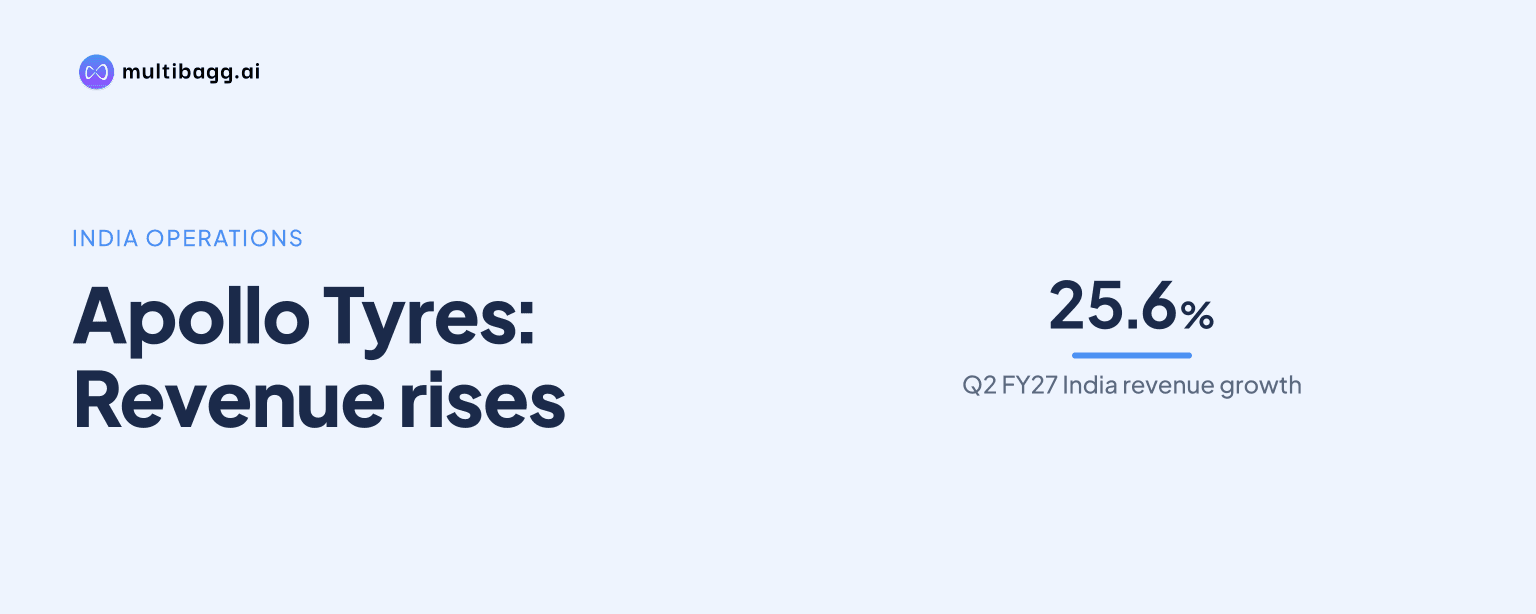
Apollo Tyres Limited reported standalone India revenue growth of 25.6% year on year to Rs 5,921.7 crore in Q2 FY27, its fastest growth in 17 quarters, but EBITDA margin fell 423 basis points to 11.1% from 15.3%. Apollo Tyres said raw-material inflation outweighed part of the benefit from cost controls and operating leverage.
Know Apollo Tyres inside out
Results, valuation, peers and who's buying, in one view.
Why did Apollo Tyres India revenue grow 25.6% in Q2 FY27?
Apollo Tyres India revenue grew through broad-based demand in replacement and original equipment manufacturer, or OEM, channels in Q2 FY27. Standalone revenue increased by Rs 1,206.8 crore from Rs 4,714.9 crore in Q2 FY26 to Rs 5,921.7 crore, and was 8.4% above Rs 5,461.9 crore in Q1 FY27.
Management described the 25.6% year-on-year increase as Apollo Tyres' strongest growth in 17 quarters, following double-digit growth in Q1 FY27. The presentation does not provide a quarterly split between replacement and OEM sales, but says both channels contributed to growth during the quarter.
Apollo Tyres also linked the sales momentum to premiumisation, including larger-rim passenger-car radial, or PCR, tyres and the Vredestein brand. Management cited new product launches, expanding distribution reach and stronger brand equity. In H1 FY27, truck and bus tyres accounted for 52% of standalone revenue by product, while passenger-vehicle tyres represented 23%.
India capacity utilisation was 92% in H1 FY27, compared with 83% in Europe. That utilisation level provides context for Apollo Tyres' reference to operating leverage, although quarterly EBITDA declined despite the higher India revenue base.
How much did Apollo Tyres India profitability change?
Apollo Tyres India earnings before interest, tax, depreciation and amortisation, or EBITDA, declined 9.2% year on year to Rs 654.6 crore in Q2 FY27. EBITDA was essentially unchanged from Rs 654.9 crore in Q1 FY27, while the margin fell to 11.1% from 15.3% a year earlier and 12.0% in the previous quarter.
The 423-basis-point year-on-year margin decline means a reduction of 4.23 percentage points, as 100 basis points equal one percentage point. Standalone earnings before interest and tax, or EBIT, fell to Rs 455 crore from Rs 516.8 crore, and EBIT margin fell to 7.7% from 11.0% between Q2 FY26 and Q2 FY27.
Raw-material expense increased by Rs 1,124.1 crore year on year to Rs 4,045.3 crore in Q2 FY27 from Rs 2,921.2 crore. Staff cost rose by Rs 5.4 crore to Rs 329.1 crore and other costs increased by Rs 143.2 crore to Rs 892.7 crore, while EBITDA decreased by Rs 66 crore.
Apollo Tyres said disciplined cost management and operating leverage partly offset raw-material inflation, allowing it to maintain a double-digit EBITDA margin. Raw-material cost was about 68.3% of standalone revenue in Q2 FY27, calculated from disclosed figures, compared with about 62.0% in Q2 FY26.
Got a follow-up? Ask IRIS
How did Apollo Tyres India compare with group and Europe operations?
Apollo Tyres India outgrew the consolidated business in Q2 FY27, while Europe reported lower revenue. Consolidated revenue increased 16.6% year on year to Rs 7,968.2 crore, compared with 25.6% growth in India standalone revenue to Rs 5,921.7 crore.
India accounted for 69% of consolidated revenue in H1 FY27, Europe represented 26%, and other regions made up 5%. In the standalone India channel mix for H1 FY27, replacement sales accounted for 63%, OEM sales for 25%, and exports for 12%.
Consolidated EBITDA declined 16.2% to Rs 855.4 crore in Q2 FY27 and EBITDA margin declined 421 basis points to 10.7% from 14.9%. India’s 11.1% EBITDA margin was 40 basis points above the group margin, but it had declined by a slightly larger 423 basis points from the prior-year quarter.
Europe sales and manufacturing revenue was €157 million in Q2 FY27, down 11.5% from €177 million in Q2 FY26, while EBITDA margin fell 240 basis points to 10.3%. These figures exclude ReifenCom GmbH, Apollo Tyres' distribution business. Management said Europe’s PCR business gained market share across key segments and recorded healthy OEM-channel growth.
What actions and financial commitments has Apollo Tyres disclosed?
Apollo Tyres said it will undertake calibrated pricing actions to manage raw-material inflation, while describing India’s demand environment as healthy in Q2 FY27. The presentation gives no price-rise amount, implementation date or margin target, so the action remains a management plan rather than a reported pricing outcome.
Management also said Apollo Tyres will continue its premiumisation agenda through new products, distribution expansion and brand positioning. In Europe, management said Enschede restructuring was progressing as planned, with benefits from its evolving manufacturing footprint beginning to materialise while supply-chain realignment continued.
Apollo Tyres reported capital expenditure of Rs 1,500 crore in H1 FY27, above Rs 1,400 crore for the full FY26. It said the spending supported growth and capacity-building initiatives, while free cash flow was negative Rs 1,400 crore in H1 FY27 compared with positive Rs 2,000 crore in FY26.
Net debt rose to Rs 3,300 crore at September 2026 from Rs 1,600 crore at FY26-end, and net debt to EBITDA increased to 0.9 times from 0.4 times. For H1 FY27, consolidated revenue increased 14.7% to Rs 15,365.9 crore, while EBITDA fell 8.7% to Rs 1,723.3 crore and margin declined 289 basis points to 11.2%.
Conclusion
Apollo Tyres combined its fastest India revenue growth in 17 quarters with lower operating profitability in Q2 FY27. Standalone sales rose to Rs 5,921.7 crore, but higher raw-material expense contributed to a fall in EBITDA to Rs 654.6 crore and a 423-basis-point decline in EBITDA margin to 11.1%. The group also recorded lower profitability, while Europe reported a year-on-year revenue decline.
The next results will show whether Apollo Tyres' planned calibrated pricing actions and premiumisation initiatives narrow the raw-material cost pressure. Investors can also watch the impact of Rs 1,500 crore of H1 FY27 capital expenditure on cash flow and borrowings, after net debt reached Rs 3,300 crore at September 2026.