










Asgard Alcobev Limited to approve Q2 FY27 results November 13
Key highlights
- Asgard Alcobev’s board will consider Q2 FY27 unaudited results on November 13, 2026.
- Q1 FY27 consolidated revenue was ₹53.04 crore, up 45.20% quarter on quarter.
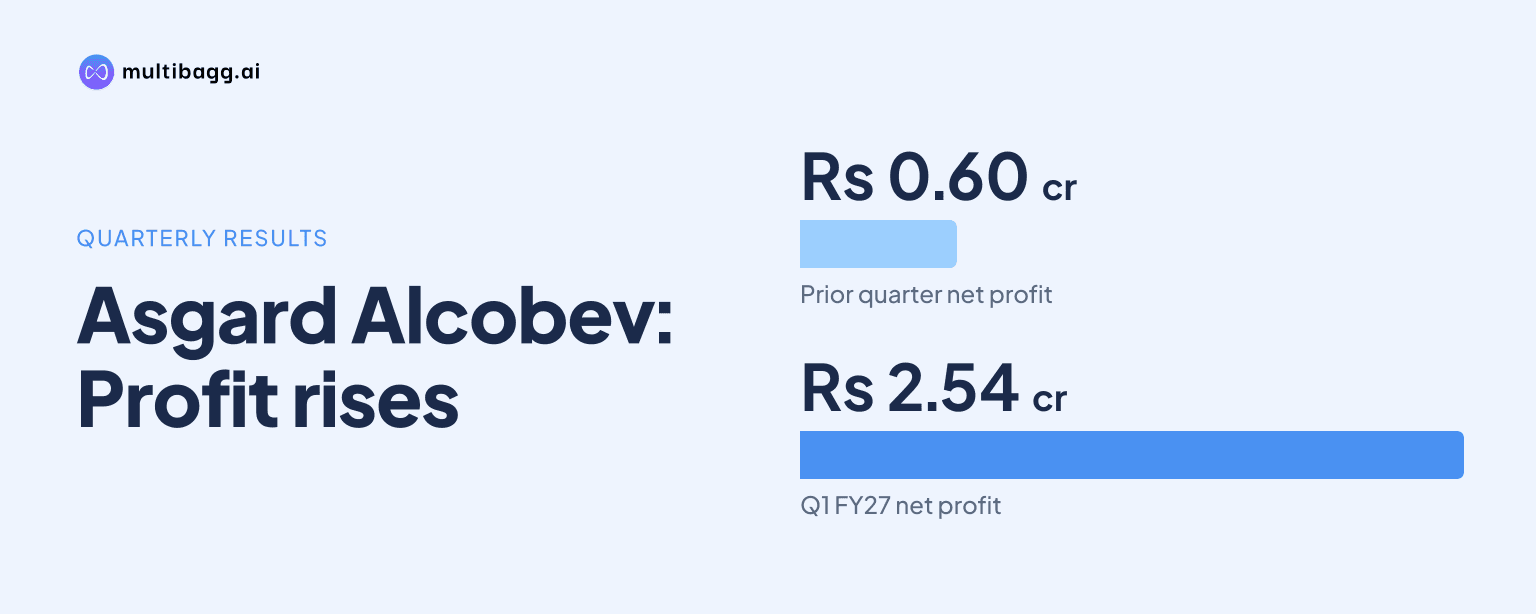
- Q1 FY27 net profit was ₹2.54 crore, compared with ₹0.60 crore in the preceding quarter.
- CMJ Breweries supports contract manufacturing and Asgard Alcobev’s portfolio of 7 owned labels.
powered by IRIS
Asgard Alcobev Limited will consider unaudited standalone and consolidated results for Q2 FY27, ended September 30, 2026, on November 13, 2026, following Q1 revenue of ₹53.04 crore and net profit of ₹2.54 crore. The board meeting is important because it will provide the next reported financial update after the company’s transition to a beverage-focused operating business.
Know Asgard Alcobev inside out
Results, valuation, peers and who's buying, in one view.
When will Asgard Alcobev approve Q2 FY27 results?
Asgard Alcobev’s board is scheduled to meet on Friday, November 13, 2026, to consider and approve unaudited standalone and consolidated financial results for the quarter ended September 30, 2026. The board-meeting intimation was disclosed on November 6 and specifically covers both sets of financial statements.
The company also said its trading window would remain closed until 48 hours after the results are declared. This restriction applies around the result announcement and is a standard governance measure intended to limit trading while unpublished price-sensitive information may be available to designated persons.
The available disclosure does not provide the board-approved Q2 FY27 or first-half FY27 financial statements. Therefore, revenue, profitability, margins and any segment-level details for the September quarter should be assessed only after the approved results and accompanying filings are released.
What did Asgard Alcobev report in Q1 FY27?
Asgard Alcobev reported consolidated revenue of ₹53.04 crore and net profit of ₹2.54 crore in Q1 FY27. Revenue increased 45.20% sequentially from ₹36.53 crore and was 150.66% higher year on year, according to the quarterly-results summary provided.
Operating profit was ₹5.15 crore, compared with ₹1.54 crore in the preceding quarter. Profit before tax was ₹2.57 crore, while profit before depreciation and tax was ₹4.18 crore. The reported net profit of ₹2.54 crore was up from ₹0.60 crore in the prior quarter and represented year-on-year growth of 290.77%.
These figures followed a period in which the group’s operating business became focused entirely on beverages. The provided information says the standalone entity reported no operating revenue in the June quarter, making consolidated disclosures particularly relevant for assessing the operating business.
Got a follow-up? Ask IRIS
How has Asgard Alcobev's business changed?
Asgard Alcobev has moved from its earlier paper-linked structure to a brewing and beverage-focused business, with CMJ Breweries Private Limited serving as its operating base. The company’s presentation identifies expansion of its Meghalaya brewing platform through contract manufacturing and a portfolio of seven owned labels as a key area of focus.
Through CMJ Breweries, Asgard Alcobev manufactures beer for contract customers and produces beverages under its own labels. The company describes this platform as one of the larger brewing operations in Northeast India. Its activities include manufacturing and trading alcoholic and non-alcoholic beverages in India.
The transition followed the sale of the paper subsidiary. For FY26, the company reported net profit of ₹0.56 crore, reversing the prior-year loss, largely because of exceptional income from the sale of Banganga Paper Mills Limited. Consolidated revenue for FY26 was reported at ₹101.51 crore following the acquisition of CMJ Breweries.
This background matters because reported earnings can reflect both operating performance at the brewing business and non-recurring effects from earlier corporate actions. Investors reviewing the upcoming quarter may therefore distinguish between recurring operating results and exceptional items where those are disclosed.
What should investors compare when Q2 FY27 results are released?
Investors should compare Q2 FY27 consolidated revenue, operating profit and net profit with the Q1 FY27 base of ₹53.04 crore, ₹5.15 crore and ₹2.54 crore, respectively. The release should also clarify how much of the group’s reported performance comes from the brewing operations versus the standalone parent company.
The September-quarter filing may provide updated information on contract manufacturing, owned labels, capacity use and the Meghalaya platform, if the company chooses to disclose operating details. Such information would help readers understand whether the Q1 expansion in revenue and profit was accompanied by changes in operating activity.
The provided material includes several figures attributed to Q2 FY27 in different summaries, while the official board-meeting notice says the unaudited results are to be considered on November 13. Until the board-approved standalone and consolidated statements are available, the scheduled filing is the appropriate reference point for the quarter’s financial outcome.
For shareholders, the result will also be a governance and disclosure event because it follows the company’s restructuring into beverages. The stated 48-hour post-results trading-window closure defines the immediate compliance period around the announcement, while the financial statements will establish the reported numbers for the September quarter.
Conclusion
Asgard Alcobev’s November 13 board meeting is the next formal milestone for its beverage-led business after a Q1 FY27 in which consolidated revenue reached ₹53.04 crore and net profit reached ₹2.54 crore. The company’s operating base is CMJ Breweries, which supports contract manufacturing and seven owned labels through its Meghalaya brewing platform.
The key item to watch next is the board-approved Q2 FY27 standalone and consolidated filing for the quarter ended September 30, 2026. That disclosure should establish the reported September-quarter figures and indicate whether the operating trends seen in Q1 continued through the first half of FY27.