










Ashika completes Dhanush 2.0 migration with zero legacy logins
Key highlights
- Ashika reports 100% customer migration to Dhanush 2.0, with zero active logins on the legacy app.
- Ashika’s digital operation serves about 1.35 lakh clients and averages roughly 1 lakh traders per day.
- Ashika reports more than 1 lakh demat accounts, 300+ authorised persons and 1,000+ channel partners in its retail and HNI broking business.
- Ashika reports approximately Rs 26,000 crore+ of retail and HNI assets under advisory, but has not disclosed Dhanush 2.0’s revenue impact or feature-level usage.
powered by IRIS
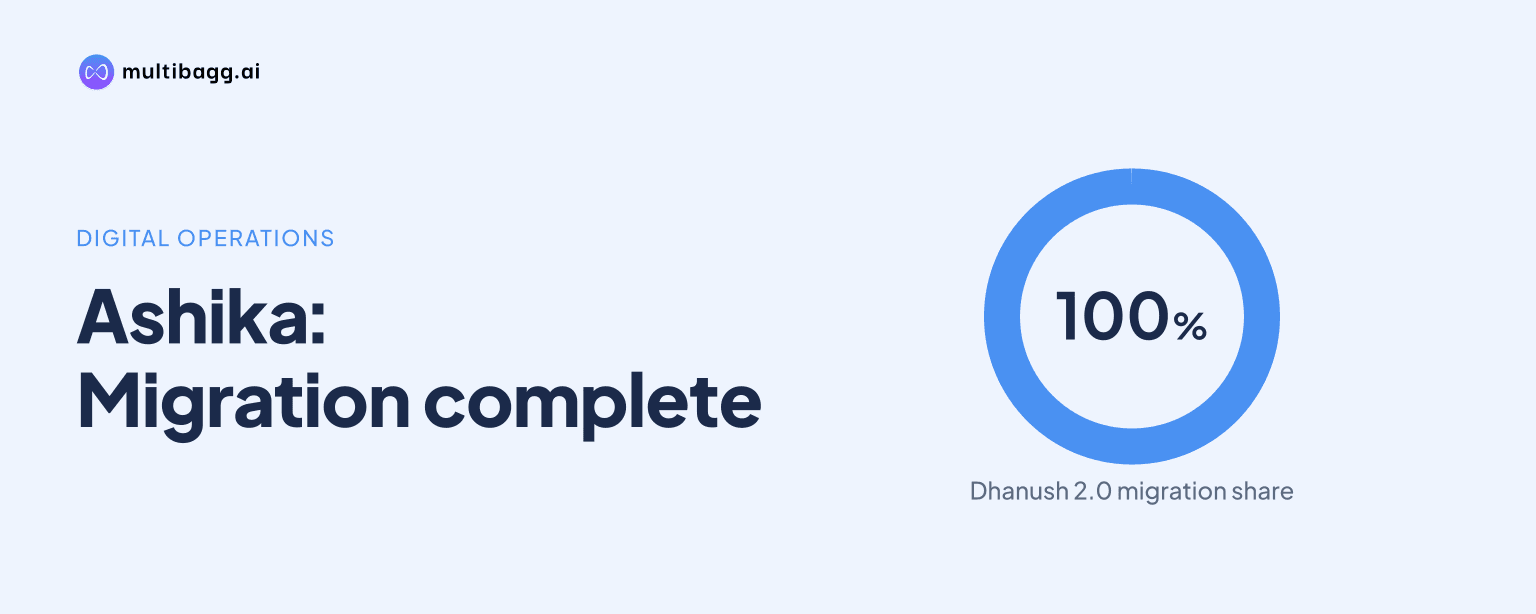
Ashika Group says it has completed a 100% rollout of Dhanush 2.0 and migrated 100% of customers, leaving zero active logins on its legacy app. The company says the shift moves its digital proposition from an execution-first trading platform toward an integrated wealth ecosystem, while retaining the previous app as a backup.
Know Ashika Global Securities inside out
Results, valuation, peers and who's buying, in one view.
Has Ashika completed the Dhanush 2.0 customer migration?
Yes. Ashika reports a 100% rollout across its user base and 100% customer migration to Dhanush 2.0, with zero active logins on the legacy application. This is the clearest operational change disclosed in the presentation: customers are no longer actively logging in to the former Dhanush app, although Ashika has retained it as a backup rather than saying it has been decommissioned.
The migration applies to a digital operation that Ashika presents as serving about 1.35 lakh clients, with an average of roughly 1 lakh traders per day. Dhanush is available through Android, iOS and web platforms, and Ashika says it supports trading across the five exchanges listed in its presentation, alongside equities, derivatives and mutual funds.
Ashika does not disclose a completion date, migration timeline, cost, outage record or customer-retention measure for the 100% transition. It also does not state how many of the approximately 1.35 lakh clients were active traders. The zero-login measure establishes movement away from the legacy app, but does not by itself quantify usage of individual Dhanush 2.0 features.
How does Dhanush 2.0 differ from the old Dhanush platform?
Dhanush 2.0 is positioned as an integrated wealth platform rather than a traditional platform focused only on trade execution and transactions. Ashika describes old Dhanush 1.0 as having a legacy user interface and user experience, multiple fragmented platforms or apps, little to no artificial-intelligence layer, and a static experience. It also says the earlier application was vendor-based, with intellectual-property and dependency exposure to that vendor.
The comparison signals a broader product ambition, but Ashika provides more detail on Dhanush 1.0's limitations than on completed Dhanush 2.0 functionality. Its confirmed changes are the full rollout, full customer migration and frictionless electronic know-your-customer, or E-KYC, process. Goal-based journeys, open application programming interfaces, or APIs, retail algorithms and personalised recommendations are listed as upcoming innovations rather than delivered capabilities.
Ashika also links the platform shift to its wider retail and high-net-worth individual broking business. That business reports more than 1 lakh demat accounts, more than 300 authorised persons and more than 1,000 channel partners. The Dhanush 2.0 description therefore places digital onboarding and execution alongside relationship-led advisory and distribution, rather than presenting the app as a standalone service.
Got a follow-up? Ask IRIS
What products does Ashika intend Dhanush 2.0 to support?
Ashika says Dhanush 2.0 is intended to think beyond equity by covering fixed deposits, bonds, exchange-traded funds, margin trading facility and loans. This expands the stated scope from the older platform's execution-led model, while the existing Dhanush offering already supports equities, derivatives and mutual funds.
The product framing is consistent with Ashika's six retail service verticals: equity, derivatives, commodity, depository services, distribution and private client group services. Its distribution activities include mutual funds, initial public offerings and structured products, while depository services include demat, custody and settlement support. The presentation does not specify which of those six verticals were already integrated into Dhanush 2.0 at the time of the stated 100% migration.
Ashika reports approximately Rs 26,000 crore+ of assets under advisory for its retail and high-net-worth individual broking platform. It attributes strategic importance to margin trading facility in its wider brokerage model, saying competitive rates and awareness programmes are accelerating adoption of that book. Ashika does not disclose the margin-trading balance, interest income, or the number of Dhanush 2.0 users taking any wealth or credit product.
What is Ashika planning after the Dhanush 2.0 rollout?
Ashika lists several post-rollout initiatives: fintech and startup collaborations, a revamped retail website, goal-based journeys, open APIs, retail algorithms and personalised recommendations. These are forward-looking plans, not reported completion milestones. The presentation says the retail website initiative is intended to improve user experience, organic traffic and customer acquisition, but gives no target date or traffic objective.
The planned partnerships sit alongside a leadership structure that names Gagan Singla as chief executive officer of Digital Business and Vatsal Jain as executive director and chief innovation officer. Ashika says Singla has more than two decades of experience and is driving the digital business through innovation, technology and automation. Jain is identified as leading Dhanush and technology-led innovation across the group.
Ashika's digital plan also operates within a physical distribution footprint of 14 operating branches across 19 states, with outreach in Tier 2 and Tier 3 cities. The company calls this a phygital model, combining technology with human advisory. That model is relevant to the wealth-platform proposition because Ashika describes relationship-led engagement and cross-selling as part of the retail business, while Dhanush provides digital execution and onboarding.
Conclusion
The disclosed result is that Ashika has removed active customer logins from its legacy Dhanush app through a reported 100% migration to Dhanush 2.0. The platform is being repositioned from trading execution toward a broader wealth ecosystem spanning investments, credit-related products and digitally enabled advisory, supported by Ashika's approximately 1.35 lakh-client retail base and approximately Rs 26,000 crore+ of assets under advisory.
What to watch next is delivery of the initiatives Ashika labels upcoming: goal-based journeys, open APIs, retail algorithms, personalised recommendations, fintech partnerships and the revamped retail website. The presentation provides no rollout dates, adoption targets, revenue effects or feature-level usage data, so future disclosures would be needed to show how the completed migration translates into customer activity and product adoption.