










Ashika Group reports Rs 215 crore PE and Rs 300 crore credit closes
Key highlights
- Ashika’s private-equity Category II AIF reported approximately Rs 215 crore-plus in first-close commitments against a Rs 500 crore base target.
- Ashika Credit Opportunities Fund reported approximately Rs 300 crore in commitments against a Rs 1,000 crore base target and has initiated a 20% drawdown.
- The private-equity AIF plans 12 to 15 investments, with target investment sizes of Rs 50 crore-plus and a 10% to 20% reserve for follow-on investments.
- Ashika India Select Fund returned 40.32% over six months to 30 September 2026, compared with 7.52% for the Nifty 500.
powered by IRIS
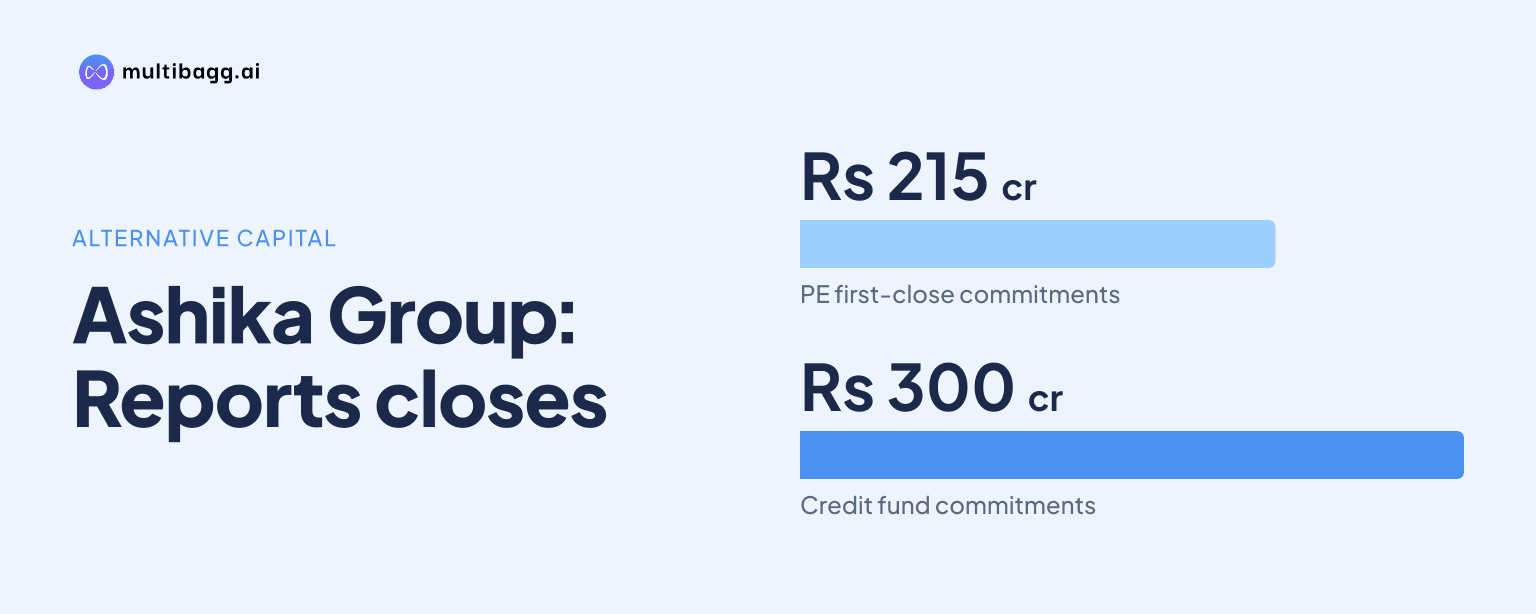
Ashika Group has reported approximately Rs 215 crore-plus of first-close commitments for its Category II private-equity alternative investment fund, or AIF, and approximately Rs 300 crore for its Category II private-credit fund. The credit vehicle has initiated a 20% drawdown and plans to begin deployment in Q3FY27, while Ashika has also presented its Category III healthcare-focused Ashika DNA fund.
Know Ashika Global Securities inside out
Results, valuation, peers and who's buying, in one view.
What has Ashika raised for its private-equity and credit funds?
Ashika has reported approximately Rs 215 crore-plus in commitments for its private-equity AIF and approximately Rs 300 crore for Ashika Credit Opportunities Fund. The private-equity total includes a Rs 100 crore anchor commitment from Ashika Group, while the private-credit fund has begun a 20% drawdown of commitments received.
The two Category II funds have different target structures. The private-equity AIF has a Rs 500 crore target fund size and a Rs 500 crore green-shoe option, whereas Ashika Credit Opportunities Fund has a Rs 1,000 crore target and a Rs 1,000 crore green-shoe option. The credit fund’s reported commitments are higher than the private-equity first close, but both vehicles remain below their stated base targets.
Ashika has also set out two Category III listed-equities strategies. Ashika India Select Fund reported a 39.14% absolute return since inception on 31 January 2024, against 12.76% for the Nifty 500, while Ashika DNA is presented as an open-ended pharma and healthcare fund. The presentation does not disclose assets under management or a first-close amount for Ashika DNA.
How will Ashika’s private-equity AIF invest?
Ashika’s private-equity AIF plans 12 to 15 investments, with target investment sizes of Rs 50 crore-plus and a 10% to 20% reserve for follow-on investments. Sarvesh Kanodia and Sougata Roy are identified as managing partners, with more than 15 years and 16-plus years, respectively, of investing and mergers-and-acquisitions experience.
The stated thesis covers manufacturing and consumer opportunities. Manufacturing includes climate-related electric-vehicle and energy businesses, electronics, industrials, defence and aerospace, while consumer coverage includes durable goods, fast-moving consumer goods and logistics. The 12-to-15-company plan represents a concentrated approach relative to the Rs 500 crore base target.
The Rs 100 crore anchor commitment accounts for part of the approximately Rs 215 crore-plus first close. Ashika does not disclose portfolio investments, a deployment schedule, management fees, fund term or target returns for the private-equity AIF. The available information therefore describes fundraising progress, team credentials and investment parameters rather than realised results.
What are Ashika Credit Opportunities Fund’s terms and targets?
Ashika Credit Opportunities Fund targets gross returns of 16% to 18%, periodic distributions of 8% to 10% a year and a three-to-five-year investment horizon. These are strategy targets rather than reported fund-level returns, and the fund says its investments will be fully secured with collateral and covenant protection.
The fund has warehoused a Rs 100 crore investment at a stated 19.5% internal rate of return, or IRR, and says deployment starts in Q3FY27. Its underwriting framework covers four elements: collateral, cashflows, covenants and counterparty. Abhinav Jain, Ashika’s chief executive officer for private credit, is described as having more than 23 years of private-credit and structured-finance experience.
Ashika Credit Opportunities Fund is close-ended for five years, with two extensions, and has an 18-month commitment period that can be extended by six months. Its stated hurdle rate is 12% and its operating-expense cap is 0.3% a year. The Rs 1,000 crore base target is twice that of the private-equity AIF, while the credit fund is the only one of the two for which Ashika gives a deployment quarter.
Got a follow-up? Ask IRIS
What is Ashika DNA’s healthcare investment approach?
Ashika DNA is Ashika’s Category III open-ended listed-equities fund focused on pharma and healthcare. Sudarshan Padmanabhan is named fund manager and Ishita Jain president; the presentation cites Padmanabhan’s sell-side and buy-side healthcare experience and Jain’s biochemistry and biotech-enterprise background.
Ashika identifies production-linked incentives, the China+1 supply-chain trend, contract development and manufacturing organisation activity and rising healthcare spending as sector drivers. It also identifies more than 25 sub-segments across the healthcare value chain, making the fund’s stated approach focused on selection across distinct sub-sector cycles.
Ashika says 77% of the BSE Healthcare index is held in 30 of its 135 stocks. On that basis, Ashika DNA proposes bottom-up analysis, with portfolio position sizes determined by research rather than index weight. Ashika does not provide a launch-date return, target fund size, assets under management or fundraising figure for the fund.
How has Ashika India Select Fund performed against the Nifty 500?
Ashika India Select Fund outperformed the Nifty 500 in every disclosed period as of 30 September 2026. Its six-month return was 40.32%, compared with 7.52% for the index, while its one-year return was 15.33% against a 2.91% decline for the Nifty 500.
Over one month, the fund returned 1.87% versus a 5.88% decline for the index, and over three months it returned 11.69% compared with a 4.02% decline. Since inception on 31 January 2024, its compound annual growth rate, or CAGR, was 13.19%, against 4.61% for the Nifty 500; the respective absolute returns were 39.14% and 12.76%.
The fund uses Ashika’s G-VERGE process, covering growth, valuation, earnings, re-rating and governance. Ashika describes the strategy as flexible across market capitalisations, with dynamic allocation and research-led selection. The presentation says returns are pre-tax and post-expenses, are not verified by a regulatory authority, and are annualised for periods above one year.
Conclusion
Ashika’s alternatives buildout combines approximately Rs 215 crore-plus in private-equity commitments, approximately Rs 300 crore for private credit and a healthcare-focused listed-equities strategy. The products have distinct structures: private equity targets 12 to 15 investments, private credit uses a secured-investment framework and Ashika DNA focuses on pharma and healthcare selection across more than 25 sub-segments.
The next disclosed event is the planned Q3FY27 start of private-credit deployment following the 20% drawdown and the Rs 100 crore warehoused investment. Ashika’s progress toward the Rs 500 crore private-equity base target and Rs 1,000 crore private-credit base target, along with any disclosure of Ashika DNA assets or performance, remain matters to watch.