










Asian Paints Limited Reports 16.9% Q2 Sales Growth, Margin Drops
Key highlights
- Asian Paints Limited reported Q2 FY27 consolidated net sales of ₹9,953.9 crore, up 16.9% year on year.
- Q2 FY27 PBDIT margin was 15.6%, down 202 basis points year on year.
- Domestic coatings grew 16.4% by value and 6.8% by volume in Q2 FY27.
- Asian Paints approved an interim FY27 dividend of ₹5.75 per equity share.
powered by IRIS
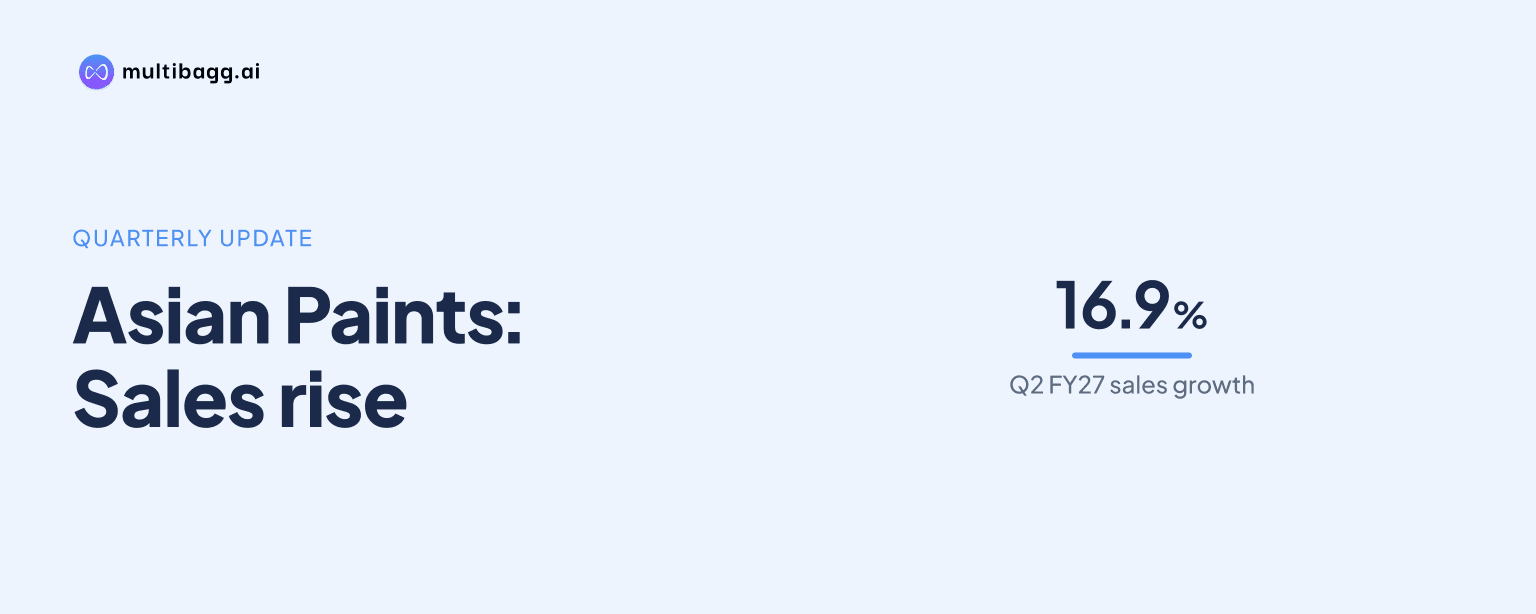
Asian Paints Limited reported 16.9% year-on-year growth in Q2 FY27 consolidated net sales to ₹9,953.9 crore, but PBDIT margin declined 202 basis points to 15.6% as input inflation and delayed price pass-through weighed on profitability. The July-September 2026 result showed broad revenue growth while highlighting pressure on operating margins.
Know Asian Paints inside out
Results, valuation, peers and who's buying, in one view.
What did Asian Paints report for Q2 FY27?
Asian Paints reported consolidated net sales of ₹9,953.9 crore for Q2 FY27, up 16.9% year on year, while profit after tax after minority interest rose 7.5% to ₹1,067.6 crore. The sales growth was materially faster than profit growth because higher input costs and the timing of pricing actions affected margins.
The company released its quarterly results on October 29, 2026, followed by an investor call attended by senior management, including Managing Director and Chief Executive Officer Amit Syngle. Management described the quarter as reasonably positive on demand and value growth, but acknowledged that raw-material inflation had become a significant operating issue.
For the first half of FY27, consolidated net sales increased 17.4% and profit after tax after minority interest rose 24.5%, according to the company’s earnings summary. The half-year performance indicates that the September-quarter margin compression occurred alongside continued growth across key businesses.
How did the decorative and industrial businesses perform?
Asian Paints’ domestic coatings business grew 16.4% by value and 6.8% by volume in Q2 FY27, supported by decorative-paint demand and industrial-business growth. In the standalone decorative segment, volume growth was 6.4% and value growth was 14.5% for the quarter.
The gap between value and volume growth reflected a higher realisation contribution than physical volumes alone. For the first half, decorative-paint volumes rose about 8%, while decorative value growth was about 16%. Decorative and industrial value growth combined was 16.4% in Q2 and about 16.5% in the first half.
The industrial segment reported revenue growth of 33.7% to ₹795 crore during the quarter. International sales also increased 29.5%, adding to the company’s consolidated sales expansion. These businesses supported overall growth even as the domestic decorative category remained the main contributor to the group’s operations.
Why did Asian Paints’ operating margin decline?
Asian Paints’ PBDIT margin fell to 15.6% in Q2 FY27 from the year-earlier level, a decline of 202 basis points, as raw-material inflation increased costs faster than price pass-through. Quarterly PBDIT was ₹1,557 crore, up 3.6% year on year, substantially below the pace of sales growth.
Management said gross margin had moved into a 41% to 43% range from an earlier 44% to 45% range. The company cited inflation in key inputs and a weaker product mix as factors affecting profitability. New anti-dumping duties on titanium dioxide, or TiO2, were also part of the cost backdrop discussed around the quarter.
Despite the near-term pressure, Asian Paints maintained its 18% to 20% EBITDA margin guidance. The guidance signals that management continues to frame the Q2 margin outcome within its stated operating range, although the reported quarterly margin was lower because of the inflationary environment and delayed recovery through prices.
Got a follow-up? Ask IRIS
What are the key Q2 FY27 financial figures?
Asian Paints delivered double-digit sales growth in Q2 FY27, but operating profitability rose modestly as cost inflation reduced margin conversion. The following table summarises the principal reported operating and financial indicators.
The figures show that revenue expansion was broad-based, while profitability reflected a different trajectory. Net sales grew at 16.9%, compared with 3.6% growth in PBDIT and 7.5% growth in profit after tax after minority interest. This divergence is central to the quarter’s financial outcome.
Asian Paints also approved an interim dividend of ₹5.75 per equity share for the financial year ending March 31, 2027. The dividend decision was approved by the board at its October 29 meeting.
How does the Q2 result matter for investors and the paint industry?
The Q2 result matters because Asian Paints continued to record strong value growth despite a more demanding cost environment. Decorative-paint volume growth of 6.4% and domestic coatings value growth of 16.4% point to continuing sales momentum, while the difference between these measures shows the importance of realisations and business mix.
For investors, the key issue is the contrast between top-line growth and margins. The reported gross-margin range of 41% to 43%, compared with the earlier 44% to 45% range, provides a direct measure of the pressure from inputs. The 202-basis-point decline in PBDIT margin shows that the cost impact was visible in quarterly profitability.
For the wider coatings industry, the quarter illustrates the sensitivity of paint manufacturers to raw-material costs and the timing of price revisions. TiO2 is an important paint input, and anti-dumping duties add to the cost context cited during the period. Asian Paints’ industrial and international growth partly diversified the sales base, but did not eliminate the impact of inflation on consolidated margins.
Conclusion
Asian Paints combined 16.9% Q2 FY27 net sales growth with positive performance in domestic coatings, industrial operations and international markets. However, input-cost inflation limited operating leverage, resulting in a 15.6% PBDIT margin and only 3.6% growth in PBDIT despite the stronger sales increase.
The next focus will be the company’s ability to manage raw-material inflation and price pass-through while maintaining its stated 18% to 20% EBITDA margin guidance. Investors will also monitor whether decorative volumes, industrial revenue growth and international sales momentum continue through the remainder of FY27.