










ASM Technologies Declares ₹6 Interim Dividend for FY2027
Key highlights
- ASM Technologies declared a ₹6 per-share interim dividend on 5 August 2026, with 12 August as the ex-date and record date.
- Q1FY27 net profit rose 72% year-on-year to ₹26.8 crore, while revenue increased 62% to ₹198.8 crore.
- ASM Technologies reported an EBITDA margin of 23.2% in Q1FY27.
- The company disclosed plans for a ₹510 crore investment in Karnataka alongside its Q1FY27 update.
powered by IRIS
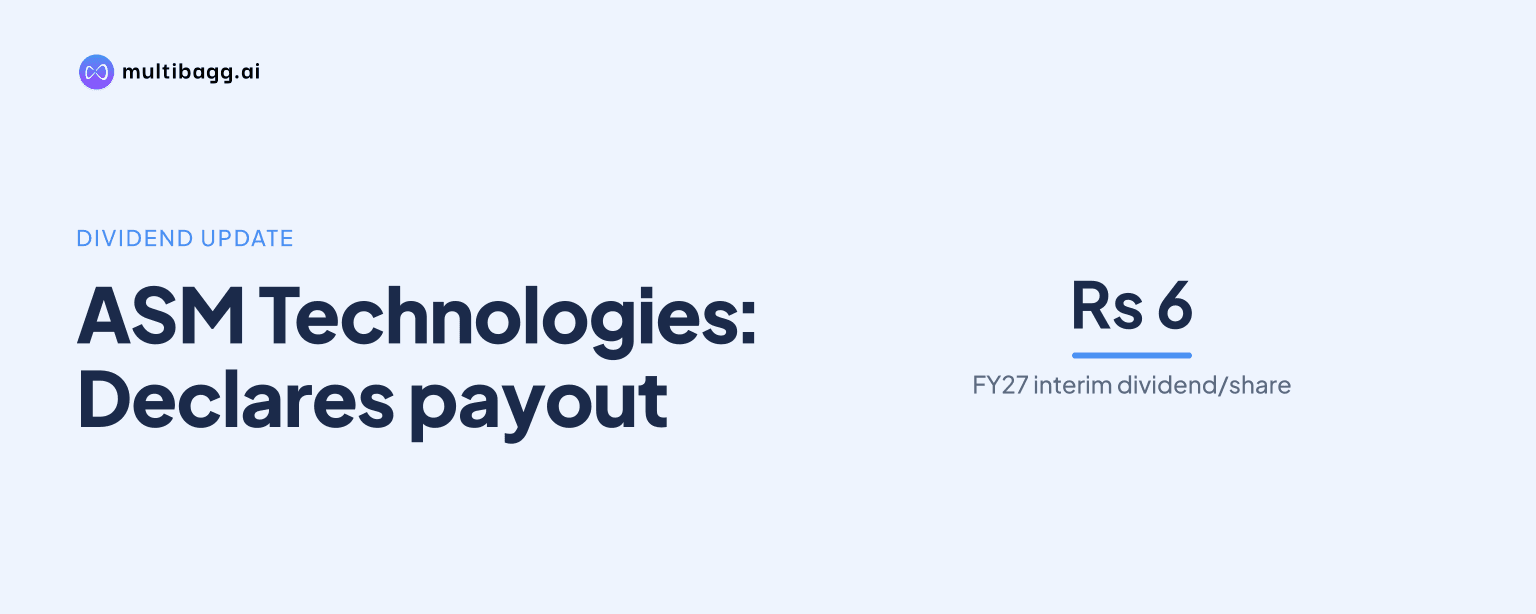
ASM Technologies Limited declared a ₹6 per-share interim dividend for FY2027 on 5 August 2026, following a 72% year-on-year rise in Q1FY27 net profit to ₹26.8 crore and a 62% increase in revenue to ₹198.8 crore. The dividend’s ex-date and record date were both 12 August 2026.
Know ASM Technologies inside out
Results, valuation, peers and who's buying, in one view.
What is ASM Technologies’ latest dividend announcement?
ASM Technologies Limited’s latest confirmed dividend is an interim payout of ₹6 per equity share, declared on 5 August 2026. The company set 12 August 2026 as both the ex-date and record date, meaning shareholders recorded as owners on that date were eligible for the distribution.
The dividend was described as 60% in the company’s corporate-action information. For shareholders, the ₹6 amount is the relevant cash payout per share. The reported trailing 12-month dividend yield was 0.34% as of 5 November 2026, while the yield at the 12 August ex-date was listed at 0.12%.
ASM Technologies is an India-based consulting and product engineering company with operations and a global presence across the US, Singapore, the UK, Canada, Mexico and Japan. Its services cover enterprise solutions, technology solutions, engineering services and product engineering, supported by offshore development and support centres in India and overseas.
When were the ex-date and record date for the ₹6 dividend?
The ex-date and record date for ASM Technologies’ ₹6 interim dividend were both 12 August 2026. Investors needed to hold the equity shares in time for settlement before the ex-date to be reflected as shareholders on the record date.
The company’s dividend information states that the payout is credited to the bank account linked to the shareholder’s demat account. The available material refers to payment around 12 August 2026, although shareholders generally rely on their depository and bank records for the actual credit date.
The August dividend followed a final dividend of ₹12 per share for FY2026, for which the ex-date and record date were 29 July 2026. Earlier in calendar 2026, ASM Technologies had also declared an interim dividend of ₹2.50 per share, with an 11 February ex-date.
How did ASM Technologies perform in Q1FY27?
ASM Technologies reported Q1FY27 net profit of ₹26.8 crore, up 72% year-on-year, while revenue increased 62% to ₹198.8 crore. EBITDA margin improved to 23.2%, according to the company update published after its first-quarter results.
The improvement in profit, revenue and operating margin provides context for the August dividend declaration. Dividend decisions are made by the board and remain distinct from quarterly earnings, but the reported first-quarter figures show that the company entered FY2027 with higher operating and financial performance than in the comparable prior-year period.
The company also disclosed plans for a ₹510 crore investment in Karnataka and new AI-focused partnerships. These are strategic initiatives identified alongside the quarterly update. The available information does not provide a schedule for the full investment or quantify the potential financial contribution from the partnerships.
Got a follow-up? Ask IRIS
What does the dividend history show about shareholder payouts?
ASM Technologies’ disclosed dividend history shows 39 declared dividends, with the ₹6 interim payout being the newest listed distribution. The sequence indicates that the company has used both interim and final dividends, including multiple interim payouts in some financial periods.
The most recent entries show a ₹12 final dividend dated 9 May 2026 with a 29 July ex-date, followed by the ₹6 interim dividend declared on 5 August. Before these, the company declared ₹2.50 as an interim dividend in January 2026, a ₹1 second interim dividend in November 2025 and a ₹3 final dividend in May 2025.
Dividend history is useful for understanding past distributions, but it does not establish a fixed payout pattern. The company’s listed dividend payout percentages have varied across years, reflecting that distributions can change with earnings, cash needs, investment plans and board decisions.
What should investors watch after the August dividend?
Investors should watch ASM Technologies’ board meeting scheduled for 7 November 2026, which was convened to approve financial results for the quarter and half year ended 30 September 2026 and to consider an interim dividend, if any. The notice did not confirm that a dividend would be declared.
The second-quarter results will provide an update on whether the Q1FY27 rise in revenue, profit and EBITDA margin continued. Investors may also seek further disclosures on the proposed ₹510 crore Karnataka investment, including its structure, timing and expected operational scope.
For income-focused shareholders, the key distinction is between the ₹6 dividend already declared in August and any future payout that the board may consider. Until the company releases an official outcome from the November meeting, no additional dividend amount or record date is confirmed.
Conclusion
ASM Technologies’ latest confirmed shareholder distribution is the ₹6 per-share interim dividend declared on 5 August 2026, with 12 August as the ex-date and record date. The announcement came after Q1FY27 revenue reached ₹198.8 crore, net profit rose to ₹26.8 crore and EBITDA margin improved to 23.2%.
The next disclosed event to watch is the 7 November 2026 board meeting for Q2 and half-year results, where the board is also set to consider an interim dividend, if any. Updates on the proposed ₹510 crore Karnataka investment and AI-focused partnerships will also remain relevant to the company’s operating plans.