










Associated Alcohols ethanol realization fell to Rs 57 in H1FY27
Key highlights
- AABL’s H1FY27 ethanol realization was Rs 57 per litre, compared with Rs 69 in FY26.
- AABL operated its ethanol plant at 95% capacity utilization in H1FY27.
- AABL’s Q2FY27 ethanol revenue was Rs 56.6 crore, down 20% year on year, while volume declined 5% to 93 lakh litres.
- AABL received an additional ethanol allocation of 87.4 lakh litres for Q4 ESY 2025-26.
powered by IRIS
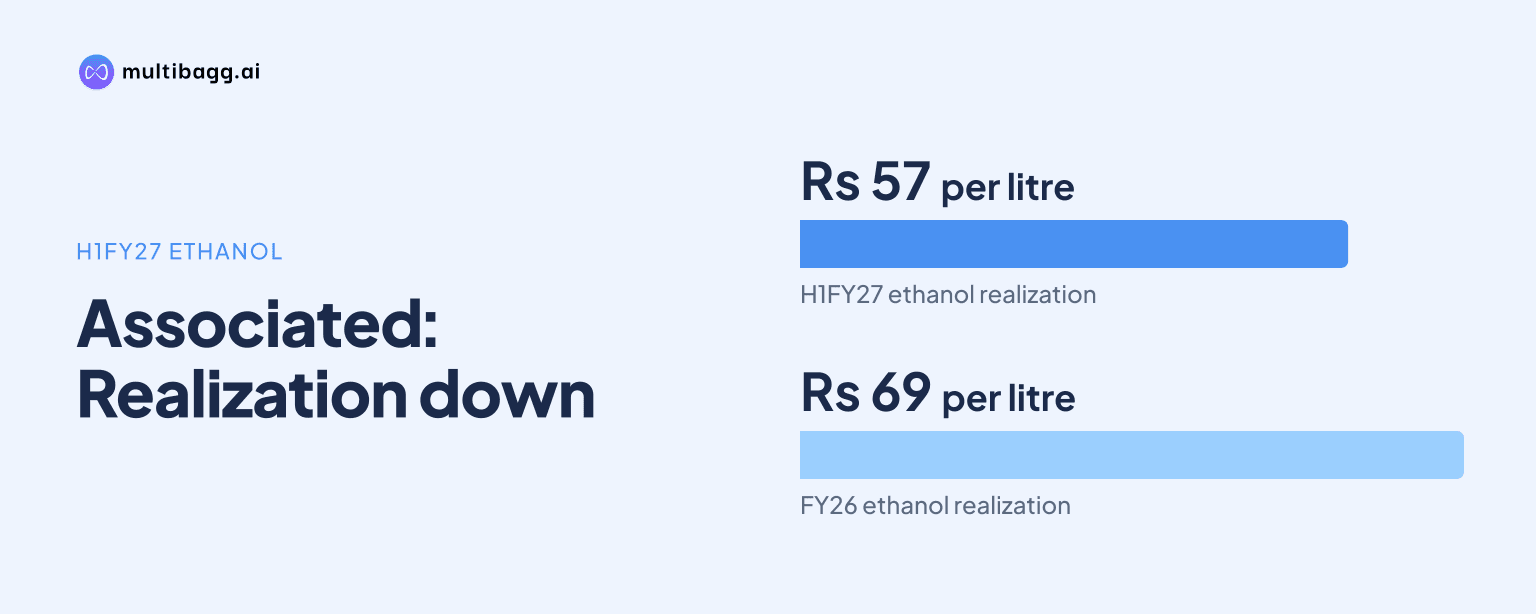
Associated Alcohols’ H1FY27 ethanol realization fell to Rs 57 per litre from Rs 69 in FY26 as industry oversupply reduced oil marketing company allocations and moved sales to lower-priced private buyers; despite 95% capacity utilization, Q2FY27 revenue declined 20% year on year and EBITDA margin was 2%.
Know Associated Alcohols & Breweries inside out
Results, valuation, peers and who's buying, in one view.
Why did AABL’s ethanol realization fall to Rs 57?
AABL’s ethanol realization fell to Rs 57 per litre in H1FY27 because industry oversupply resulted in lower allocations from oil marketing companies, or OMCs, and pushed higher sales to private buyers at lower realizations. The presentation identifies that sales-channel shift as the mechanism behind the decline, despite 95% capacity utilization at the ethanol plant.
The H1FY27 realization of Rs 57 per litre was Rs 12 lower than FY26’s Rs 69, Rs 16 below FY25’s Rs 73 and Rs 15 below FY24’s Rs 72. AABL states that the realization measure excludes revenue reported under “Others”, so the series tracks ethanol pricing rather than all segment revenue.
AABL’s flexible product offering includes ethanol sales to OMCs and private players, as well as extra-neutral alcohol, or ENA, for captive use and supply to bottlers. Its facility can use rice, maize, jawar, barley and other starch-rich feedstock, but its H1FY27 disclosure shows that the buyer mix, rather than operating capacity alone, affected average ethanol pricing.
How did AABL’s ethanol revenue change across periods?
AABL reported ethanol revenue of Rs 111.6 crore in H1FY27, after Rs 201.9 crore in FY26, Rs 247.7 crore in FY25 and Rs 46.9 crore in FY24. H1FY27 is a six-month period and is therefore not directly comparable with the full-year figures, while the FY25-to-FY26 comparison shows revenue declined by Rs 45.8 crore.
Revenue classified as Others was Rs 31.9 crore in H1FY27, versus Rs 33.4 crore in FY26, Rs 57.8 crore in FY25 and Rs 2.7 crore in FY24. The presentation does not disclose what is included in Others, while it specifically notes that ethanol realization excludes this revenue line.
AABL recorded Q2FY27 ethanol revenue of Rs 56.6 crore, down 20% year on year, on volume of 93 lakh litres, down 5% year on year. Revenue declined faster than volume, which is consistent with AABL’s stated shift towards private-player sales at lower realizations.
Why did 95% utilization not prevent lower ethanol margins?
AABL operated at 95% ethanol capacity utilization in H1FY27, yet its average realization was Rs 57 per litre because oversupply lowered OMC allocations and increased exposure to private buyers. The disclosure indicates that the price received and destination of production mattered alongside the amount produced.
AABL’s Q2FY27 ethanol EBITDA, or earnings before interest, tax, depreciation and amortisation, margin was 2%, compared with 4% a year earlier. That 2-percentage-point decline accompanied a 20% revenue fall and a 5% volume decline, although the presentation does not provide a cost bridge or an absolute EBITDA figure.
AABL can direct output across ethanol, ENA, malt, Indian-made foreign liquor and Indian-made Indian liquor. This operational flexibility provides multiple product routes, but the company’s Q2FY27 segment data shows it did not prevent lower ethanol economics when private-player sales increased at lower pricing.
Got a follow-up? Ask IRIS
What allocation changes could affect AABL’s ethanol sales next?
AABL received an additional ethanol allocation of 87.4 lakh litres for Q4 ESY 2025-26, or ethanol supply year 2025-26. The presentation does not disclose the realization, expected revenue or expected margin on this allocation, leaving its financial contribution unspecified.
AABL also highlighted an ESY 2026-27 tender of about 1,100 crore litres that excludes sugar-based ethanol allocation. Management said the structure benefits grain-based ethanol players, a development relevant to AABL because its disclosed feedstock options include rice, maize, jawar and barley.
The potential tender benefit needs to be considered with the lower OMC allocations reported in H1FY27. AABL does not disclose its expected share of the 1,100 crore litre tender, the timing of any award or the selling price, so the extent to which it could change the company’s OMC-private buyer mix remains unresolved.
How is AABL funding its operating investments?
AABL reported cash flow from operations of Rs 51.8 crore in FY26, down from Rs 73.9 crore in FY25 and above Rs 28.4 crore in FY24. Its cash-flow-from-operations-to-EBITDA conversion was 0.36 times in FY26, compared with 0.58 times in FY25 and 0.37 times in FY24.
AABL completed capital expenditure of Rs 51.9 crore in FY26 after Rs 85.9 crore in FY25 and Rs 103.8 crore in FY24. For FY27, it listed Rs 50 crore of capital expenditure done and Rs 22 crore earmarked or expected, with requirements funded primarily through internal accruals.
AABL expects a Rs 38 crore bottling-line acquisition and rehabilitation at SDF Industries, a Rs 15.2 crore polyethylene terephthalate bottling line and a Rs 10 crore biogas plant to commence or be commissioned in Q4FY27. Management expects the biogas plant to save 4% to 5% on power and fuel, but the presentation does not assign those savings to the ethanol segment.
Conclusion
AABL’s H1FY27 ethanol results show that 95% plant utilization did not offset the effect of oversupply and a lower-allocation environment. Realization fell to Rs 57 per litre, while Q2FY27 revenue declined 20% on a 5% volume reduction and EBITDA margin moved to 2% from 4% a year earlier.
The next disclosed developments are the additional 87.4 lakh litre allocation for Q4 ESY 2025-26 and the approximately 1,100 crore litre ESY 2026-27 tender that excludes sugar-based allocation. Management’s stated benefit for grain-based players will depend on AABL’s allocation outcome, achieved realization and the proportion of ethanol sold to OMCs rather than private buyers.