










Astonea Labs Limited targets Rs 215 crore FY27 revenue
Key highlights
- Astonea reported H1 FY27 revenue from operations of Rs 95.86 crore, up 44.6% year on year.
- Astonea needs about Rs 119 crore of H2 FY27 revenue to reach its Rs 215 crore full-year target.
- Astonea increased tablet output capacity by 35% and said its OTC portfolio has grown around 5% month on month.
- Astonea has filed 95 export dossiers across Nicaragua, Bolivia, Guatemala and Panama.
powered by IRIS
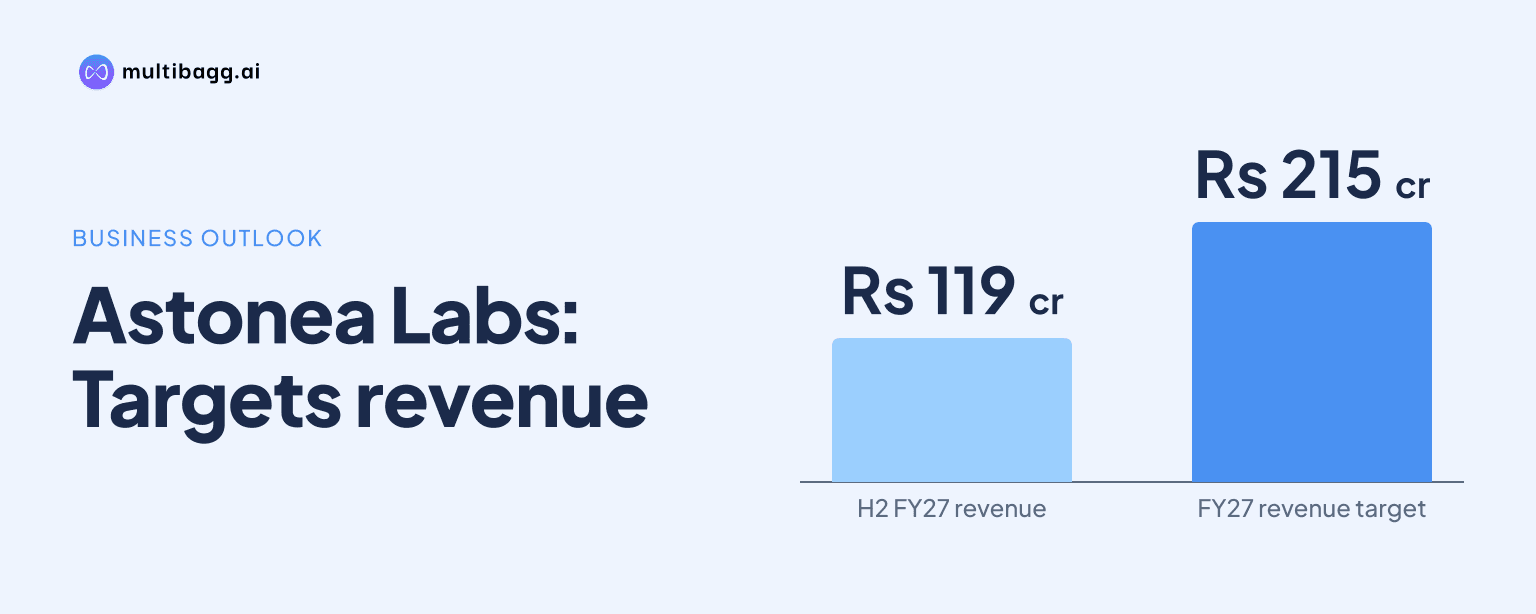
Astonea Labs Limited targets FY27 revenue of at least Rs 215 crore after reporting Rs 95.86 crore of revenue from operations in H1 FY27, requiring about Rs 119 crore in H2 FY27. Management links the plan to OTC brands, a 35% increase in tablet output capacity, delayed September dispatches and export registrations.
Know Astonea Labs inside out
Results, valuation, peers and who's buying, in one view.
How much revenue must Astonea deliver in H2 FY27?
Astonea needs about Rs 119 crore of revenue in H2 FY27 to meet management’s FY27 target of Rs 215 crore or more. The implied second-half amount is Rs 23.14 crore above the Rs 95.86 crore reported in the six months ended 30 September 2026, making the remaining half larger than the first.
Management said the required H2 FY27 revenue would be 47% above H2 FY26 revenue of Rs 81.29 crore. H2 FY26 also contributed 55% of FY26 revenue, according to the filing, while H1 FY26 revenue from operations was Rs 66.29 crore and H1 FY27 revenue was Rs 95.86 crore.
Astonea said five regulatory audits in September slowed its plant and shifted some dispatches into Q3 FY27. The company said inventory held back during the audits is expected to ship in Q3, providing a disclosed source of second-half sales timing rather than a new revenue stream.
What did Astonea report for H1 FY27?
Astonea reported H1 FY27 revenue from operations of Rs 95.86 crore, up 44.6% from Rs 66.29 crore in H1 FY26 and 17.9% from Rs 81.29 crore in H2 FY26. Total income was Rs 96.21 crore, including Rs 0.35 crore of other income, against Rs 66.39 crore in H1 FY26.
Earnings before interest, tax, depreciation and amortisation, or EBITDA, rose 140.7% year on year to Rs 13.20 crore, while profit after tax increased 153.3% to Rs 4.82 crore. EBITDA margin rose 550 basis points to 13.8% from 8.3%, and profit-after-tax margin rose 216 basis points to 5.0% from 2.9%.
Management attributed margin changes to a larger sales share from Astonea’s own over-the-counter, or OTC, brands. Gross profit rose 103.4% year on year to Rs 36.04 crore and gross margin increased 1,086 basis points to 37.6%, although gross margin was 113 basis points below H2 FY26’s 38.7%.
Astonea recorded an exceptional loss of Rs 46 lakh following a fire at its plant on 27 April 2026. These were the company’s first half-year results under Indian Accounting Standards, or Ind AS, with H1 FY26 restated on the same basis; the figures are consolidated and include its share of profit from an associate.
Which OTC products and capacity changes support Astonea’s plan?
Astonea said its OTC portfolio has grown around 5% month on month, and Young Fuel, an anti-ageing cream launched in H1 FY27, made a good start. The filing does not provide sales for Young Fuel, the number of OTC products, or the measurement period behind the monthly portfolio-growth statement.
Tablet output capacity has risen 35%, according to Astonea’s business update. The company said its plant complies with revised Schedule M requirements and World Health Organization Good Manufacturing Practices, or WHO-GMP, but did not disclose tablet capacity in units or the commissioning date for the additional capacity.
Inventory days were 83 at 30 September 2026, unchanged from 31 March 2026 and above 72 days a year earlier. Astonea said inventory retained because of the September audits partly explained the higher year-on-year inventory level and is expected to be dispatched in Q3 FY27.
Got a follow-up? Ask IRIS
How is Astonea building its export business?
Astonea appointed distributors in Guatemala and Panama, taking its network to nine markets across Central America, South America and the Caribbean. It has filed 95 product dossiers in Nicaragua, Bolivia, Guatemala and Panama, without disclosing the split by country or product.
Ghana had completed an inspection of Astonea’s plant by the H1 FY27 update, while inspections in Ethiopia and Kenya were expected shortly. The filing gives no dates for those inspections and does not state that inspections will automatically produce product approvals or commercial launches.
Management targets FY28 revenue of Rs 300 crore or more and FY29 revenue of Rs 405 crore or more, describing the path as about 40% compound annual growth from FY26. Management identified OTC brands in India and exports as the growth routes, with around 60 export product registrations expected in Q1 FY28.
What margin and borrowing limits has Astonea set?
Astonea targets an FY27 EBITDA margin of 13% to 15%, compared with its reported H1 FY27 margin of 13.8% and H2 FY26 margin of 10.5%. The outlook prints a profit-after-tax margin target as “56%”, while also saying the 5.0% H1 margin is within the targeted ranges; the filing does not resolve that apparent formatting inconsistency.
Gross borrowings were Rs 57.15 crore and net worth was Rs 72.19 crore at 30 September 2026, producing debt to equity of 0.79 times. At 31 March 2026, gross borrowings were Rs 43.00 crore, net worth was Rs 67.30 crore and debt to equity was 0.64 times.
Management said it intends to keep last-12-month debt to EBITDA at or below 3 times and debt to equity at or below 1 time. Debt to EBITDA was 2.6 times at 30 September 2026, based on Rs 21.75 crore of EBITDA for October 2025 to September 2026, compared with 3.1 times at 31 March 2026 based on FY26 EBITDA of Rs 14.03 crore.
Conclusion
Astonea’s FY27 target requires a larger H2 than its Rs 95.86 crore H1, with management citing delayed September dispatches, OTC portfolio growth, 35% higher tablet capacity and a nine-market export network. H1 EBITDA of Rs 13.20 crore and a 13.8% margin show the reported earnings position from which the company is pursuing that plan.
The next disclosed milestones are Q3 FY27 shipments of inventory held during the September audits, expected plant inspections in Ethiopia and Kenya, and around 60 anticipated export registrations in Q1 FY28. Management’s revenue plan also depends on keeping debt to EBITDA at or below 3 times and debt to equity at or below 1 time while funding working-capital needs.