










Astron Paper & Board Mill Limited Seeks 90-Day CIRP Extension
Key highlights
- Astron Paper & Board Mill Limited sought a 90-day CIRP extension after its initial 180-day period was due to expire on 6 November 2026.
- Astron Paper reported FY26 sales of about Rs 3 crore and a net loss of about Rs 19 crore.
- The Committee of Creditors approved six resolutions through e-voting held from 22 October to 5 November 2026.
- Astron Paper has three Gujarat manufacturing units with annual industrial capacity of approximately 175 thousand tonnes.
powered by IRIS
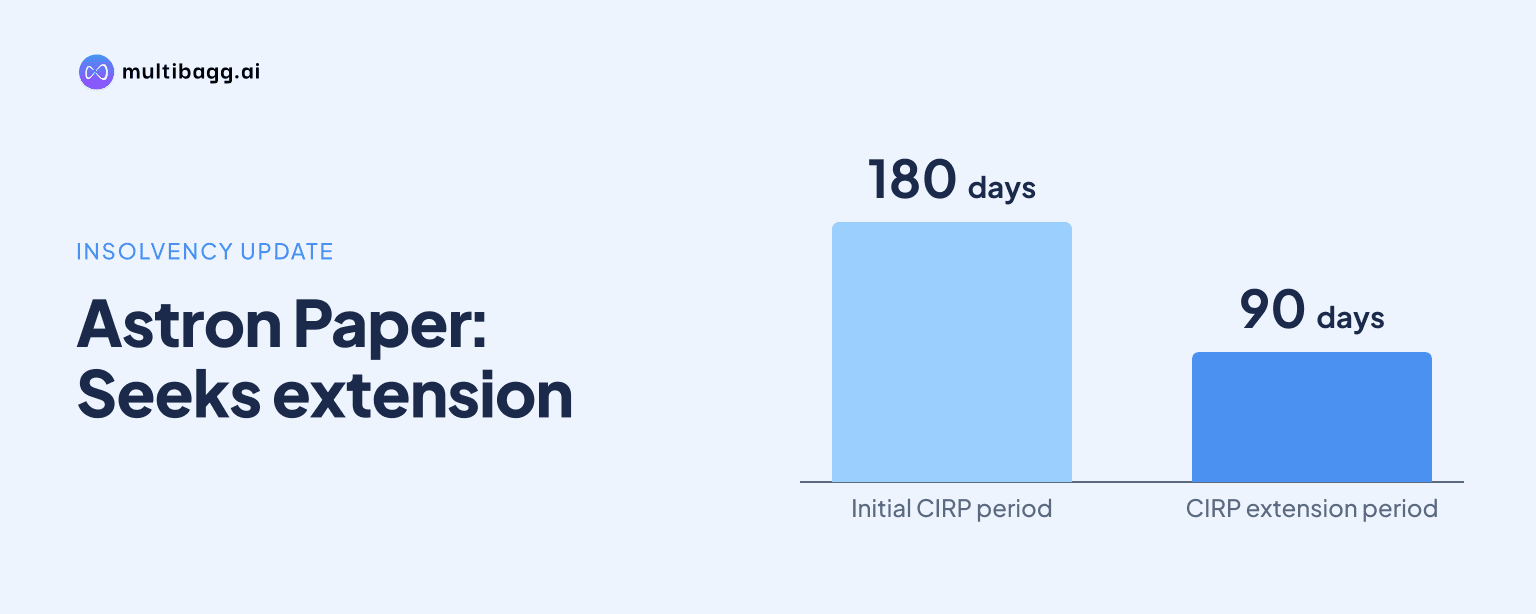
Astron Paper & Board Mill Limited has sought a further 90-day extension to its Corporate Insolvency Resolution Process after its initial 180-day period was due to end on 6 November 2026, while reporting FY26 sales of about Rs 3 crore and a net loss of about Rs 19 crore. The request prolongs an unresolved insolvency process for the Gujarat-based paper producer.
Know Astron Paper & Board Mill inside out
Results, valuation, peers and who's buying, in one view.
Why has Astron Paper sought a longer CIRP period?
Astron Paper sought the extension because the existing 180-day CIRP period was scheduled to expire on 6 November 2026. The company's deemed Resolution Professional, CA Atul J Sheth, filed an application before the Ahmedabad Bench of the National Company Law Tribunal under Section 12(2) of the Insolvency and Bankruptcy Code, 2016, seeking another 90 days.
The company disclosed that the application was made under Section 12(2), read with Regulation 40 of the CIRP Regulations and Rule 11 of the NCLT Rules. The available filing describes an application for an extension, rather than an NCLT order approving it. It also does not disclose the status of any resolution applicant, bidder, or resolution plan.
Astron Paper is under the management of a Resolution Professional during CIRP. Its operations have been described as largely shut, leaving the insolvency process central to the company's immediate future. The extension request means creditors and shareholders remain dependent on progress in the resolution process rather than normal operating recovery.
What did the Committee of Creditors approve?
The Committee of Creditors approved a 90-day CIRP extension through e-voting conducted between 22 October and 5 November 2026. The sixth CoC meeting was held on 19 October, and the Resolution Professional disclosed the voting outcome on 6 November under SEBI's Regulation 30 disclosure requirements.
Six resolutions were approved in the voting process. Along with the CIRP extension, creditors approved the appointment of Ashwin Thakkar in relation to a GST show-cause notice, a modification to first-month CIRP cost approval, and ratification of recovery from an operational creditor. The CoC also ratified CIRP costs and the appointment of Lex29A for verification under Section 29A of the IBC.
The CoC further approved an application under Section 19(2) of the IBC against the management of Balaram Papers Private Limited. Separate disclosures state that the Resolution Professional cited non-cooperation and withholding of critical financial documents and records by suspended management. No vote percentages, CIRP cost amounts, or further details of the alleged withheld records were disclosed.
Got a follow-up? Ask IRIS
What is behind Astron Paper's financial distress?
Astron Paper's financial position has weakened sharply, with FY26 sales of only about Rs 3 crore and a net loss of about Rs 19 crore. The low revenue base and loss were reported while the company was already under CIRP and its plant operations were largely suspended.
The company is an Ahmedabad-headquartered producer of recycled kraft paper used in corrugated packaging. It has three manufacturing units and four paper machines at strategic locations in Gujarat, with industrial capacity of approximately 175 thousand tonnes annually. The contrast between this installed capacity and its FY26 sales indicates the scale of the operating disruption described in the disclosures.
Historical operating data also points to significant stress in working-capital measures during FY26. Debtor days rose to 2,605 days, inventory days to 1,921 days, and payable days to 5,030 days. These figures are reported accounting metrics and should be assessed alongside the company's insolvency status, rather than as indicators of normal ongoing business activity.
How does the extension affect shareholders and creditors?
The extension request keeps Astron Paper's insolvency process open for longer and delays a final outcome for creditors and shareholders. Until a resolution plan is approved or another legally permitted outcome is reached, equity holders face continued uncertainty over the value of their investment and the eventual treatment of the company's liabilities.
For creditors, the additional time is intended to support completion of the CIRP process, including evaluation of resolution plans due by 16 November 2026. However, the disclosures do not identify any prospective bidder, indicate the number of plans expected, or state whether any plan has been received. They also do not provide debt figures or expected recovery amounts.
The Section 19(2) application is relevant because access to company records can affect the Resolution Professional's ability to manage the process and provide information to potential resolution applicants. The filing signals that the CoC has backed additional legal action connected with management cooperation, but it does not establish the outcome of that application.
Conclusion
Astron Paper's request for a 90-day CIRP extension reflects the unfinished state of its insolvency process at the end of the original 180-day period. With FY26 sales of about Rs 3 crore, a net loss of about Rs 19 crore, and largely suspended operations, the company remains in a financially distressed position despite its paper manufacturing capacity in Gujarat.
The next disclosed milestone is the 16 November 2026 deadline for resolution plans. Investors should watch for an NCLT decision on the extension application, updates on resolution-plan receipt or evaluation, and disclosures concerning the Section 19(2) application and the Resolution Professional's access to company records.