










Atmastco Ind AS transition reduced group equity by Rs 5.79 crore
Key highlights
- Atmastco’s 31 March 2026 consolidated equity was Rs 140.26 crore under Ind AS, versus Rs 146.30 crore under previous GAAP.
- Expected credit-loss adjustments were negative Rs 6.22 crore at 1 April 2025 and negative Rs 4.43 crore at 31 March 2026.
- Atmastco identified negative Rs 97.02 lakh of subsidiary pre-operative expenses as ineligible under Ind AS 16.
- FY26 consolidated profit after tax was Rs 18.01 crore under Ind AS, versus Rs 19.05 crore under previous GAAP.
powered by IRIS
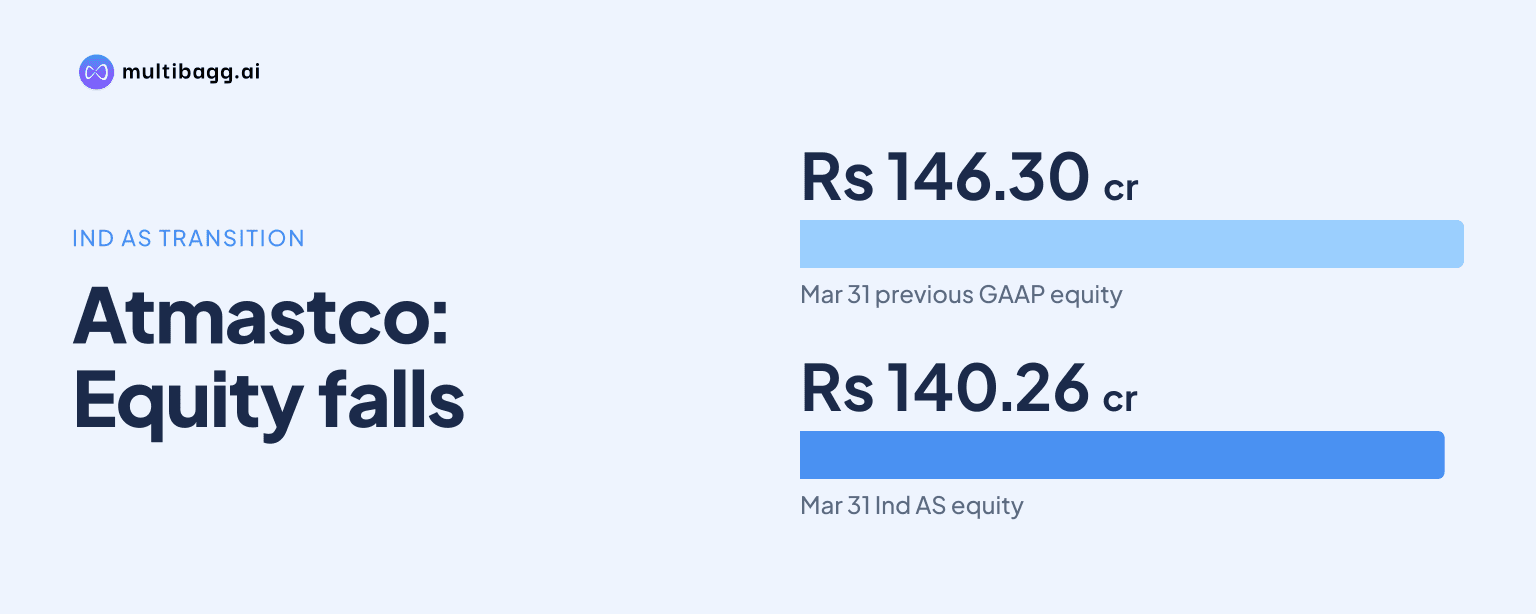
Atmastco Limited’s first-time transition to Indian Accounting Standards (Ind AS) reduced consolidated equity at 31 March 2026 by Rs 5.79 crore, to Rs 140.26 crore from Rs 146.30 crore under previous generally accepted accounting principles (GAAP), principally through expected-credit-loss and subsidiary asset-recognition adjustments.
Know Atmastco inside out
Results, valuation, peers and who's buying, in one view.
How much did Ind AS change Atmastco’s consolidated equity?
Atmastco’s consolidated equity was Rs 5.79 crore lower at 31 March 2026 under Ind AS than under previous GAAP. The reconciliation moves from Rs 146.30 crore of previous-GAAP consolidated equity to Rs 140.26 crore under Ind AS, with total Ind AS adjustments of negative Rs 5.79 crore.
The opening transition-date reduction was larger than the year-end reduction. At 1 April 2025, previous-GAAP consolidated equity of Rs 127.25 crore was restated to Rs 121.17 crore under Ind AS, a negative adjustment of Rs 6.07 crore. The difference between the Rs 6.07 crore opening effect and the Rs 5.79 crore effect at 31 March 2026 shows that the adjustment balance changed during FY26.
Atmastco’s 31 March 2026 previous-GAAP total included Rs 146.35 crore of standalone equity and Rs 1.73 crore of equity at Atmastco Defence Systems Private Limited, before eliminating the parent’s Rs 1.78 crore investment against the subsidiary’s share capital. The bridge is therefore a group reconciliation rather than a restatement of the parent’s standalone equity alone.
Which adjustment was largest in Atmastco’s equity reconciliation?
The expected credit loss adjustment was the largest separately stated item in Atmastco’s equity reconciliation. The allowance relating to trade receivables, retention and withheld amounts was negative Rs 6.22 crore at 1 April 2025 and negative Rs 4.43 crore at 31 March 2026 under Ind AS 109, reducing the adjustment by Rs 1.79 crore across the period.
Atmastco also recorded a negative Rs 25.73 lakh correction of a prior-period error at 31 March 2026. The filing describes this item as unrealised intra-group interest capitalised by the subsidiary, net of depreciation, and identifies Ind AS 101 paragraph 26 as the relevant first-time-adoption provision.
Other parent-level entries at 31 March 2026 were smaller in absolute value. Borrowings at amortised cost reduced equity by Rs 20,000, deferred tax added Rs 22,000, and other adjustments added Rs 39.20 lakh. The equity reconciliation shows a nil amount for revenue recognised over time and contract balances under Ind AS 115 at that date.
Why did Atmastco reverse subsidiary capitalised costs?
Atmastco reversed certain costs at its wholly owned subsidiary because the reconciliation identifies them as ineligible for continued capitalisation under Ind AS. Atmastco Defence Systems Private Limited recorded negative Rs 97.02 lakh for pre-operative expenses not eligible under Ind AS 16 at 31 March 2026 and negative Rs 70.37 lakh for FY26 overheads that had been capitalised but were not eligible.
The same reconciliation separately lists eligible pre-capitalisation costs recognised in property, plant and equipment (PPE), prior-period income reversed or PPE derecognised, and depreciation on derecognised amounts. These lines show the mechanism of the adjustment: removing ineligible capitalised expenditure affects asset recognition, while the related depreciation entry affects the cumulative result of derecognition.
A lease-related subsidiary adjustment was Rs 15,000 at 31 March 2026. The item is defined in the filing as the right-of-use (ROU) asset less the lease liability, net of rent already charged. Atmastco also states that the subsidiary adopted the same 1 April 2025 transition date as the parent.
Got a follow-up? Ask IRIS
How did Ind AS affect Atmastco’s FY26 profit?
Ind AS reduced Atmastco’s consolidated profit after tax for the year ended 31 March 2026 by Rs 1.04 crore. Consolidated profit under previous GAAP was Rs 19.05 crore, compared with Rs 18.01 crore under Ind AS, based on the total-comprehensive-income reconciliation.
The FY26 income bridge includes a negative Rs 25.73 lakh prior-period correction and a Rs 1.79 crore net reversal of the expected-credit-loss allowance. It also lists adjustments for revenue and contract balances, leases, employee benefits, borrowings at amortised cost, deferred tax, and the subsidiary’s prior-period income and capitalised-cost entries.
Other comprehensive income, net of tax, was Rs 17.41 lakh under Ind AS in FY26. Adding that amount to profit after tax of Rs 18.01 crore produced consolidated total comprehensive income of Rs 18.18 crore, compared with the prior-GAAP profit figure of Rs 19.05 crore before the disclosed Ind AS income adjustments.
Did the Ind AS transition alter Atmastco’s cash-flow reporting?
Atmastco said the Ind AS adjustments were non-cash and had no material effect on the consolidated statement of cash flows, except for lease payments moving to financing activities. The cash-flow statement was prepared using the indirect method under Ind AS 7, while the group’s transition date was 1 April 2025.
The filing also says the Appendix C business-combinations exemption was not relevant because the subsidiary was formed by the holding company, and no goodwill arose. That disclosure, together with the Rs 5.79 crore equity reconciliation at 31 March 2026, confines the stated transition effects to recognition, measurement, presentation and consolidation entries rather than goodwill accounting.
At 30 September 2026, the consolidated balance sheet was presented under Ind AS, with total assets of Rs 416.61 crore and total equity of Rs 177.34 crore. Those later interim figures are reported after the 31 March 2026 reconciliation, whereas the first-time-adoption bridge explains the movement from previous GAAP into the Ind AS basis.
Conclusion
Atmastco’s first-time Ind AS adoption reduced consolidated equity by Rs 6.07 crore at 1 April 2025 and by Rs 5.79 crore at 31 March 2026. Expected credit losses on receivables, retention and withheld amounts were the largest separately stated adjustment, while the subsidiary review removed pre-operative expenses and FY26 overheads that the filing says were not eligible for capitalisation.
The filing discloses no future transition target, implementation plan or scheduled accounting milestone beyond adoption from 1 April 2025. The disclosed items to follow in subsequent reporting are the Rs 4.43 crore expected-credit-loss adjustment at 31 March 2026, the treatment of contract-related balances, and any further effect of subsidiary cost recognition and lease-payment classification.